Difficulty
You know the routine. You struggle to get out of bed, then rush to get ready for work. Once there, you try to get everything done. In the afternoon, it's taking the kids to activities, fitting in some exercise or a drink with friends, shopping, cooking, dinner, household chores...
When you finally have a moment to yourself, you're just glad to catch your breath. Your finances are the last thing on your mind, so you decide to leave it until tomorrow. And tomorrow is almost certain to look much the same.
Me: What if I told you that putting off saving for retirement has cost you €30,000 over the past year?
You: Really? [shakes head in disbelief] Are you serious?
Me: Yep. Really.
You: No, I don't believe it. That can't be right. I'd only have been putting aside €100 a month anyway.
Me: Yes. By not investing €100 a month over the past year, you've missed out on €30,000 for your retirement. Have you got a moment so I can show you?
Sometimes it feels as though procrastination is everyone's favourite pastime. And when it comes to finances, that goes double. With everyday purchases, you can simply buy something when you need it. But with investing, you're saving for things you won't buy until many years from now, so the need doesn't feel immediate.
I know plenty of people who have been putting off investing for a very long time and still haven't quite got around to starting. So I decided to work out how much delaying that decision has cost you over the past year (as at September 2026).
Imagine you'd opened a Finax account at the end of September 2025 and started investing for retirement. You already have some basic investing experience (for example, through a pension savings plan), and since retirement is still a long way off and you're comfortable taking risks, the robo-adviser's algorithm recommends a 100% equity portfolio.
Let me illustrate this with two examples:
- you decided to invest the €100 a month mentioned earlier;
- you decided to invest a lump sum of €10,000.
The only variable is age. I'll illustrate this for three age groups: 25, 35 and 45.
Please note: All figures relating to the performance of Finax portfolios reflect the actual returns achieved by representative portfolios between 30 September 2025 and 30 September 2026. We have explained how actual performance is calculated in the article How do we calculate the actual performance of Finax portfolios? Past performance is not a guarantee of future returns, and your investment may also result in a loss. Find out what risks you take when investing.
If you'd started investing €100 a month with Finax a year ago, you'd now have €1,419 (after all fees). If you'd made a one-off investment of €10,000, your profit would be €1,972.
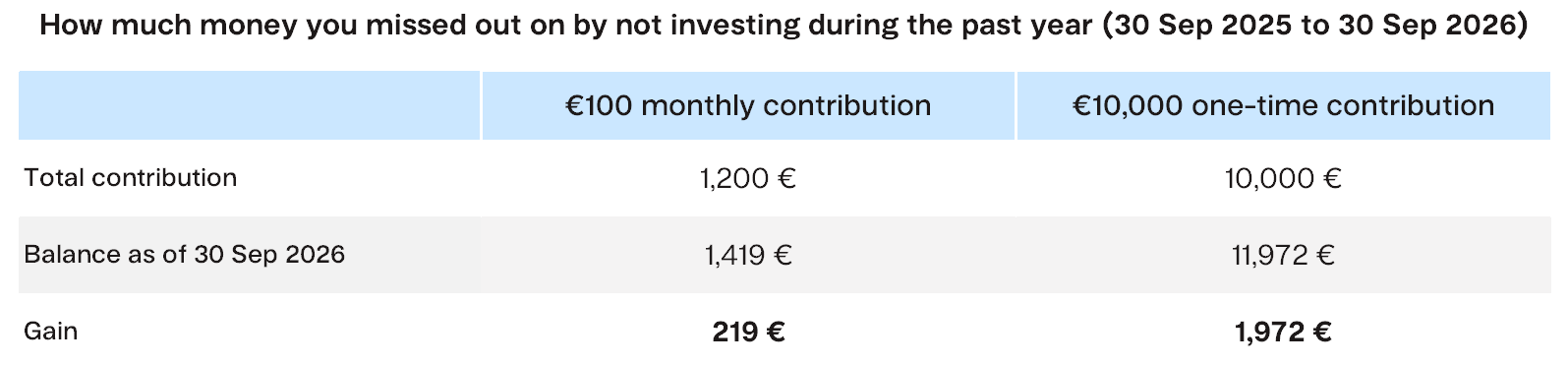
You: Well, there you go! I haven't missed out on €30,000 for my retirement after all. We're only talking about a few euros: just €219 in the case of monthly investing.
Me: Yes and no. Remember, that money could keep working for you for another X years (40 if you're lucky enough to be only around 25).
You: Can money really work? I thought only people did that.
Yes, it can. Stock markets performed exceptionally well over the past year. Historically, global equity indices have risen by roughly 8 - 10% a year over the long term. Their value is driven higher by the gradual growth of the global economy and rising corporate profits thanks to technological progress. So the returns you earned last year would, in all likelihood, continue to compound and grow (to understand this better, read more about compound interest).
Of course, your investment won't grow in a straight line. Stock markets fluctuate and sometimes fall. That's why it's important to invest in them for the long term and give them time to recover from downturns.
For the calculations below, we'll therefore assume that you stay invested until retirement and earn the expected return on Finax's 100% equity portfolio.
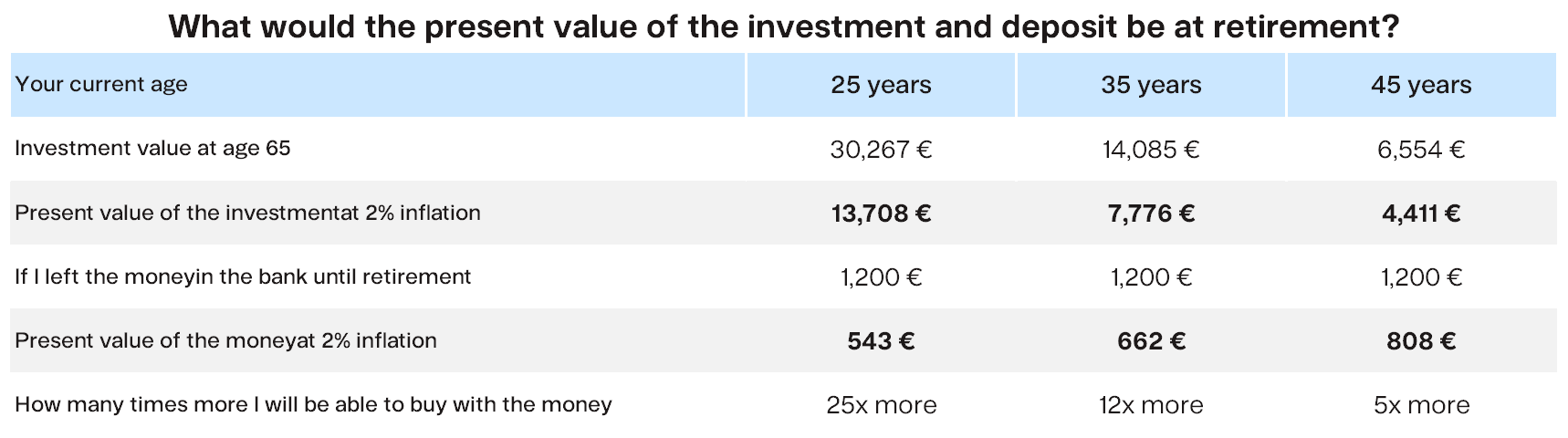
We've already established that if you'd started investing €100 a month a year ago, you'd have €1,419 today. How much could that sum grow by the time you retire?
If you earned the expected return on Finax's 100% equity portfolio, that €1,419 could grow to as much as €30,380 over 40 years. I know not everyone is still 25, but even with a shorter investment horizon, the amount could still add up to a sizeable sum.
If you kept your money in a bank account paying close to zero interest, you'd earn very little. If you'd started saving a year ago, you could have €1,200 today. Inflation would erode the real value of that €1,200, meaning it would buy you less in retirement than it would today. So let's compare what your money would be worth in today's prices if you left it sitting in the bank or invested it instead.
What about a lump-sum investment?
Let's return to the example of investing a lump sum of €10,000 a year ago. Here, the cost of delaying investing is even greater.
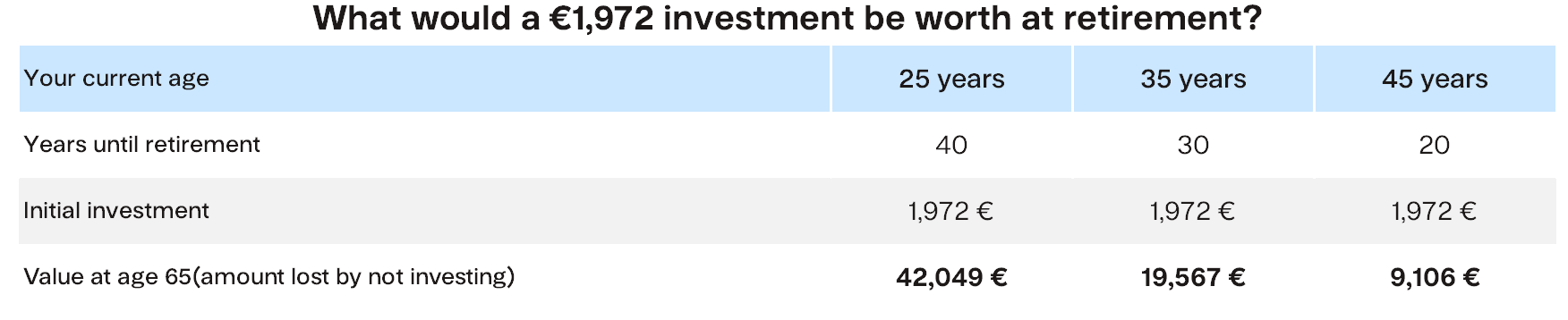
As I mentioned above, you'd have earned €1,972 on that €10,000 over the past year. The table below shows what happens if you miss out on that profit and don't invest it for another 40, 30 or 20 years. This best illustrates the impact of delaying a lump-sum investment by just one year.
Leaving your money in a bank account rather than investing it over the past year may have cost you only tens or hundreds of euros in returns so far. But when you factor in the returns that money could have earned in the future, the cost can become substantial.
Unfortunately, Rado and I know dozens of people in our own circles who have been waiting for a crisis or putting off investing for years. Fortunately, it's never too late to start investing. You can open a Finax account in just 10 minutes.
Unbank the money sitting in your current or savings account and enjoy hassle-free investing.

Create an account and start investing today
Frequently asked questions about the cost of delaying investing
1. How much does delaying investing really cost?
More than it looks at first glance. If you'd started investing €100 a month in Finax's 100% equity portfolio a year ago, you'd now have €1,419 after all fees, compared with €1,200 in a bank account. That €219 difference seems small, but if you stay invested and earn the portfolio's expected return, the €1,419 could grow to as much as €30,380 over 40 years. With a €10,000 lump sum, you'd have missed out on €1,972 in the first year alone. The real cost isn't last year's return, but the years of compound interest that money no longer gets.
2. Should I wait for a market dip before I start investing?
No. Nobody can reliably predict when markets will fall or recover, and people who wait for the "right moment" often end up sitting on the sidelines for years. What matters most is time in the market, not timing the market. Markets fluctuate, but with a long investment horizon they have historically recovered from every downturn. We explain why in Do Not Try to Time the Markets, You Will Earn Less.
3. Is it better to invest a lump sum or a fixed amount every month?
If you already have the money and a long investment horizon, a lump sum has historically come out ahead more often, because your money spends more time in the market. Regular monthly investing suits people who invest from their income and helps smooth out market swings. Either way, both beat leaving your savings in a bank account, where inflation erodes their value. Just keep an emergency fund for unexpected expenses first. Read more in Should I Invest in One Lump Sum or Spread the Investment?