Difficulty

Protecting your savings from inflation is easier than it may seem at first glance. The most effective and time-tested way to do it is to grow them at a return higher than the rate at which prices rise. Keep only part of your emergency fund in a regular bank account. Put money for goals within three years into conservative investments, and invest savings you won’t need for longer in stocks and bonds, for example through index ETFs. The value of your investments may fluctuate in the short term, but over the long term, stocks have historically beaten inflation by the widest margin.
In this article you will learn:
- How does inflation impact your savings and assets?
- Wouldn't it be better to just spend everything now before the money loses value?
- How can you protect your savings from losing value to inflation?
- Where should you invest your savings today so that inflation doesn't eat them up?
- How much money should I invest? All of it?
- How should I invest so that inflation doesn't catch me off guard?
- Frequently Asked Questions About Inflation and Savings
Inflation has a fundamental impact on personal finances and household budgets, primarily on three layers:
- Savings and assets - we will be able to buy fewer goods and services in the future for the same amount of money.
- Spending - when prices rise, our income buys us less.
- Debt - borrowers benefit from inflation.
If you want to get through a period of inflation with as little damage to your savings and as limited an impact on your spending as possible, you must be aware of these three effects of inflation on your budget, internalize them, and keep them constantly in mind.
Today we will focus on the first mentioned consequence of inflation: its impact on savings. We will also discuss how to efficiently protect your assets against it.
Impact of Inflation on Savings and Assets
Most of us are aware of the effect that rising prices have on the money we have. If the prices of the goods and services we regularly buy rise, we will inevitably be able to buy fewer of them with the cash we hold.
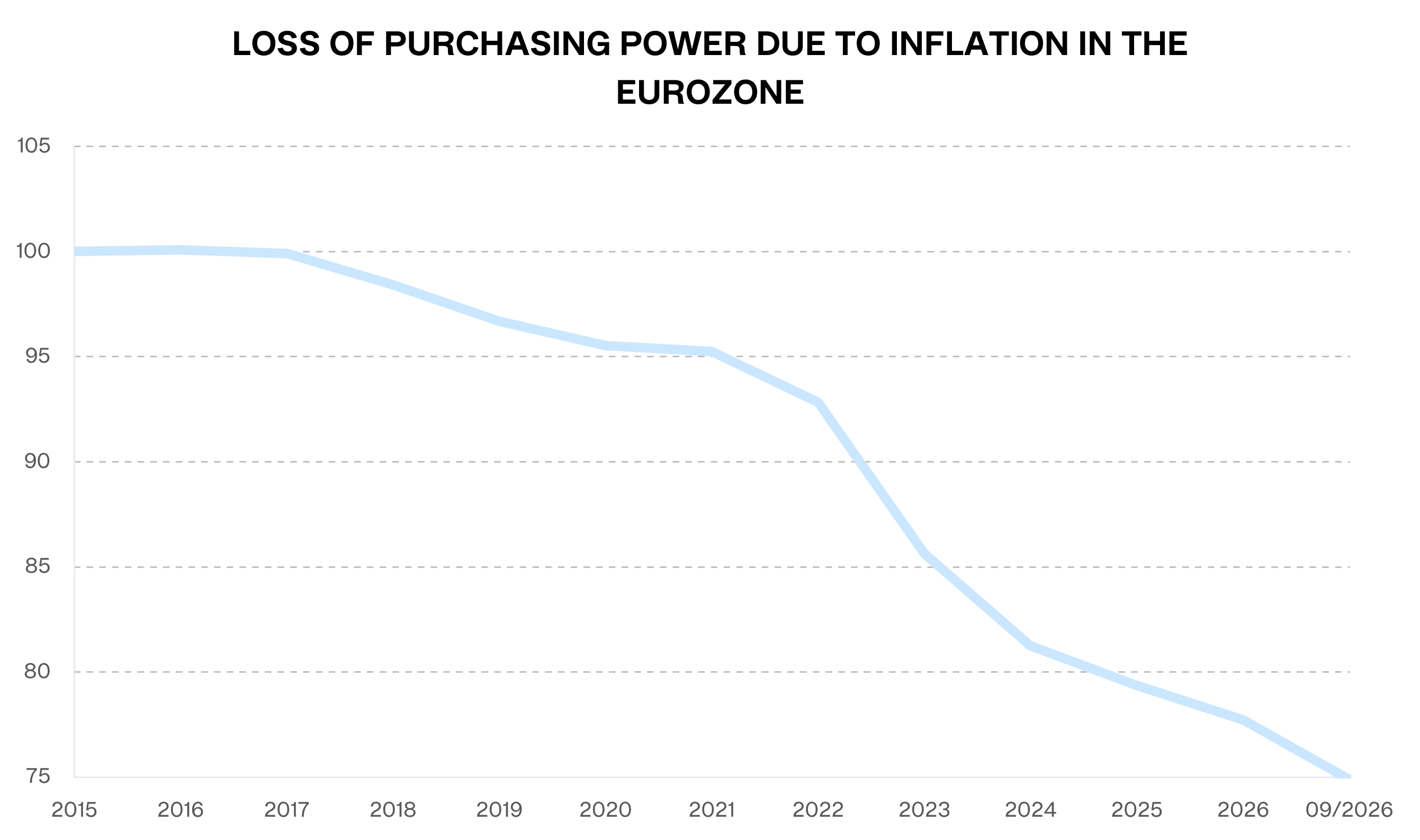
If we assume that price growth in 2026 will remain at approximately 3,8% (Eurostat data as of September 2026), then the consumer basket prices of the average Eurozone resident have risen by 33.6% since 2015 (Eurostat).
Own calculations. The source of the inflation data is Eurostat.
Translated into the value of money, 10,000 euros today purchases the same amount of goods that would have cost you 7,487 euros at the beginning of 2015. The chart above accurately captures the erosion of the purchasing power of money due to inflation over the past 11 years.
If you held money in a bank account or in cash during this period, you could buy 25.1% fewer goods with it today. Or, if you failed to grow your savings by at least 2.4% per year on average, the real value of your savings has declined.
In other words, even “securely” holding money in the bank is not riskless. It slowly but surely loses value, and by the time you realize it, your funds have lost more than a quarter of their purchasing power.
Wouldn't It Be Better to Spend Everything Now Before Money Loses Value?
This line of thinking is quite rational. It makes sense to spend earlier than planned, for example on a home renovation, while the materials are cheaper. Why wait for prices to rise?
Inflation encourages immediate spending. People often think and act this way. It is completely natural. Even though we are big fans of saving, in some cases we recommend carrying out your plans sooner if that makes economic sense.
For example, buy property if you plan to acquire your own home within a few years and your financial situation already allows it. The last few years have shown us that mortgage interest rates can be quite volatile, but the only thing certain about them is that we won't see cheap mortgages again anytime soon. On top of all that, the already high growth in real-estate prices is most likely to continue.
Regardless of inflation, your big expenses will wait for you, whether it is retirement, your children's education, a change of housing, starting your own business, or fulfilling other dreams. And thanks to inflation, these life events will be more expensive. If you spend all your savings now, future problems will only be more expensive and bigger.
That is why, even after years of above-average inflation, it is not sensible or suitable to spend all your savings, unless you plan to pursue your specific goals within the next few years.
The solution is to maintain your savings rate even as prices rise, i.e., to save the same share of your income every month, which is a far bigger challenge during high inflation. We have already covered this topic in more detail in our blog on beating inflation with a raise.
At the same time, it is necessary to protect the money you have already saved from losing value, and a bank account will probably fall short for that.
How Can You Protect Your Savings from Losing Value to Inflation?
The answer is, again, quite simple, but harder to carry out. It is enough to grow your savings and financial assets at returns higher than inflation. Then the real value of your assets will also grow even after accounting for higher prices.
For that, however, you need some knowledge and experience, but above all your personal conviction and understanding, because the most effective weapon against the loss of savings to inflation is investing.
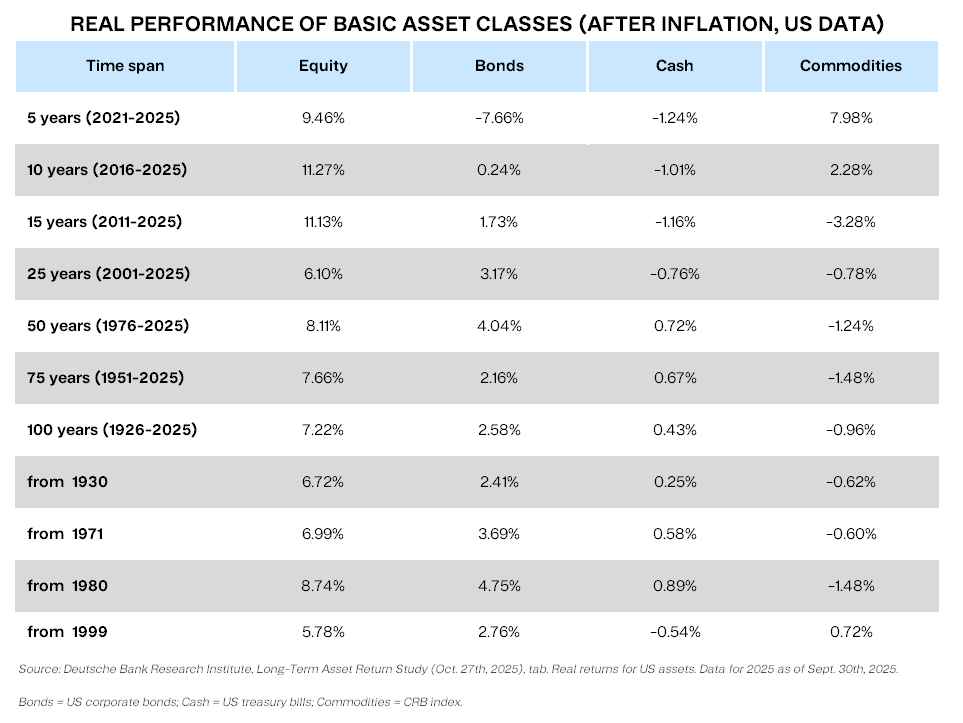
Over the long term, investments in stocks are the clear winner. No other instrument has historically beaten the rate of inflation by such a significant margin as stocks.
Investing in stocks, however, comes with risk. The price of higher returns is precisely the risk, which shows up as fluctuations in their prices. Stocks do not rise steadily. In the short term, their performance is unpredictable and they often fall. Short-term losses are nothing out of the ordinary.
Over long horizons, however, they grow in step with the growth of the global economy and the profits of the world's companies. In the past year alone, American companies generated profits of nearly $3.4 trillion (3,400,000,000,000 USD!). Why not take a slice of this pie when it is so easy?
Rising prices in the economy mean higher revenues for these companies for the products they make and sell and the services they provide. These companies own assets, including real estate, so stock valuations reflect the growth of prices in the economy well.

Create an account and start investing today
So Where Should I Invest My Savings Today So That Inflation Doesn't Eat Them Up?
Investing and beating inflation go hand in hand. Neither is a 60-meter sprint; both are marathons lasting many years.
If you woke up today after years of at times double-digit inflation and are urgently looking for a way to rescue your lifetime savings in the shortest possible time, we have bad news for you.
Finding an investment today that would, with greater certainty and acceptable risk over a short horizon, e.g., within the next year, beat double-digit inflation, as many EU countries have experienced, is rather unrealistic. You are arriving on the field at stoppage time with the score at 0:3.
Will you put your money into gold and silver at their peak after a two-year 200 percent rise? As the following table shows, commodities have not managed to beat inflation at all over the long term.
Or will you try extremely risky cryptocurrencies of dubious value and with no real use?
For real estate, you need a larger sum of money or a mortgage. It also carries considerable risk, with prices at their peaks and rising interest rates. Let's not forget the administration and costs involved and the potentially limited liquidity.
Unfortunately, there is no magic wand for beating inflation instantly. Rising prices cannot be beaten with certainty in the short term.
But over at least a medium-term horizon, inflation can be beaten comfortably. You need to reach for equity investments, whose returns exceed the growth of prices in the economy most significantly over the long term. You can reduce their risk by adding bonds.
That does not mean, however, that you will certainly earn a return higher than inflation every year. But if you hold on, then within a few years the cumulative returns will comfortably beat the growth in prices of goods and services over that period.
If you think about inflation ahead of time, you will win. Those who are prepared are not surprised.
To invest successfully, you only need to give your investments enough time, have a clear financial goal (e.g., retirement), sufficient patience, and emotional resilience. Beating inflation is a long-term and continuous process.
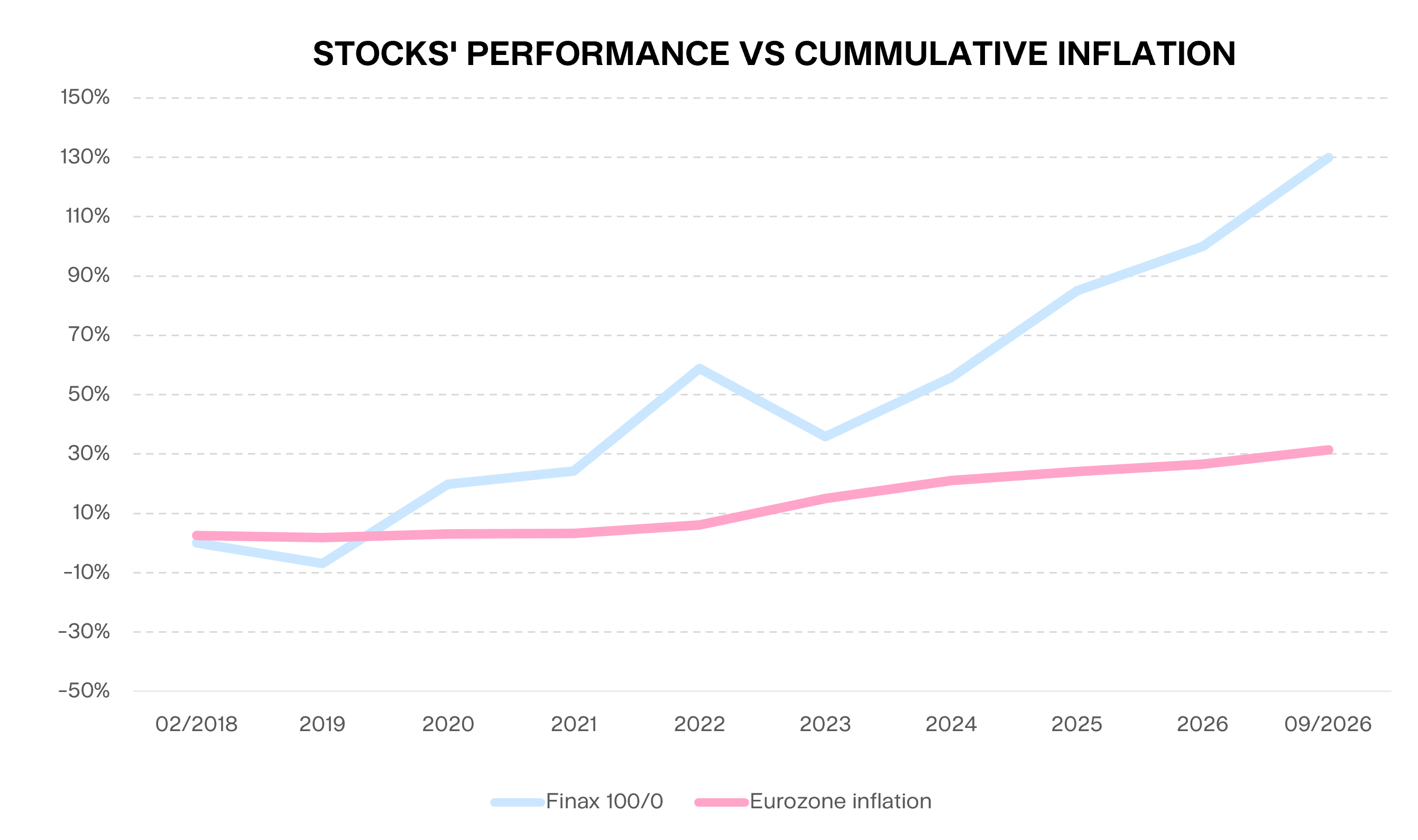
All data related to the development of Finax portfolios represents the actual performance achieved since the launch of the Finax portfolios on February 21st, 2018. We described how we calculate actual performance in the article How do we calculate the actual performance of Finax portfolios? Past results are not a guarantee of future returns, and your investment may also result in a loss. Learn about the risks you take when investing.
For simplicity of calculation, the inflation data shown are for the whole of 2018, not just since the launch of Finax portfolios. The source of the inflation data is Eurostat.
The chart illustrates the actual performance of a 100% equity Finax portfolio compared with the loss of value of money in the Eurozone (cumulative inflation) over the past 8 years. The data is as of September 2026, so it already includes this year's equity market growth of 15% to date and the expected inflation of 3.8% this year.
The historical horizon of the chart covers several difficult periods, such as the COVID pandemic outbreak in 2020, the start of the war in Ukraine in 2022, the sharp rise in energy prices in 2023, Trump's tariffs in 2025, and the US and Israeli attack on Iran in April 2026.
As you can see, we investors have built a cushion. Our investment returns comfortably cover the current high rate of inflation, even considering several adverse periods and events.
Inflation is no great worry for our savings and our assets. We can relax because we are growing our assets at a higher rate than the long-term price growth.

Take a look at Ivan Chrenko's transparent account and track its progress
How Much Money Should I Invest? All of It?
There is no single answer to this question, but certain rules apply here too that will help you get through inflation unscathed, as well as other challenging life situations. The very foundation is to plan and to know your means, that is, your income and expenses. And of course, not to spend your entire paycheck.
Then the question of investing money depends on the time horizon for which you will need it.
The first pillar of healthy finances is an emergency fund. Keep 1,000 euros of it immediately available in your checking and savings account. Invest the rest of the fund (in total, it should cover three to six months of living expenses) in a balanced portfolio in which stocks make up less than half and bond investments make up the larger part.
For savings toward goals you plan to achieve within three years, you can use so-called money market portfolios. These investments track the short-term interest rates set by the central bank with minimal fluctuations in value. At Finax, this role is filled by Calm Investing. At current interest rates, you won't fully cover inflation with them, but you can still grow your savings at least a little compared with a regular account.
Invest the rest of your money without hesitation, so that inflation doesn't destroy it. Don't let it needlessly rot in accounts or under a mattress. Right now, you are losing every month.
Funds earmarked for expenses in 4 to 7 years need balanced portfolios mixing stocks and bonds. Any longer-term goal, such as retirement, your children's education, etc., can be invested more dynamically, with a more pronounced predominance of stocks. With these medium-term and long-term investments, you have a high chance of conquering inflation.
For example, if you have a larger sum of money that you want to use within a year to buy a property, either buy it today or put the savings into a money market portfolio that is also suitable for investments lasting a few months (e.g., our Calm Investing for up to 1 year). But if you want to buy it in roughly 5 years and are gradually saving 20% for a home deposit, invest that money.
How Should I Invest So That Future Inflation Doesn't Catch Me Off Guard?
The unrivaled investment tool of the present day is an ETF (Exchange-Traded Fund). What are these and why are they ideal investments for beginners and experienced investors alike?
ETFs invest in the entire market. They don't look for cherries among stocks or a needle in a haystack; they buy the whole haystack, the entire market, all the securities traded in a particular region or according to specific criteria.
They spread risk across hundreds to thousands of stocks or bonds, which means they reduce it. Thanks to this, you fully participate in the growth of the global economy and profit from the earnings of the world's companies. This investment approach is also significantly cheaper than other solutions and eliminates speculation from investing.
Thanks to these attributes, the long-term returns of ETFs are the maximum that most investors can achieve without getting actively involved in searching for the winners. Index funds have a high ratio of return per unit of risk taken. To top it off, many EU countries have favorable tax rules for ETFs, make sure to check those with your local tax authority.
As if that weren't enough, Finax will help you set up your investment, whether you are a beginner or an experienced investor. Based on a simple investment questionnaire, we will automatically adjust the investment risk to your horizon, risk tolerance, and experience.
Become an investor today. Protect the wealth created by your work, put your feet up, and relax.
Frequently Asked Questions About Inflation and Savings
1. Is it safe to keep my money in a savings account during high inflation?
Your balance will not fall, but its purchasing power will whenever the interest rate is lower than inflation. If your account pays 2% a year while prices rise by 3.8%, the real value of your money shrinks by roughly 1.7% a year. A savings account is still the right place for the money you may need at short notice, such as part of your emergency fund. For goals within three years, a conservative money market solution such as Calm Investing can help, and money you will not need for many years is better off invested for the long term.
2. Do gold, real estate, or cryptocurrencies protect against inflation?
Not reliably. As the comparison in this article shows, commodities such as gold have not beaten inflation over the long term, and buying after a sharp price rise adds extra risk. Real estate requires a large sum or a mortgage, comes with costs and administration, and can be hard to sell quickly. Cryptocurrencies are highly speculative. Historically, broadly diversified stocks have beaten inflation by the widest margin over long periods, which is why a long-term portfolio of global ETFs is a simple way to grow savings faster than prices, although its value can also fall in the short term.
3. How long does it take for investments to beat inflation?
There is no fixed period, and no investment can beat inflation with certainty in a single year. The longer your horizon, the higher the chance: money you need in four to seven years suits a balanced mix of stocks and bonds, while goals ten or more years away can be invested more dynamically. The chart above shows how a 100% equity Finax portfolio has stayed ahead of eurozone inflation since 2018, despite several crises along the way. Before you start, read about the risks you take when investing and how we calculate the actual performance of Finax portfolios.