 Difficulty
In which situations, and why, you should not leave money sitting in bank accounts:
- You are not earning interest on your deposit account that comes anywhere close to current market rates
- You hold a larger financial reserve because you are cautious or run a business
- You are planning to buy a property
- Paying taxes
- You are saving for your annual holiday
- You are planning a wedding
- Large purchases, renovation, buying a car
- You want to start growing your savings cautiously
- You dislike wasting money
- You are conservative with your fiances, but 0% does not appeal to you
- You may even be waiting for a stock market correction
- When is it finally time to move to Global Investing portfolios?
- How do I open Calm Investing?
Do you want to be rich? Let me share the recipe for getting rich – there is no secret. To succeed financially, all you need to do is spend less than you earn and invest that difference sensibly and, above all, over the long term. Done, that is all there is to it.
For extra good results, I recommend avoiding speculation, spreading your risk and also watching out for fees and taxes. After that, all you have to do is wait. Thanks to passive investing you can achieve any realistic goal. As a rule, the longer you let your money work, the higher the return you will achieve.
Don't let market interest rates pass you by
Europeans are known for holding trillions of euros in banks. These staggering sums sit in current and savings accounts which, in most banks, do not earn market interest rates.
You can assess this in your own situation. Banks today can earn more than 2% on deposits with the ECB. Governments borrow money at interest rates reaching 3-4% through bonds.
What interest are you earning on your current or savings account? Is it even visibly above zero? Is it at least half of the rates mentioned above? If not, we recommend you read this blog to the end.
Finax has designed a conservative product whose aim is to give savers access to today's market interest rates with minimal risk of fluctuation in the value of the investment. It is Calm Investing, intended for savings you plan to use within three years.
Let's look at a few real-life examples of how it can be used.
1. A larger financial reserve for the cautious (and for entrepreneurs)
A financial reserve is the cornerstone of personal finances. We have written and said a great deal about its importance in recent years. I would particularly draw your attention to the blog by Finax founder Juraj Hrbatý: Emergency Fund - the first and most basic goal of an investor.
An ideal financial reserve should be able to cover a loss of income for 3 to 6 months and, given the low probability that it will be needed, it is best to invest the bulk of it. Personal finance is not an exact science, though, and you would look in vain for universal solutions.
If, for example, you work in an industry with a higher risk of job loss (tourism, hospitality and the like), it may be sensible to try to build an even larger reserve, ideally in the range of 6 to 12 months of expenses. As the probability of drawing on a larger part of the financial reserve soon rises, the risk you should take with it falls.
It still holds true, however, that a situation causing a drop in income or unexpected expenses may never occur at all. It would therefore be a shame for your reserve to lose value every day in a current account at the bank. Unfortunately, today that is also true of many savings accounts, whose returns still lag behind market interest rates.
Calm Investing is equally suitable for entrepreneurs whose income is highly variable. If your income fluctuates from month to month (for instance because of seasonality or a small number of large contracts during the year), you can top up the missing funds in leaner months from this product.
2. Buying a property
Have you reserved a new build „off plan“ and will you have to pay the remaining part of the purchase price from your own funds over the next 2 to 3 years?
In that case I recommend that you read the future purchase contract with the developer carefully once more. It probably also contains what is known as an inflation clause, which allows the developer to increase the final price if construction costs rise significantly.
Here too you must not rest on your laurels and you should try to grow the savings earmarked for this purpose. That way you will be better prepared for the surprise of a higher bill. And what if the price does not go up after all? Never mind, you can use the return to furnish the flat once it has been approved and handed over.
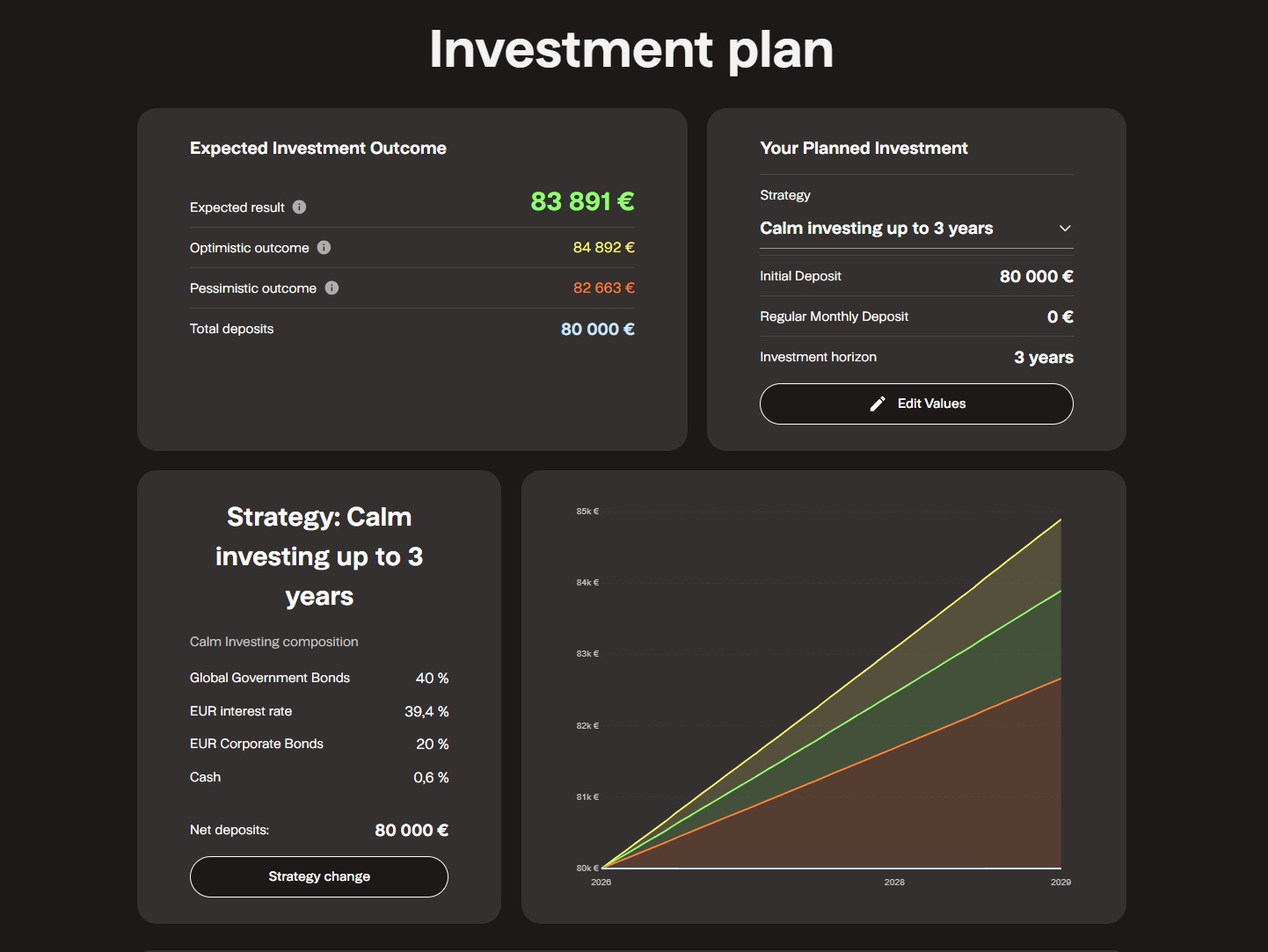
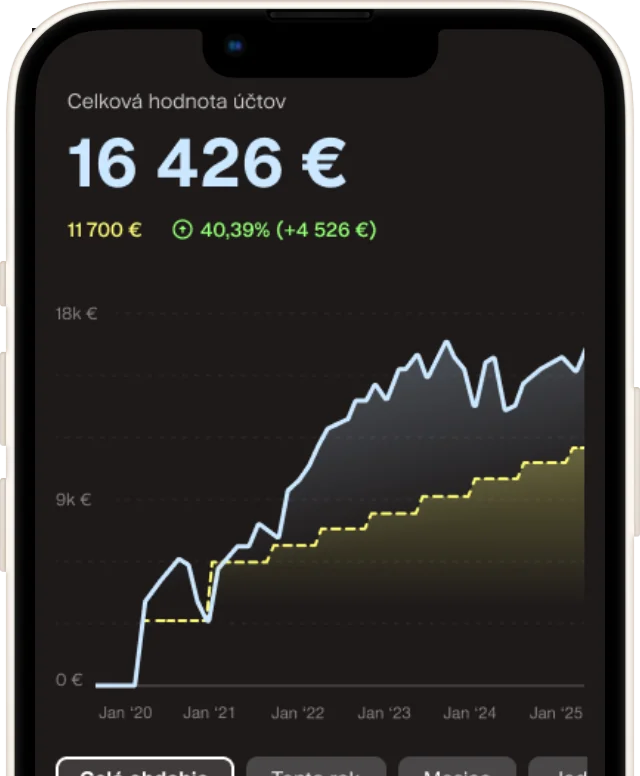
The example above shows the possible return on a one-off investment of 80 thousand euros held in the Calm Investing strategy for up to 3 years. An average expected result of almost 84 thousand euros after 3 years of low-risk investing is worth considering, don't you think?
Even if you have not found your prospective property yet, you do not have to leave the prepared 10-20% of the purchase price in a bank account with zero appreciation. If you are planning to buy an asset (real estate), whose value usually grows over time by at least the rate of inflation, it is good to at least keep up with the rise in its price. Otherwise, the vision of your own housing will become more and more distant as years go by.
3. Taxes
If you run a business, you are probably very well aware of the unpleasant fact that in March (or June, if you have used the option to file your tax return three months later) a sizeable item regularly falls due for payment – income tax and, when profit is paid out, dividend tax too. It is best to prepare for such larger expected expenses gradually.
A good practice is to set aside at least 15-20% of every invoice paid (depending on the type of company and on total income and expenses) for taxes. For many entrepreneurs that can be thousands of euros a month. Wouldn't it be a shame not to grow this money by at least a few percent as well? Calm Investing is the ideal tool for that!
4. Holiday
For many families, a summer holiday by the sea is the largest single expense of the year. Anyone travelling with 2 small children probably already knows that a 2-week stay by the sea runs into the thousands. Here too, Calm Investing is a better alternative to a savings account at the bank.
If you do not book and pay for your holiday well in advance and rely more on last-minute deals, rising accommodation and transport costs may hit you too. The return on Calm Investing can offset this increase at least to some extent.
5. Wedding
Are you planning a wedding in the near future and don't want just a registry office ceremony without guests? Then set aside a decent sum, which can easily exceed 10 thousand euros.
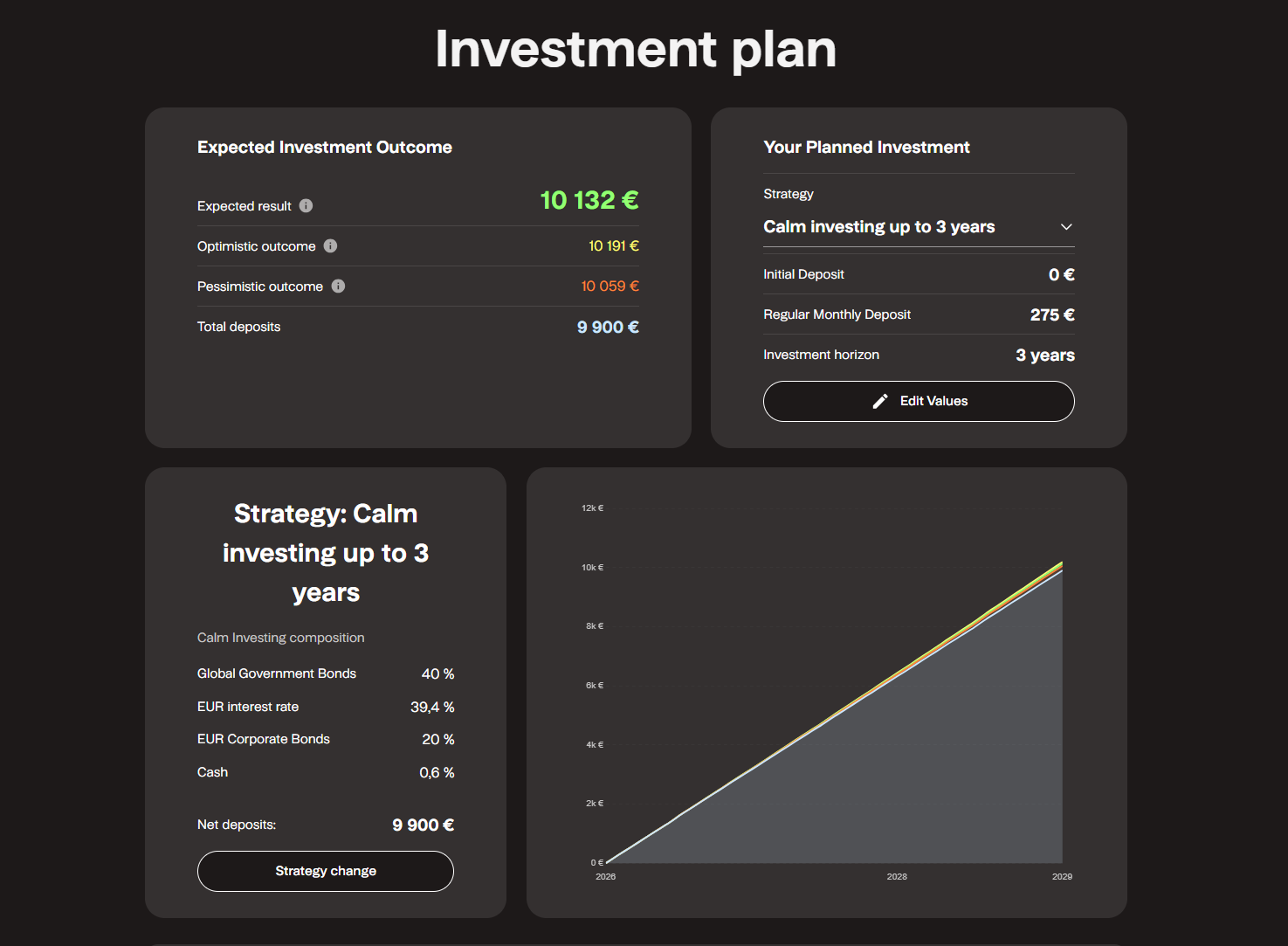
If you don't want to rely solely on gifts from family and guests, draw up a financial plan as soon as possible and start saving. Thanks to Calm Investing you can save 10 thousand euros by investing just 275 euros a month over 3 years.
6. Other large purchases and deferred consumption
There are countless reasons to save. For some the goal may be buying a new (or better still, used) car, for others buying expensive electronics or a major home renovation. Whatever your goal, as long as it is more than a few months away, you can use our Calm Investing to save for it.
You can likewise put in part of an exceptionally large bonus, money from the sale of a property or an inheritance you have received. Simply put, funds you have no clear plan for yet and will need within 1 to 3 years.
7. Training wheels
If you have no investing experience yet and have not gained enough confidence in how financial markets work, our conservative product is a good start for you. An analogy with cold-water swimming suggests itself.
For newcomers it is wiser to start by gradually exposing yourself to ever greater cold (in our case, the investment risk expressed by the share of equities in the portfolio), so that in the end you can handle almost any cold water (stock market swings) without difficulty.
For most people such an approach is certainly more suitable than shock therapy. An inexperienced daredevil jumping into icy water can very quickly end up in panic and with an unpleasant experience. Plenty of novice investors have certainly tasted this, having started investing at the peak of the investment fever in 2021, which was followed by a crisis year of deep declines.
In its current composition, Calm Investing contains no equity component. The bond and money markets offer adequate returns at a lower risk of fluctuation in value. For inexperienced investors it can therefore be a good way to try out growing money on the financial markets.
8. If you don't like waste
Do you switch off the light when you leave a room? Do you dislike leaving the water running longer than is really necessary? Do you compare prices in several e-shops before buying? Do you diligently meet your bank's conditions to get a free account? If you answered yes to these questions (or at least nodded in agreement), you probably find waste distasteful.
The problem with the slow rise in savings account interest is that its impact is not directly visible. If you have 10,000 euros in a savings account at the bank today and look at the account again a year later, you will not have less money there. The account will show either the same 10,000 euros or even slightly more (depending on which bank you keep your money in).
But if you could have earned more on the financial market during that year, you have lost a certain amount of money. Yes, these will not be staggering sums, much like leaving a light on when you are not in the room. But if you don't like waste, you probably don't much like the idea of losing even such amounts either.
9. If you are conservative but don't want to fall behind
Each of us is naturally in a different financial situation, we have different goals and risk tolerance (volatility, i.e. fluctuation in the value of the investment). Fortunately, when investing we do not have to choose only between leaving money in a low-yield bank account and investing in a dynamic, purely equity portfolio.
That is why Finax's Global Investing portfolios offer a wide range of strategies, leaving the choice of the most suitable one to our always objective algorithms. Nevertheless, over the long term we have seen demand from clients and non-clients alike for an additional conservative investment solution with the lowest possible risk, into which they would not be afraid to put savings they will need in a few months or years.
Our answer is Calm Investing, which has met this brief to the letter. Even very conservative investors can place their money with Finax. We have built its strategies from ETFs, which carry tax incentives in several European countries. Tax treatment depends on the individual circumstances of each client and may change in the future.
10. Waiting for a correction
We have tried to explain many times that there is no need to worry about market risk at all, waiting for a decline usually does not pay off and that more money has been lost waiting for corrections than with market declines themselves.
Despite all the well-meant advice backed by statistics, we constantly receive questions from potential investors about the future development of the markets and especially about their expected decline in the near future.
Waiting to invest a larger sum of money „for the right moment“ (usually a drop of 20 to 30%) nevertheless remains one of the biggest mistakes of all investors and non-investors alike. But if you really cannot help yourself and cannot bring yourself to invest a larger sum in one go today, try to grow it at least by returns that carry minimal risk.
What good is a 20% decline one day if you wait 4 years for it, during which your investment could have grown by 40%? Wouldn't it be better to grow your spare funds by at least 1 – 2% a year?
When are Global Investing portfolios more suitable?
There is no universal answer to this question, but personally, with an investment horizon longer than 3 to 5 years, I would prefer portfolios with a higher share of equities (at least 30-50%) and therefore a higher expected return. Over a longer investment horizon, investors are helped by the greatest friend of a good investment – time. Even in the event of a decline, you have plenty of time to wait for the markets to recover and to earn their long-term return.
We believe that by introducing our conservative product we have convinced you that Finax is the right place for your money.
If you use less profitable and tax-inefficient mutual funds for short-term investing, do not hesitate, move your investment to Finax. We will reward you for transferring your investment with a discount – we will manage 50% of the transferred investment completely free of charge for 2 years.
How to open Calm Investing?
Finax clients can open any new product simply by logging into their account and clicking the Open new account button. If you are not our client yet, just click the button below.

Grow your savings short-term and stress-free with Calm Investing
Do you need more information? Do not hesitate to contact us by email at [email protected] or call us on 02/2100 9985. You can also schedule a 15-minute call at a time that suits you. Feel free to ask, we will be happy to explain everything.