
 Difficulty

Let’s say you’re in your forties. Retirement might feel like it’s a long way off. You might even catch yourself thinking, “I’ll sort that out later” or “I’ll probably never even make it to pension age anyway, so why bother?”
Stop right there. Rewind. The right way to think about it is: “Hang on – I could have as little as 20 years left to prepare. What’s actually waiting for me when I get there?”
The good news is, the Irish State Pension system does offer a decent foundation – but only if you know the rules, plan ahead, and top it up yourself. Let’s break it all down.
How Much Is the Irish State Pension?
The full State Pension (Contributory) in Ireland is currently €299.30 per week, which works out at roughly €1,297 per month. That’s assuming you qualify for the maximum rate.
For context, the average industrial wage in Ireland is around €52,000 a year – or roughly €4,300 a month gross, closer to €3,300 net. So, the full State Pension replaces only about 40% of the average take-home pay. And that’s if you get the full rate. Many people don’t.
There’s also the State Pension (Non-Contributory), which is a means-tested payment for people who haven’t enough PRSI contributions. The maximum rate here is €288 per week – slightly less than the contributory pension, and it’s subject to a means test, so what you actually receive depends on your income and assets.
The Two Types of State Pension in Ireland
Ireland has two main State Pension payments. Which one you’ll receive – and how much – depends largely on your PRSI (Pay Related Social Insurance) contribution history.
State Pension (Contributory)
- Based on your PRSI contributions over your working life.
- Not means-tested – so other income and savings don’t affect it.
- Maximum rate: €299.30 per week.
- Paid from age 66.
State Pension (Non-Contributory)
- For people who don’t qualify for the contributory pension (or only qualify at a reduced rate).
- Means-tested – your income and assets are assessed.
- Maximum rate: €288 per week.
- Also paid from age 66.
Most working people aim for the contributory pension, so that’s what we’ll focus on in detail here.
How Is the State Pension (Contributory) Calculated?
Your State Pension (Contributory) is calculated based on your PRSI contribution record. There are currently two methods used, and the Department of Social Protection will apply whichever gives you the higher payment.
Method 1: Total Contributions Approach (TCA)
Introduced more recently, the TCA method looks at your total number of PRSI contributions rather than a yearly average. This is often better for people who had gaps in their employment – for example, parents who took time out to care for children.
Under the TCA:
- You need 2,080 contributions (equivalent to 40 years of full-time work) for the full pension.
- You can use up to 1040 HomeCaring periods (caring for a child under 12 or an adult in need of full-time care) to count towards your total.
- Minimum of 520 paid contributions required to qualify at all.
If you have 2,080 or more contributions (including HomeCaring periods), you get the full pension. Below that, your pension is calculated proportionally.
Pension Rate = (Total Contributions ÷ 2,080) × Full Pension Rate |
Method 2: Combination of the Yearly Average (YA) Method and the TCA Method
If you start your SPC in 2026, your SPC rate can be a combined rate using:
- 80% of the rate calculated using the YA method and
- 20% of the rate calculated using the TCA method.
Under the YA method, the government looks at the average number of PRSI contributions you made per year over your working life – from the year you first paid PRSI up to the year before you reach pension age.
Yearly Average = Total PRSI Contributions ÷ Number of Years in the Insurance Record |
Your rate of pension then depends on what band your yearly average falls into:
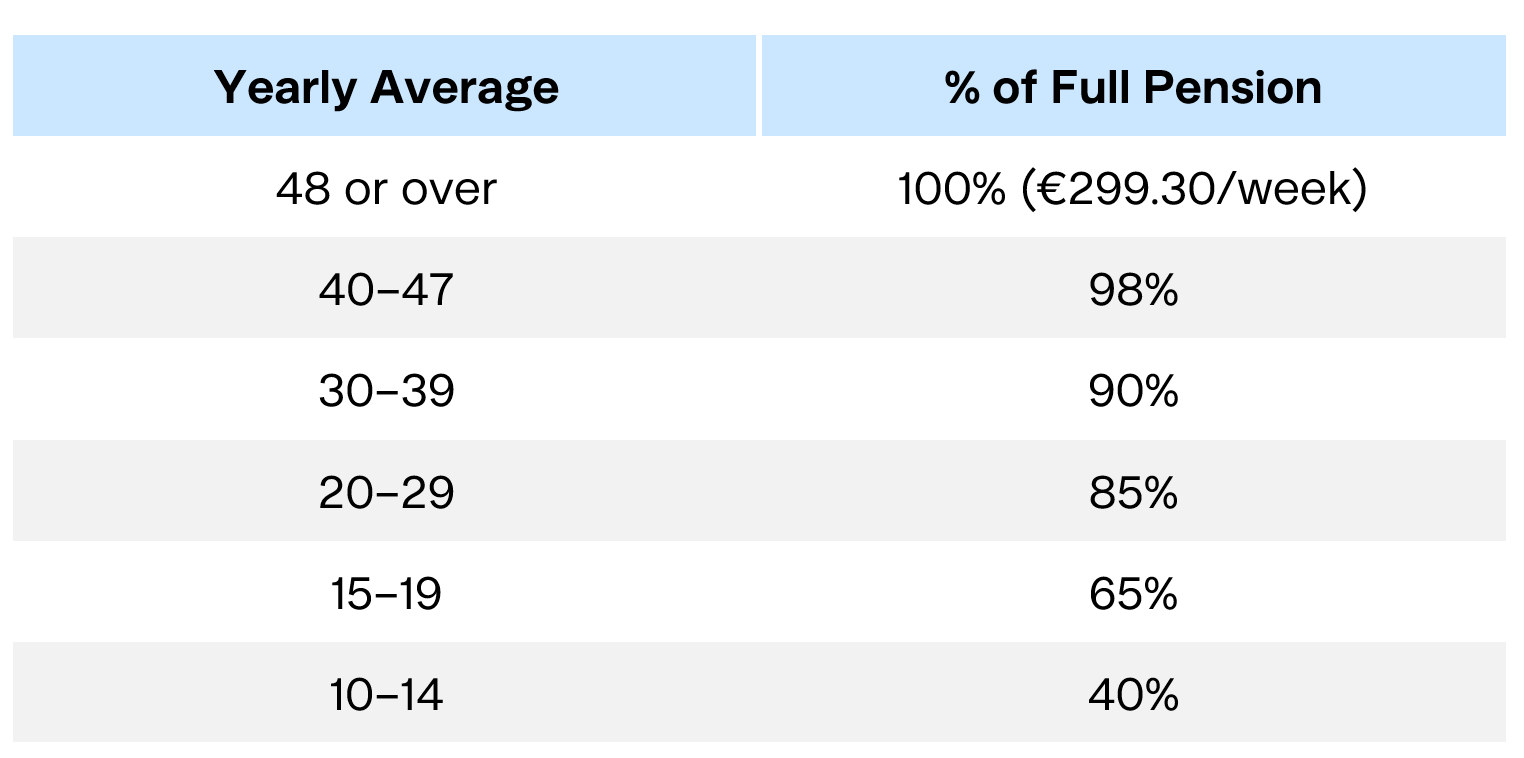
Your yearly average is rounded to the nearest number. For example, 9.4 is rounded down to 9 and 47.5 is rounded up to 48.
80% of your rate is determined using the YA method, the remaining 20% shall determine using the TCA approach we described above.
Do You Qualify? The Basic Requirements
To qualify for the State Pension (Contributory), you must:
- Be aged 66 or over.
- Have entered insurable employment before age 56.
- Have at least 520 paid PRSI contributions (that’s 10 years of full contributions).
- Be covered under PRSI Class A, E, F, G, H, N, or S.
If you don’t meet these criteria, you may instead qualify for the State Pension (Non-Contributory), subject to a means test.
What Counts as a PRSI Contribution?
Your PRSI record is built up over your working life. Here’s what counts – and what doesn’t.
What counts:
- Paid PRSI contributions from employment or self-employment.
- Credited contributions (e.g. when you’re on Jobseeker’s Benefit, Illness Benefit, or Maternity/Paternity Benefit).
- HomeCaring periods – time spent caring for a child under 12 or an adult who needs full-time care (under the TCA method only).
- Pre-entry credits
What doesn’t count:
- Time spent in full-time education
- Periods of voluntary work (unless you were paying voluntary contributions)
- Time living abroad outside a social security agreement country (unless you can combine records)
How to Get the Highest State Pension Possible
Now that you understand how the system works, here’s what you can actually do to maximise what you’ll receive.
1. Start paying PRSI as early as possible
The earlier you enter the workforce and start paying PRSI, the better your yearly average will be under the old method, and the more contributions you’ll accumulate under the TCA. Entering insurable employment at 18 or 20 rather than 25 makes a real difference over a lifetime.
2. Build up as many contributions as possible
Under the TCA, more contributions mean a higher pension – up to the maximum of 2,080. Every year you work and pay PRSI matters. The goal is 40 full years of contributions (or the equivalent combining paid and HomeCaring periods).
3. Don’t let gaps in your record go unaddressed
Gaps can hurt you under the yearly average method. If you had periods where you weren’t paying PRSI (time abroad, career breaks, etc.), it’s worth checking whether you have enough contributions to offset those gaps. Under the TCA, HomeCaring periods can help fill gaps related to child or adult care.
4. Claim HomeCaring Periods if you took time out to care for someone
This is one of the most important and under-used provisions in the system. If you took time out of the workforce to care for a child under 12, or an adult who needed full-time care, you may be able to claim HomeCaring periods. Up to 520 of these can count towards your TCA total – that’s potentially a huge boost for carers and stay-at-home parents.
5. Pay voluntary contributions if you have gaps
If you stop working – for example, due to emigration, early retirement, or a career break – you can pay voluntary PRSI contributions to maintain your record. You’re generally eligible to do this if you’ve made at least 520 paid contributions and apply within 60 months of the end of your last compulsory contribution.
6. Check your PRSI record well in advance
The Department of Social Protection holds your entire PRSI history. Errors do happen, and a missing year or two could reduce your pension. Check your record via MyWelfare.ie and contact the department if anything looks off. Do this years before you retire – not weeks before.
7. Consider deferring your pension
You don’t have to claim your State Pension the moment you turn 66. If you’re still working, you can defer it and receive a higher weekly payment when you do claim. For each year you defer (up to age 70), your pension increases. It’s worth crunching the numbers to see if this makes sense for your situation.
What If You Don’t Qualify for the Contributory Pension?
If you don’t have enough PRSI contributions to qualify for the contributory pension – or if you only qualify at a very reduced rate – the State Pension (Non-Contributory) may be an option.
It’s means-tested, which means the Department of Social Protection will look at your income, savings, investments, and property (other than your family home) to decide how much you’ll receive. The maximum is currently €288 per week.
If you have a partner who doesn’t qualify for a pension in their own right, you may be able to claim an Increase for a Qualified Adult on top of your own pension.
So, What Do These Numbers Actually Mean?
Let’s put it plainly. Even if you get the full State Pension – €299.30 per week, or around €1,297 per month – that’s a significant drop from almost any working salary. If you’re used to earning €3,000, €4,000 or €5,000 a month, retiring on the State Pension alone means a dramatic change in lifestyle.
The State Pension is a foundation, not a full retirement income. The earlier you accept that, the more time you have to do something about it.
That’s where private pension savings, investments, and products like the Pan-European Personal Pension (PEPP) come in. Combining your State Pension with your own long-term savings is the way to retire comfortably – not just survive.

Secure a comfortable future and take advantage of the European pension benefits
Frequently Asked Questions
1. When can I claim the State Pension in Ireland?
You can claim the State Pension (Contributory) or State Pension (Non-Contributory) from age 66. You can also defer claiming it and receive a higher rate.
2. How many PRSI contributions do I need for the full pension?
Under the Total Contributions Approach, you need 2,080 contributions (paid contributions plus any HomeCaring periods) for the full pension. Under the yearly average method, you need an average of 48 or more contributions per year.
3. What is the minimum number of contributions required?
You need at least 520 paid PRSI contributions (10 years) to qualify for any State Pension (Contributory) payment at all.
4. Do HomeCaring Periods count towards my pension?
Yes – under the Total Contributions Approach, up to 520 HomeCaring periods (time spent caring for a child under 12 or an adult in need of full-time care) can count towards your 2,080 total. This is especially valuable for parents and carers.
5. What’s the difference between the contributory and non-contributory pension?
The contributory pension is based on your PRSI record and is not means-tested. The non-contributory pension is means-tested and is for people who don’t have enough contributions. The contributory pension is generally higher and more secure.
6. Can I get a pension if I worked abroad?
If you worked in an EU/EEA country or a country with which Ireland has a bilateral social security agreement, your foreign contributions may be combined with your Irish ones to help you qualify. You won’t be paid twice, but your Irish pension will be calculated based on the combined record.
7. How do I check my PRSI record?
You can view your PRSI contribution history by logging in to MyWelfare.ie using your MyGovID. It’s a good idea to check it regularly – especially if you’ve had any gaps in employment or have worked abroad.
The State Pension is a cornerstone of retirement in Ireland, but the reality is that it won’t sustain the lifestyle most of us are used to. The sooner you understand the system – and start adding to it with your own savings – the better placed you’ll be for the years ahead. You’ve got this.