 Difficulty
Since March 2022 the keyword "saving" has, with a few exceptions, remained above "investing" in Google search results. “Saving energy” and “saving account” searches in particular have increased by 30%. This is not surprising. The current crisis is affecting, to a greater or lesser extent, each of us. In an era of shrinking budgets, we are increasingly looking to save money, and Google Trends data clearly confirms this.
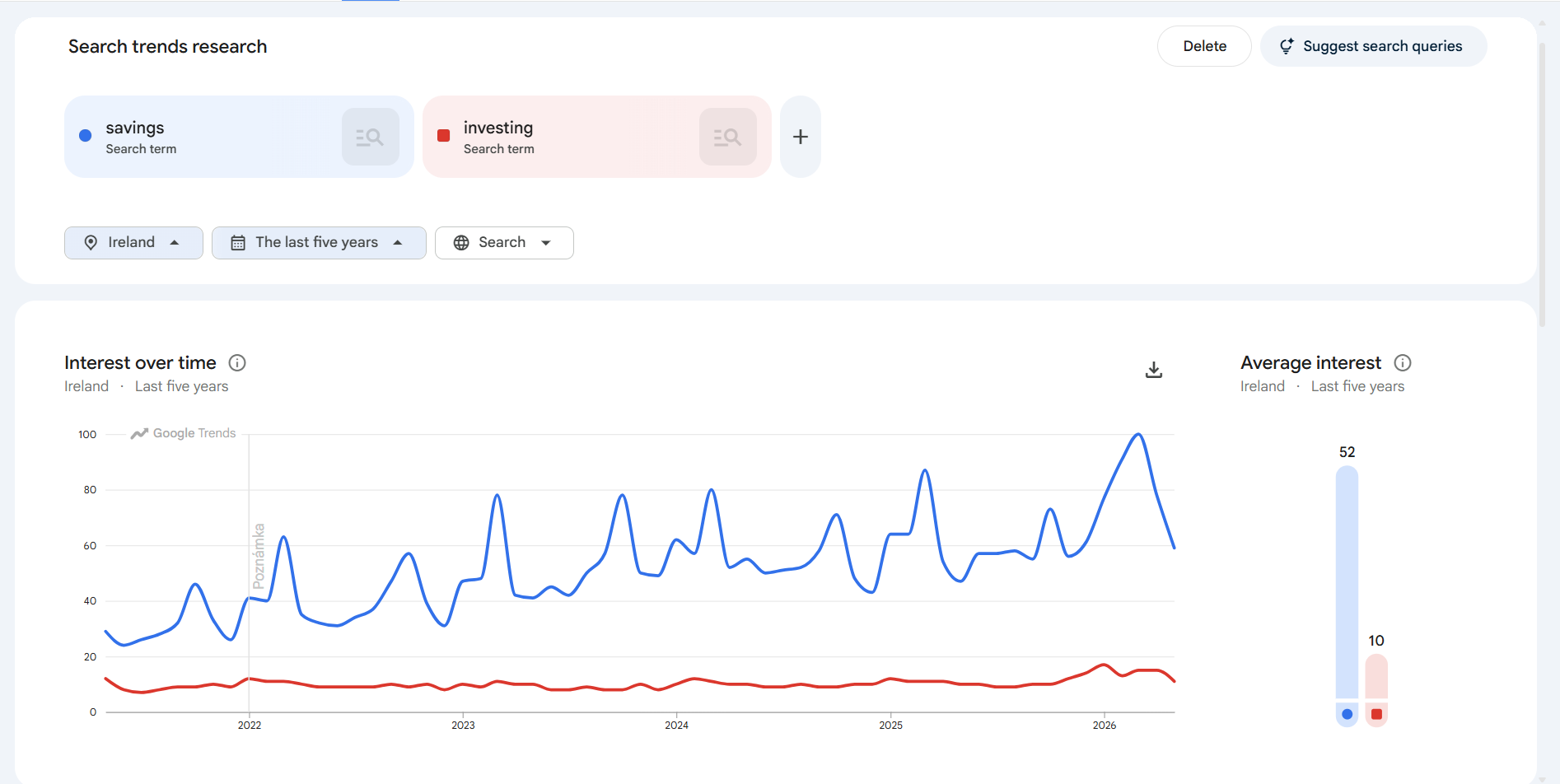
In the long run, periods of prosperity and times of crisis are intertwined. The apparently growing interest in the topic of saving in the current difficult period has therefore prompted us to ask ourselves. What is more important in the long run: saving or investing?
It has been known for a long time that the cornerstone of building wealth is to spend less than you earn and invest the accumulated surplus. Over time, through the power of compound interest, small amounts will grow into large ones, and the earlier you start, the more you will have accumulated at the end of the investment horizon.
This piece of advice was already given to the masses by George S. Clason, author of the popular financial reading "The Richest Man in Babylon”, published in 1926.
Following these principles is a recipe for success. But which of the factors mentioned has the greatest impact on the final outcome of an investment? The rate of return on investment, or the rate of savings?
Savings Rate Is More Important than the Return
We decided to check it out. Inspired by the table published by Charlie Bilello on his Twitter account, we ran our own calculations, although we already knew the result.
We looked at the final sum of an investment after thirty years for different savings rates and return rates. We assumed a take-at-home pay of €3,000 a month.
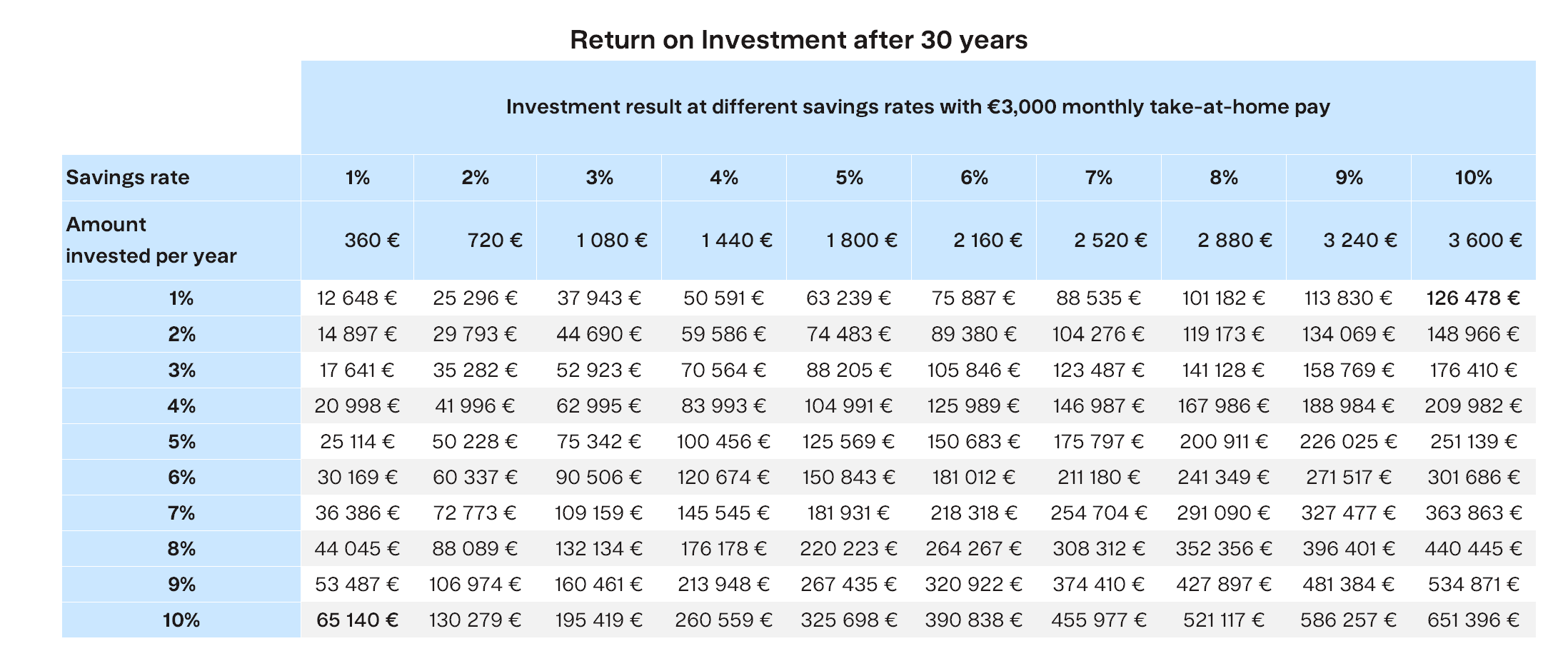
As it turns out, while the rate of return obviously translates into our final investment outcome, it’s the savings rate that has greater impact.
If you invest 1% of your income each year for 30 years, and in each of those years you manage to achieve a real rate of return of 10% p.a. (keep in mind that this is a really difficult result to achieve, as it sits above the long-term market average) at the end of the investment period you will have accumulated €65,140.
However, if you managed to put aside 10% of your earnings each year and only achieved a “measly” 1% yearly return, then despite your return being equivalent to a term account, you would have accumulated €126,478 after 30 years. That’s almost twice as much!
A Factor You Can Influence
The rate of return on investments, while important, is not under our direct control. It is directly influenced by a plethora of factors, all interacting at the same time. And while we can try to predict which of these will occur during a given period, we cannot do so with 100% certainty or accurately estimate their impact. After all, as we always mention in every blog, investing involves risk.
On the other hand, the savings rate is a parameter you have control over. Now let’s stay realistic, not all of us are able to put aside a significant portion of our salary every month.
However, if we want to increase our savings rate, we have a lot of room for creativity in both cutting expenses and increasing income.
How to increase your savings rate?
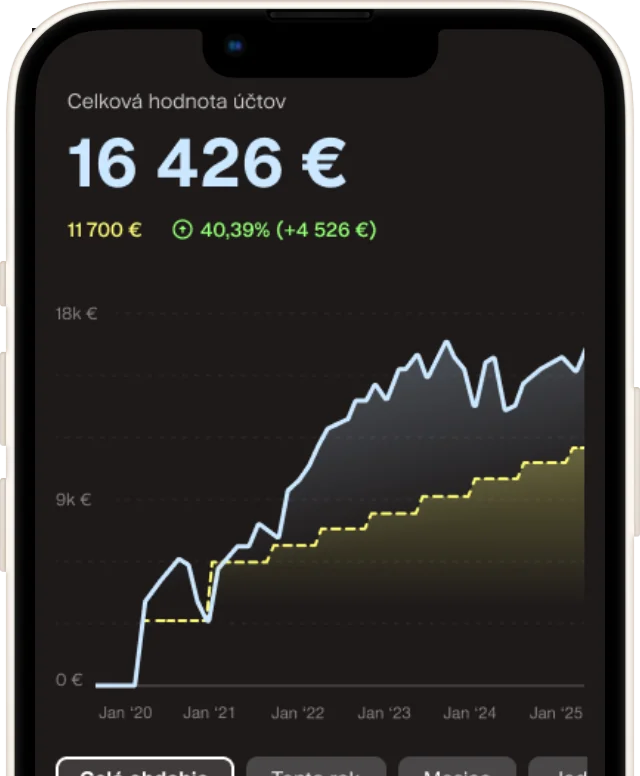
In our opinion, investing should be simple - and that's what passive investing with Finax is. A robo-advisor takes care of multiplying your invested savings, while a diversified portfolio of ETFs tracks the long-term average market return. And you, meanwhile, can focus on managing your budget for even better results.
That's why we regularly try to help you minimize your expenses. Be sure to check out our blog to learn how to reduce your grocery, electricity, gas, water or fuel bills. We teach you how to save on a daily, weekly and monthly basis.
For the same reason, we introduced the Coach function in our app. It’s a personal finance functionality free for everybody. Therefore, you can use it without investing with us, to help you look at your finances, plan budgets and identify areas for improvement.
Try the Coach
Try itFrequently Asked Questions About Saving and Investing
1. Is it better to save or invest?
Both matter, but saving comes first. Without a consistent savings rate, there is nothing to invest. The data shows that how much you save has a greater impact on your final wealth than the return you achieve on your investments.
2. How much of my income should I save and invest?
There is no universal answer, but the principle is simple - the more you save, the faster you build wealth. Even small amounts invested consistently over 30 years outperform large one-off investments with higher returns. Start with whatever you can and increase it over time.
3. Can I build wealth even with a low investment return?
Yes. Saving 10% of your income at a 1% annual return over 30 years produces nearly twice the result of saving just 1% at a 10% return. Consistency and savings rate matter more than chasing high yields.
4. What is the easiest way to start investing my savings in Ireland?
The simplest approach is to automate it - set up a standing order and let a robo-advisor like Finax handle the rest. For Irish investors focused on retirement, PEPP combines automated ETF investing with PRSA-equivalent tax relief, meaning your savings work harder from day one.
5. Does Finax help me track and improve my savings rate?
Yes. Finax offers a free Coach function in its app, available even without an investment account. It helps you analyse your budget, plan expenses and identify where you can increase the amount you save and invest each month.
As you can see, while the rate of return shapes the final outcome of our investment, the key role in building wealth is how much of our income we will invest.
So, take care of your savings and leave the investing part to us. And if you want to make your savings work as hard as possible for your future, the best investment you can make is in your retirement. For Irish investors, PEPP from Finax combines consistent long-term investing with PRSA-equivalent tax relief - so both your savings rate and your returns work in your favour.