 Difficulty
The war between Iran, Israel, and the United States began during the last weekend of February, and over the course of the month it drove declines across both equity and bond markets.
The war hit technology companies hardest, precisely those, that had grown the fastest since the “AI boom.” From the beginning of March, the large-cap US index S&P 500 fell by 5.1%, while the European Stoxx 600 dropped a full 8%. Yet once again we see the benefits of diversification, as the energy sector rose and cushioned the decline for our investors.
Performance was also boosted by the dollar’s March appreciation against the euro of 2.1%. Finax holds its US equity positions in dollars without currency hedging, meaning the dollar’s strength works in our investors’ favour.
The primary cause of the declines is the war’s sweeping reach. Iran closed the Strait of Hormuz, sharply reducing the supply of essential raw materials. Gulf countries exported approximately 20% of the world’s oil and liquefied natural gas supply through the strait. Cutting tankers off from international waters drove the price of Brent crude (the benchmark for Arab oil) up by nearly 63%. Prices were further pushed up by the disabling and destruction of oil wells in the region.
Higher oil prices have a broader impact than simply raising fuel costs at the pump. Energy is needed to provide almost every good and service, and therefore affects overall global prices. Food price inflation will hit Americans in particular, whose agriculture is heavily dependent on fossil fuels consumed in the production and use of fertilisers, pesticides, and machinery.
Energy prices are also a concern for the AI sector’s key infrastructure: artificial intelligence data centres. Beyond that, the Strait of Hormuz is critical for the transport of helium (used to cool semiconductors worldwide), petrochemicals used in pharmaceuticals, fertilisers, and aluminium.
In light of the potential impact of the Iran crisis on global prices, both the US Federal Reserve and the European Central Bank held interest rates unchanged in March. Both emphasised that rate hikes remained a possibility in the months ahead if needed.
The energy shock was felt most acutely by emerging markets, which, unlike Western economies, lack sufficient capital or reserves to cushion the impact of the crisis. The emerging markets index consequently fell by 9.25%.
Commodity market tensions also spilled over into bonds. Investors began pricing in the possibility that higher oil prices could slow the decline in inflation, and therefore anticipated a slower pace of interest rate cuts. Bond yields consequently rose, which pushes down their prices. The yield on 10-year US and German government bonds rose during the month by approximately 0.35 percentage points.
Despite the negatives, the crisis also leaves us with a note of persisting optimism: investors remain aware of Trump’s bet on rising equity markets. Even before the election he positioned his incoming administration as market-oriented, and experience tells us he is willing to pull the handbrake when markets fall – even if it means a complete U-turn in his policies.
The tariffs announced during last year’s “Liberation Day” and the trade war with China both ended in concessions after sharp market falls, despite their drastic initial scope, and rhetoric around the annexation of Greenland similarly softened. With Iran, we are seeing a similar pattern: its government has already lifted sanctions on Iranian oil tankers and is showing growing willingness to negotiate a ceasefire. There is therefore no need to panic — should the crisis develop favourably, a market recovery could well follow.
In our relevant currency markets, the euro strengthened against the Czech koruna by 1.35%, strengthened against the Hungarian forint by 1.76%, and strengthened against the Polish zloty by 1.42%. 
The smallest decline among the ETFs included in our portfolios was recorded by the fund tracking developed market bonds, which posted a loss of 2.18%. The fund tracking emerging market bonds saw the steepest fall, declining by 9.46%.
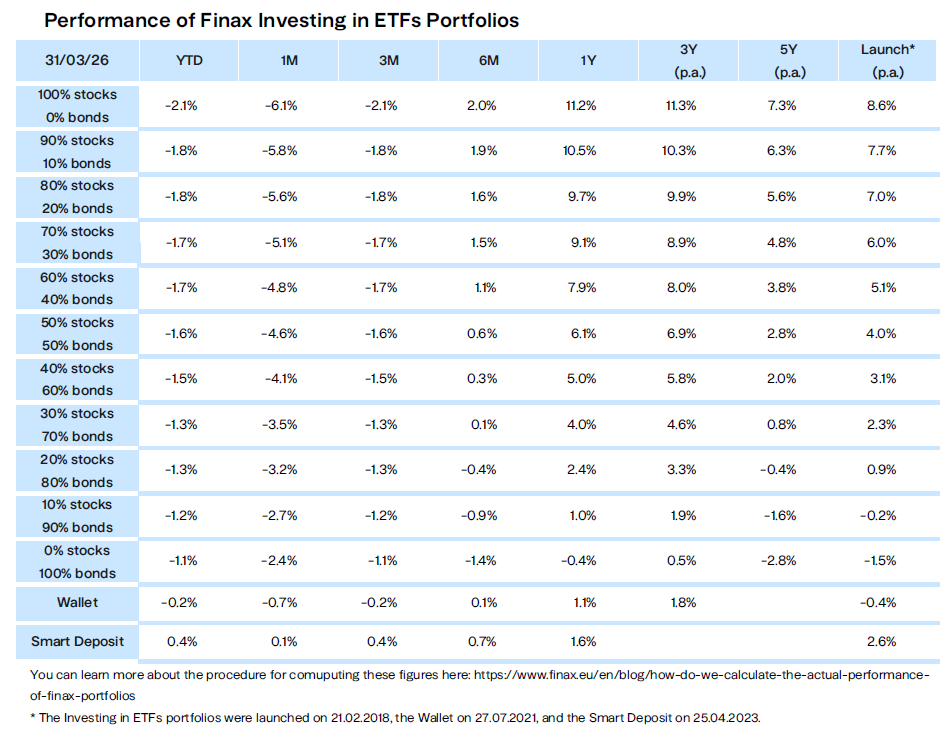
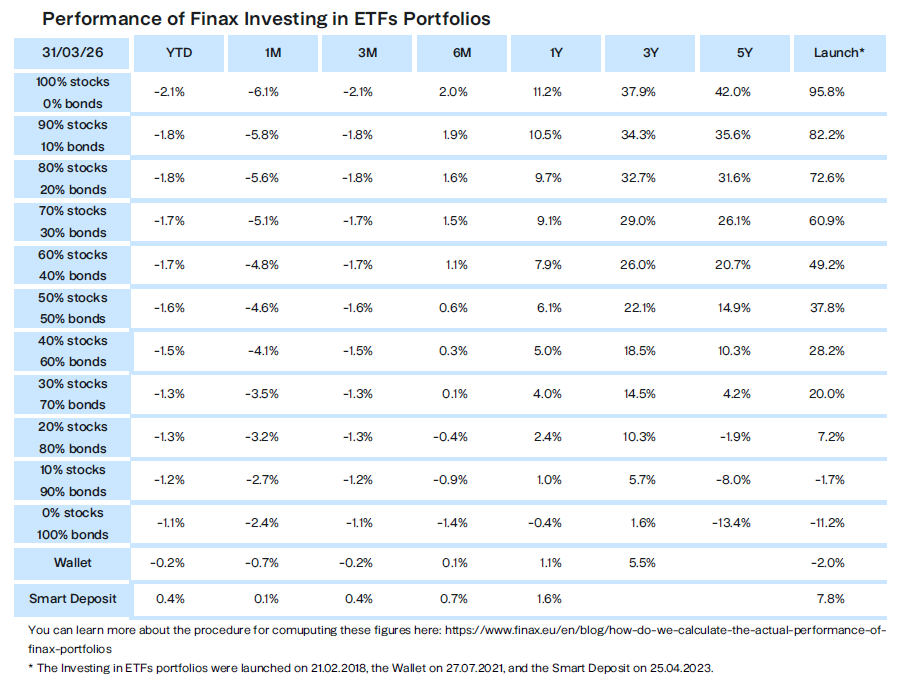
Among our Investing in ETFs strategies, the events had the smallest impact on the 100% bond portfolio, which declined by 2.37%. The deepest decline was recorded by the 100% equity strategy, at 6.06%. The Wallet fell by 0.71%, while Smart Deposit gained 0.09%.
March’s developments reminded us once again that when investing we should:
- diversify the portfolio globally and not rely on a single region or sector,
- invest passively and without reacting to short-term changes,
- maintain a long-term investment horizon.