 Difficulty
Many of us are used to receiving only a low or zero interest rate on savings accounts at large banks. Yet the rates of the European Central Bank (ECB) are much higher. They started rising from negative values in 2022 in an effort to fight record inflation (the rate of price growth). Banks, however, still have not fully adjusted the interest paid on savings accounts and term deposits.
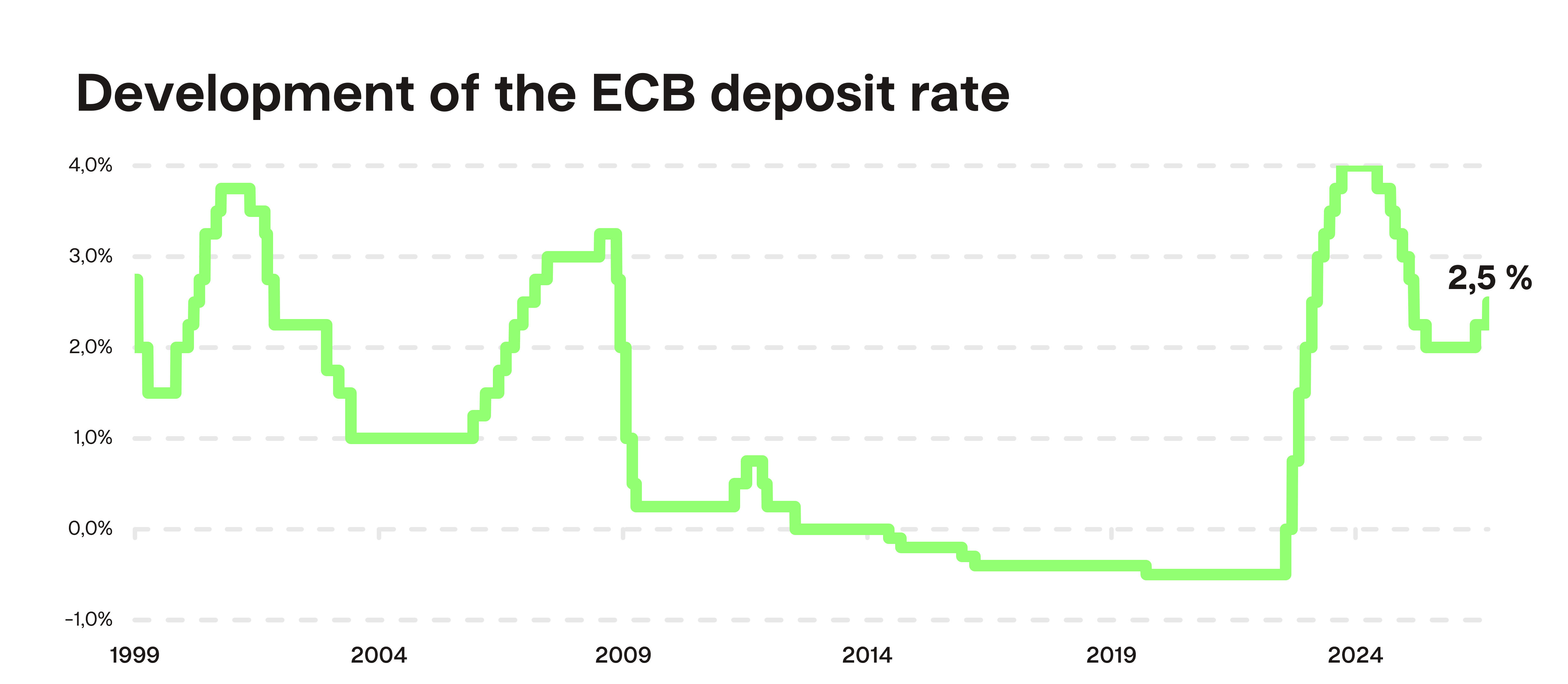
Source: The European Central Bank
Banks have little reason to change the current setup. They do not have to pay savers almost any interest, while they can deposit this money with the central bank at 2.5 %. The difference remains their income. Despite that, households hold tens of billions of euros in deposit products.
That is why we decided to come up with a product that reflects current interest rates and puts to work the money that earns you nothing in your savings account.
Deposit your short-term savings liquidly, conservatively, with minimal or low volatility and possible tax exemption. We present the killer of term deposits and savings accounts - Calm Investing, thanks to which your money will earn returns at the level of market interest rates, with no lock-up and no special conditions.

Grow your savings short-term and stress-free with Calm Investing
What Is the Calm Investing?
Calm Investing is Finax's conservative solution for depositing savings you will need within 3 years. It is an attractive alternative to savings accounts and term deposits.
It contains two investment strategies with different portfolio compositions: Under 1 Year and 1 to 3 Years. The first is intended for depositing savings you will need within 1 year, and for investors who do not wish to see any fluctuations in value in their account. Its volatility is in fact practically zero.
The 1 to 3 Years strategy has a higher expected return, but is subject to slight fluctuations in value. It is therefore intended for depositing savings you plan to use in 1 to 3 years, and for investors who are willing to accept moderate risk in exchange for a higher potential return.
Both strategies are built on money market and bond ETFs. Money market funds track, through their returns, the interest rate at which large commercial banks lend money to each other overnight. Bond ETFs contain short-term debt of high-quality companies and governments.
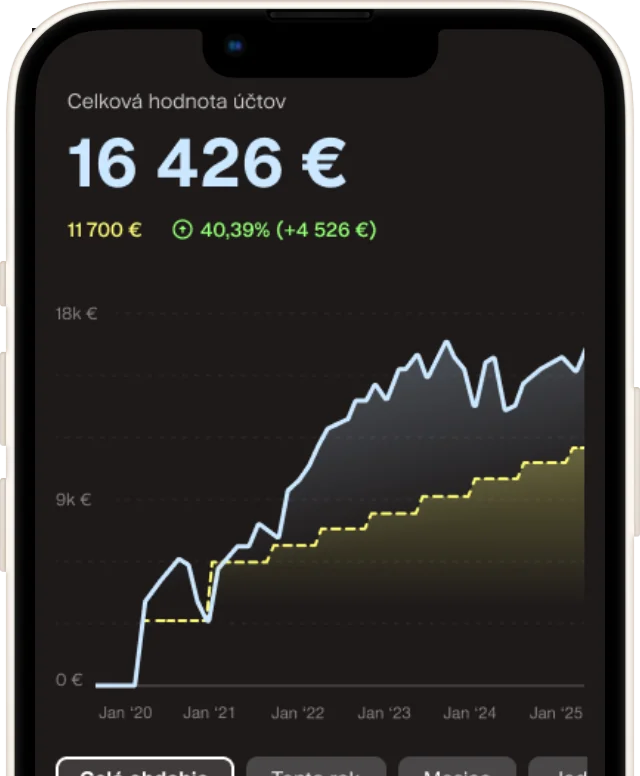
Thanks to this, their returns reflect short-term interest rates in the economy, which are close to the ECB's key deposit rate. In the chart you can see the performance of the Under 1 Year strategy since its launch in 2023. Notice how steadily its value grows. Volatility practically does not exist in this strategy.
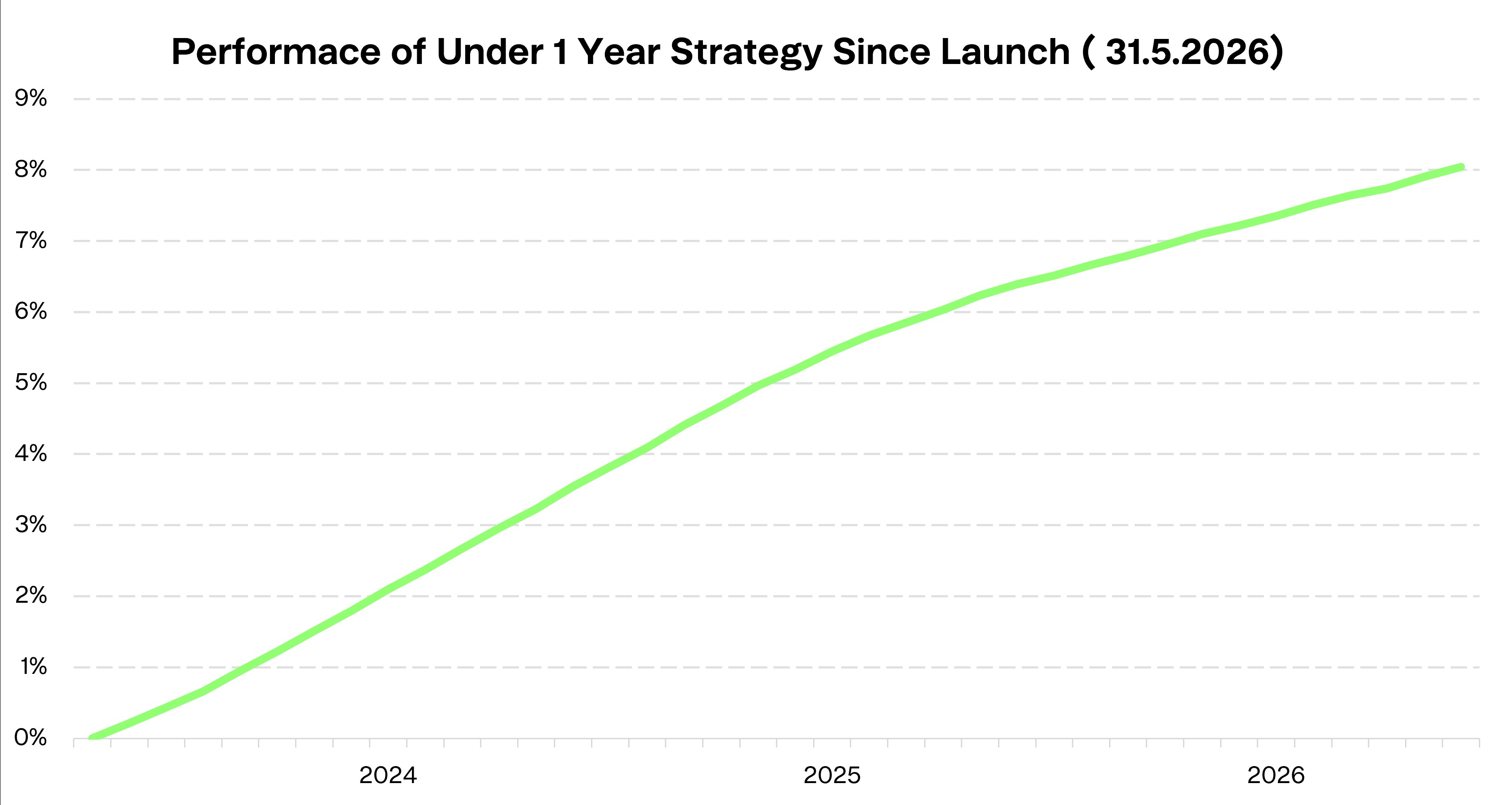
Note: We described the method of calculating actual performance in the article How do we calculate the actual performance of Finax portfolios? Past results are no guarantee of future returns, and your investment may also result in a loss. Find out what risks you take when investing.
Advantages of Calm Investing
- The opportunity to earn a gross return close to the ECB's key deposit rate.
- The current annual return is 2.5 % for the Under 1 Year strategy and 3.0 % for the 1 to 3 Years strategy* (as at 17 September 2026) - variable depending on the development of ECB interest rates and yields on the euro bond market.
- Minimal or low volatility.
- One low fee – 0.5% per year for portfolio management, including VAT.
- No lock-up – you can request a withdrawal at any time, and the money will reach your account in 3 to 10 days.
- After 1 year from investing your funds, the returns are exempt from tax.
- In the case of a withdrawal within 1 year, profit up to EUR 500 is exempt from tax.
*The expected return is calculated as the weighted average of the current interest of the euro short-term rate (€STR) and the average yield to maturity of the bond ETFs, reduced by the fee of the ETF funds. The weights are determined according to the target composition of each strategy. The return does not include Finax's portfolio management fee of 0.5% p.a. incl. VAT. Future performance may change. Tax treatment depends on the individual circumstances of each client and may change in the future.
If you would like to go really thoroughly into the details and want to learn as much as possible about this product, feel free to read on. For those who are busier, I offer just a quick overview of the basic facts together with links to the parts that may interest you.
For whom is Calm Investing suitable? For anyone who does not want to take on the higher risk of more dynamic portfolios, wants to have their money available at all times and wants to grow it significantly more than banks offer today.
How do I set up Calm Investing? Online on the Finax website - simply click the Open Calm Investing button below, or the Start investing button anywhere on the Finax website.
What is the composition of Calm Investing? It depends on the strategy; both consist of a money market and a bond component, and differ in their proportions and in the maturity of the bonds included.
Can the ECB change the level of interest rates? The ECB meets roughly once a month, when it may reassess its key interest rates. A change in interest rates is the largest component of this product's risk.
Which strategy should I choose? You do not have to worry about the choice yourself. Based on a short questionnaire, we will recommend which of the strategies is suitable for you when you open your account.
Grow your savings short-term and stress-free with Calm Investing
If you are interested in more details, the following information is intended precisely for you.
Who Is Calm Investing Suitable for?
Given its nature, Calm Investing is suitable as an alternative to savings accounts, term deposits or short-term investments in money market or bond funds. To achieve a comparable return at a bank, you would have to lock up your money for several years. At Finax you get it with practically immediate access to your money.
Calm Investing is ideal for depositing money over the short term. European households still hold enormous amounts of euros in banks, and for a large part of it Calm Investing is a substantially more attractive destination.
You can use it as an emergency reserve, or to save for a holiday, Christmas presents, taxes, or for buying a property, a renovation or replacing a car that you plan within 3 years. With minimal fluctuations, you do not have to fear having less money in your account when you want to make a withdrawal.
Despite the obvious disadvantages and inflation, many people still feel the need to hold a larger amount in cash or in a current account at a bank. A similar group is money that we do not know when we will use. Calm Investing is a suitable option for depositing a large part of these funds, as the money does not need to be locked up in it.
It is also attractive for placing corporate profits and reserves. We would remind you that for now we allow legal entities to open an account at Finax with a minimum amount €50 thousand. We are pleased that several companies with deposits of over one million euros already used this product during the test operation.
Is Calm Investing right for you as an Irish saver?
Calm Investing is built for money you'll need soon an emergency fund, a house deposit, a car, or anything else on a horizon of up to three years. Instead of leaving it in a low-rate deposit account, you earn a return close to market interest rates, with access to your money in days rather than a lock-up.
But short-term savings are only half the picture. The money you won't touch for decades your retirement belongs somewhere built for the long run, where it can compound in global equities. For Irish savers that's the European Pension (PEPP): contributions can qualify for income tax relief at your marginal rate, growth is tax-free during accumulation, and the total cost is just 0.9% a year with no entry or exit fees. Think of it as two tools for two jobs Calm Investing for the near term, PEPP for the finish line.
Grow your savings short-term and stress-free with Calm Investing
How Do I Open Calm Investing?
If you are not a Finax client, click on our website on I want to start or on the Open Calm Investing button in this blog, or download the Finax mobile app from the App Store, or Google Play. Opening an account is very simple and will take 10 minutes of your time.
At the beginning of the registration, click the „Browse Finax products“ button and select Calm Investing. You will go through a short questionnaire, verify your identity, complete your personal details, sign the contract online, send the money, and you can start growing your savings. You will conveniently follow their growth online in the mobile app or on the Finax website.
Existing clients simply add an account by clicking Open new account in the (More) menu in the mobile app, or the Open new account button in the account overview after logging in online on the website.
Portfolio Composition
All the advantages and characteristics of Calm Investing stem from its composition, i.e. the ETFs on which it is built. Two strategies with different portfolio compositions are available within Calm Investing.
The Under 1 Year strategy consists of four ETFs – two funds track the short-term interbank interest rate and two funds invest in short-term bonds with maturities of up to six months.
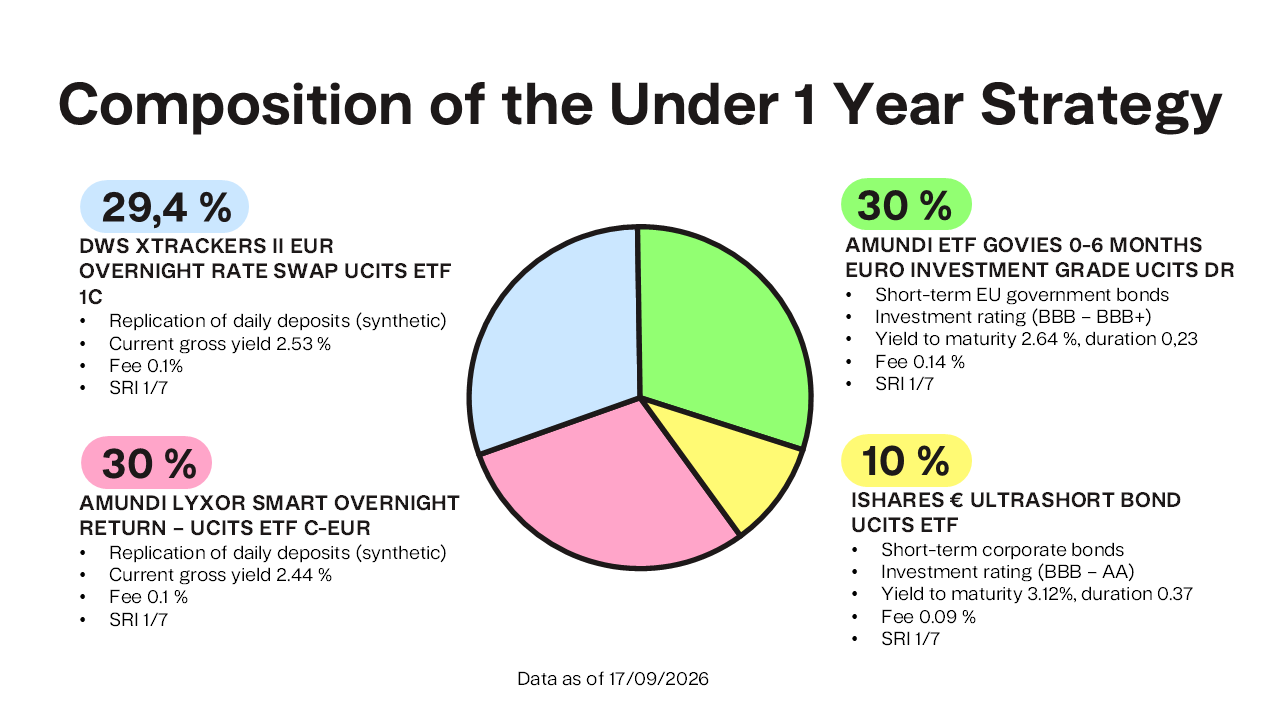
30% of the portfolio is invested in an ETF focused on short-term euro government bonds. These are bonds of euro area countries with an investment-grade rating and a maturity of up to 6 months, i.e. the safest securities Europe offers.
10% of the value is added by short-term euro corporate bonds with a rating in the investment-grade band (identical quality to the government bonds mentioned above). The average maturity of these bonds is up to six months. The fund is considerably diversified both by sector and by region.
59.4% of the initial assets is made up of two ETFs that track the returns of the short-term euro interest rate €STR (Euro Short Term Rate). This rate indicates the interest at which banks lend surplus liquidity to each other overnight (so-called overnight deposits and rates).
These interest rates are derived from the ECB's key deposit rate and are also influenced by liquidity and other conditions on the interbank market. €STR itself is not an investable asset. It is set by the ECB on the basis of developments on the interbank market as the average of banks' overnight deposits.
These funds track this rate through so-called swaps (forward contracts). They are ETFs that replicate the index synthetically. We used to see these funds as riskier, since with them the investor bore, in addition to market and interest rate risk, also the credit risk of the counterparty (a bank).
That has changed, however. Regulation today allows retail UCITS funds only a very small, negligible uncovered derivative position per counterparty, which significantly reduces credit risk. In the funds, these positions are fully covered by high-quality securities such as government bonds, or corporate bonds or shares of large companies.
The 1 to 3 Years strategy is very similar in composition. 39.4 % of its value is made up of an ETF tracking the returns of the short-term euro rate €STR, which I have already described above.
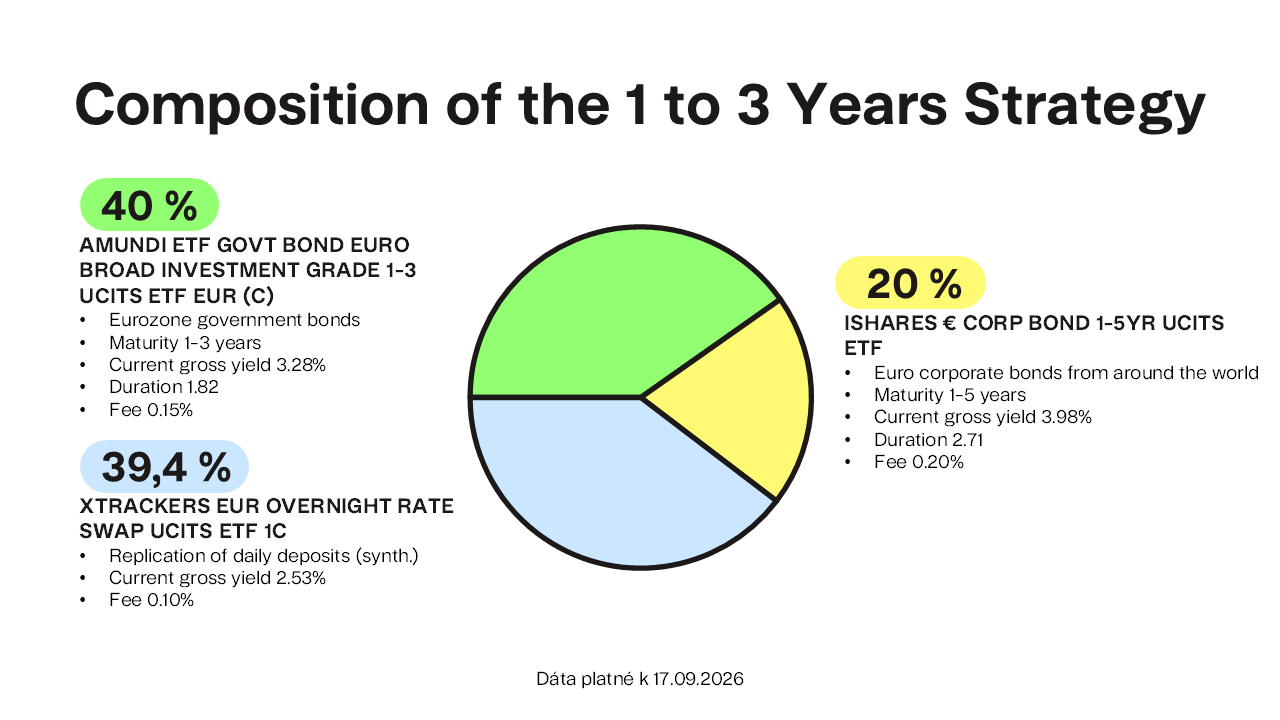
40 % of the portfolio consists of an ETF containing euro area government bonds with maturities of up to 3 years. The remaining 20 % goes into euro corporate bonds with maturities of up to 5 years. In both cases these must be investment-grade bonds issued by the highest-quality companies and governments.
How does a change in interest rates affect Calm Investing?
The key interest rates set by the European Central Bank are the main factor influencing the return of Calm Investing. The reaction to a change in interest rates depends on whether you invest in the Under 1 Year or the 1 to 3 Years strategy.
The Under 1 Year strategy benefits from an increase in interest rates. It contains instruments with such short maturities that if rates rise it starts paying a higher return practically immediately. Conversely, if rates fall, its pace of growth slows. The biggest risk for this strategy is therefore an unexpectedly sharp fall in interest rates during the term of the investment.
The 1 to 3 Years strategy reacts to changes in interest rates in the opposite way. If rates fall, it will grow even faster for some time. If, however, they rise unexpectedly, its value may decline slightly. The biggest risk for this strategy is therefore an unexpectedly sharp rise in interest rates during the term of the investment.
Risks of Calm Investing - is it as safe as a bank deposit?
The biggest risk is so-called interest rate risk. Its nature differs depending on the chosen strategy. The Under 1 Year strategy would be hurt most by an unexpectedly sharp fall in rates during the investment, which would reduce the return paid out. The 1 to 3 Years strategy is in turn sensitive to a rise in interest rates, which would send it into a slight decline.
It works the other way round too. If interest rates rise, the Under 1 Year strategy starts paying a higher return, thanks to which the investor earns more. The 1 to 3 Years strategy in turn rises above average quickly if rates fall during the investment.
The credit risk in the Calm Investing product is similar to the credit risk of a bank deposit. Investors also bear counterparty risk, which is, however, fully addressed. Specifically, in the case of ETFs tracking the overnight interbank interest rate, counterparty risk arises from the swap contracts through which the fund achieves this return. The counterparties are large banks (e.g. Société Générale, Deutsche Bank and others).
Within the fund, the risk of a single counterparty must not exceed 10 %. Swaps are at the same time fully collateralised. Only a volume of EUR 500 thousand does not have to be collateralised in the case of derivatives, which in funds with assets under management in the billions of euros represents a truly negligible volume.
If a counterparty fails, the assets of the exchange basket (high-quality bonds, or shares) remain in the assets.
Which strategy should I choose?
You do not have to worry about the choice yourself. When you open your account, our algorithms will recommend, on the basis of a short questionnaire, which strategy is suitable for you. If they recommend the 1 to 3 Years strategy and you do not agree with it, you can switch it yourself to the less risky Under 1 Year strategy before opening the account.
If you do not want to, however, you do not have to deal with or switch anything. We will take care of everything for you.
Finax once again brings you what is normally very hard to get on the market. If you want to obtain a comparable interest rate at a bank, you have to lock up your funds for several years, or the conditions are limited to a certain volume only.
Enjoy market interest rates with Finax, with all the advantages our investing and ETF funds offer. We will be very happy to answer any questions you may have. Do not hesitate to contact us on the telephone number 02/210 099 85, or send your question by email to [email protected].
Frequently asked questions
1. How is Calm Investing different from a regular deposit account?
A deposit account pays whatever rate your bank chooses often well below the ECB's rate. Calm Investing puts your money into money-market and short-term bond ETFs, so your return tracks actual market rates. There's no lock-up: you can request a withdrawal at any time and typically receive it within 3 to 10 days.
2. Is my money safe, and is it right for short-term goals?
It's designed for savings you'll need within three years, with minimal or low volatility the Under 1 Year strategy has almost none. It carries interest-rate and counterparty risk rather than being a guaranteed bank deposit, but that risk is tightly regulated and collateralised. It suits an emergency fund, a near-term purchase, or cash you simply don't want sitting idle.
3. Where should my long-term and retirement money go instead?
Not into a short-term product. Money you won't need for 10+ years should be working harder in equities. The European Pension (PEPP) is the natural home for retirement savings in Ireland a PRSA-equivalent tax-relief framework, tax-free growth while you save, and low fees with risk reduced automatically only in the final ten years before retirement. Learn what risks you take when investing before you start.

Secure a comfortable future and take advantage of the European pension benefits