 Difficulty
- What is rebalancing?
- Why do we do rebalancing?
- How do we rebalance and what are the other benefits?
- How does rebalancing increase returns?
- Frequently Asked Questions About Portfolio Rebalancing
What is rebalancing?
Rebalancing, despite sounding as something tangled, is not a complicated concept at all and is highly beneficial for your investment.
As the name suggests, it is about maintaining balance of the portfolio. Our mission is based on intelligent investing; therefore, we monitor the balance of clients’ portfolios.
Simply put, rebalancing means keeping the portfolio’s originally chosen composition, optimal for investors’ goals and their risk preference.

Create an account and start investing today
When opening an account with us, our algorithm selects a portfolio tailored to the client’s needs. Our investments are made up of 10 ETF funds targeting different asset classes, for instance, shares of large US companies, small European companies and world government bonds. Accounts of individual clients differ in the composition of funds based on the selected risk.
However, the composition of the portfolio changes over time. Different asset classes never develop equally, some may grow faster than the others, or may even grow when the rest declines.
Stock prices, for example, change more frequently than bond prices - they are more volatile, but historically achieve higher returns. Developing countries' or smaller companies' shares experience bigger price movements than those of big companies in well-established markets.
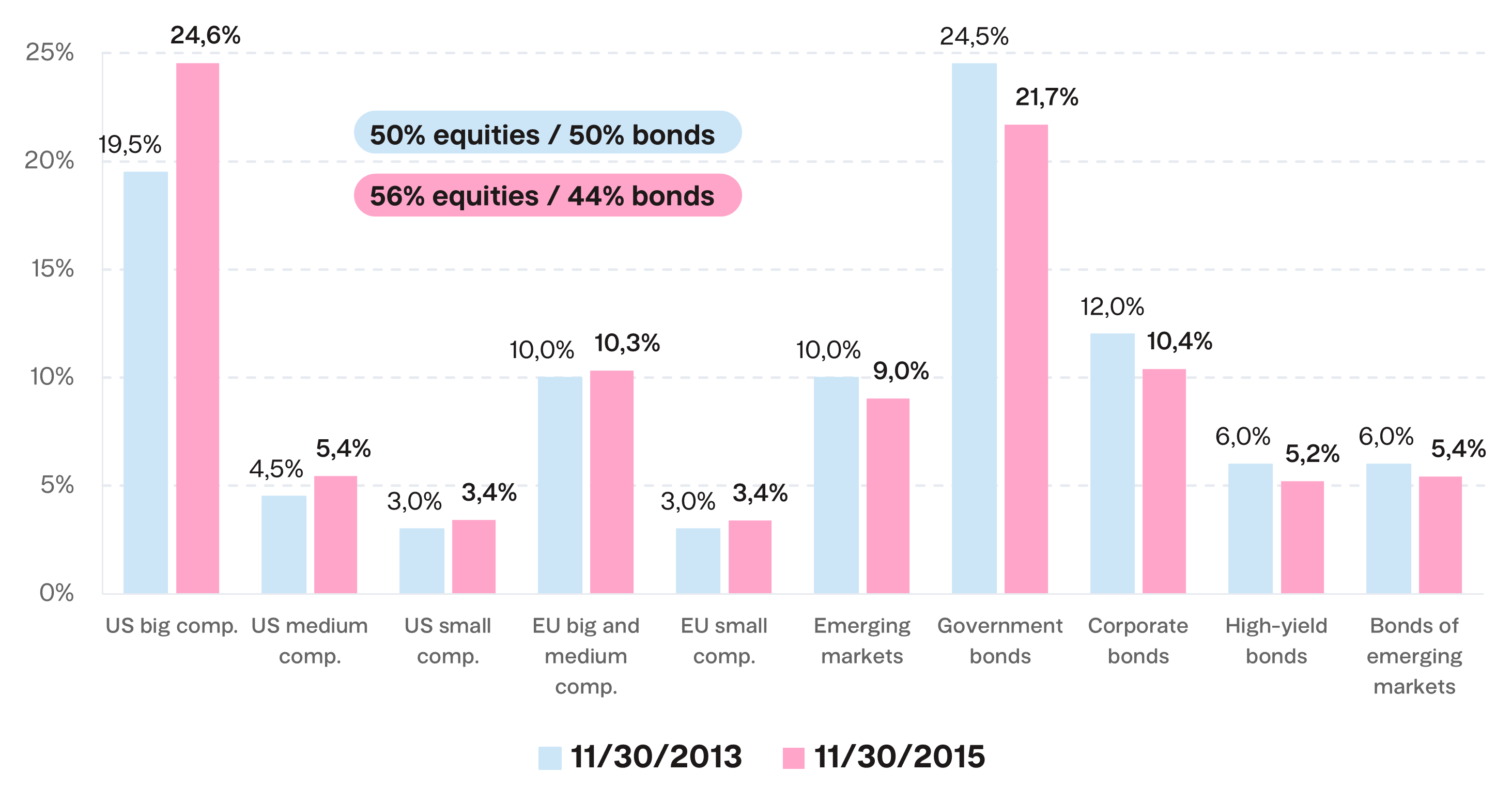
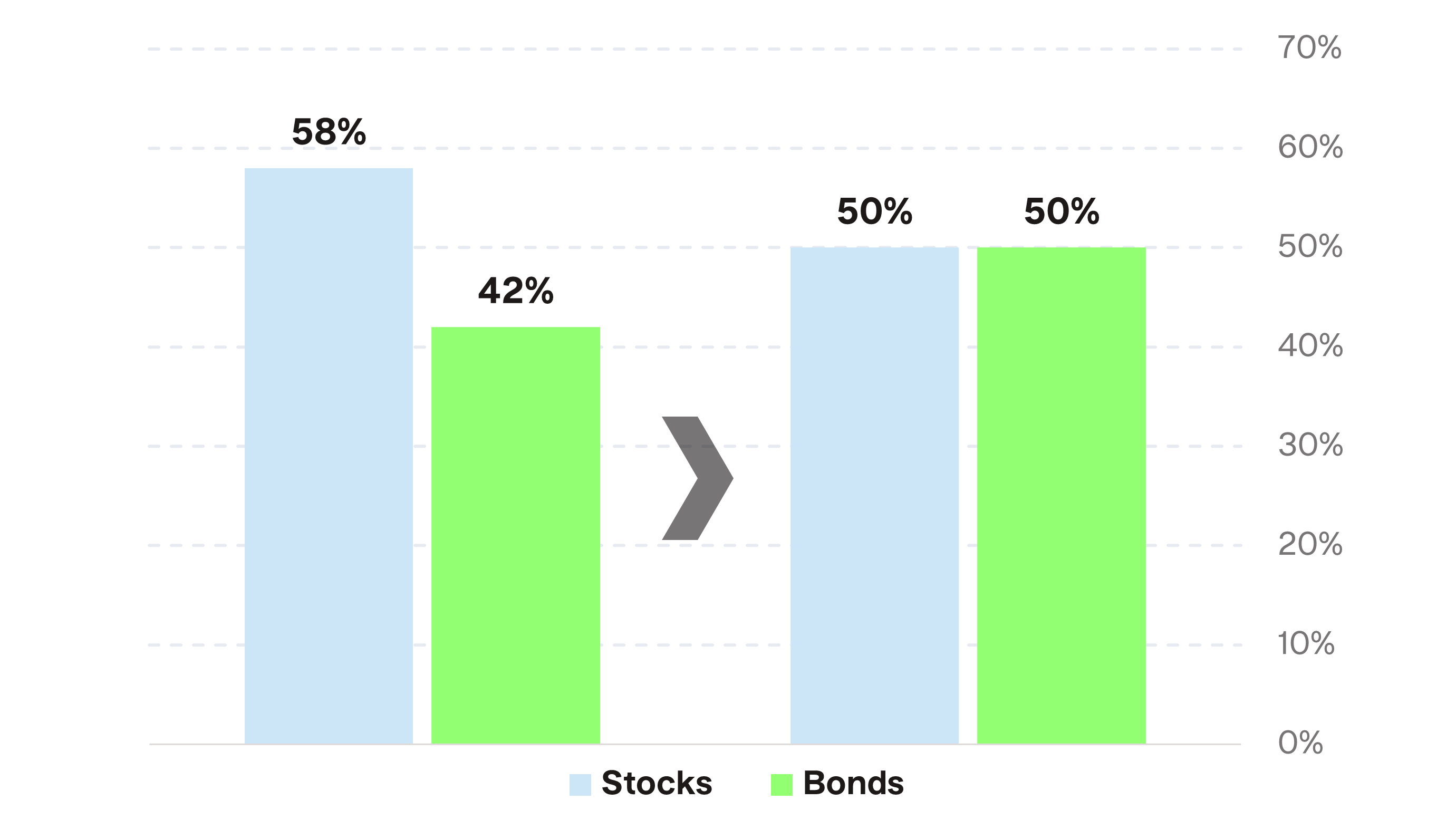
Their differences in development cause them to change the instruments’ weight within the portfolio. As shown in the following graph, comparing the composition of the 50/50 strategy (50% Shares and 50% Bonds) after 2 years, the proportion of the shares grows at the expense of bonds from the original 50/50 to 56/44 in November 2015.
Rebalancing means resetting the composition of the investment back to the original or optimal level - the original composition that was selected for the client at the beginning of the investment according to their objectives, options, and attitude towards risk.
Rebalancing is carried out through a simple sale of funds whose current portfolio weight is greater than the weight set at the beginning of the investment, and then buying currently underrepresented funds whose weight in the portfolio is lower than it is supposed to be according to the original setting.
Why do we do rebalancing?
The quality of each investment is measured by its return to associated risk ratio. Fundamentally, higher returns always brings higher risk and vice versa
The portfolio manager's goal is to achieve the highest possible return while maintaining the lowest acceptable risk for the investor. Therefore, increasing returns while lowering the risk is a dream of every investment manager, and thus a holy grail of investing.
The main role of rebalancing in management of our offered portfolios is to maintain the investment's risk at the chosen acceptable level.
Mixed portfolios comprised of different asset classes tend to increase their risk over time. Long-term stocks and other risky assets are growing faster than the safer assets. As a result, their proportion in the portfolio increases and the investment becomes riskier.
If, for example, the algorithm selects a balanced portfolio of 50% equity and 50% bonds as a suitable investment for the client, the equity weight will be 70% in a few years and the bond weight will be 30%. However, this is already a significantly different growth portfolio with a higher risk.
However, when the markets are declining the tables turn. For the time being, the portfolios become more conservative as the proportion of the safer assets grows. Therefore, their potential profitability also declines, thus stripping the investor off potential returns. So, it is more than wise to have a properly set portfolio composition.
Our goal is to maintain a stable portfolio risk at a level at which the investor feels comfortable. In addition, it is required by law to act in this way in the case of managed portfolios, such as with us.
How do we rebalance and what are the other benefits?
We at Finax were not satisfied with the standard way of portfolio rebalancing. We wanted to know when and under what conditions to return the investment composition to the original level so that the client would benefit the most.
Through detailed analysis and long-term testing of dozens and dozens of portfolio balancing methods, we have developed our own rebalancing system.
The result of our know-how is a rebalancing system that increases portfolios´ profitability and reduces their risk.
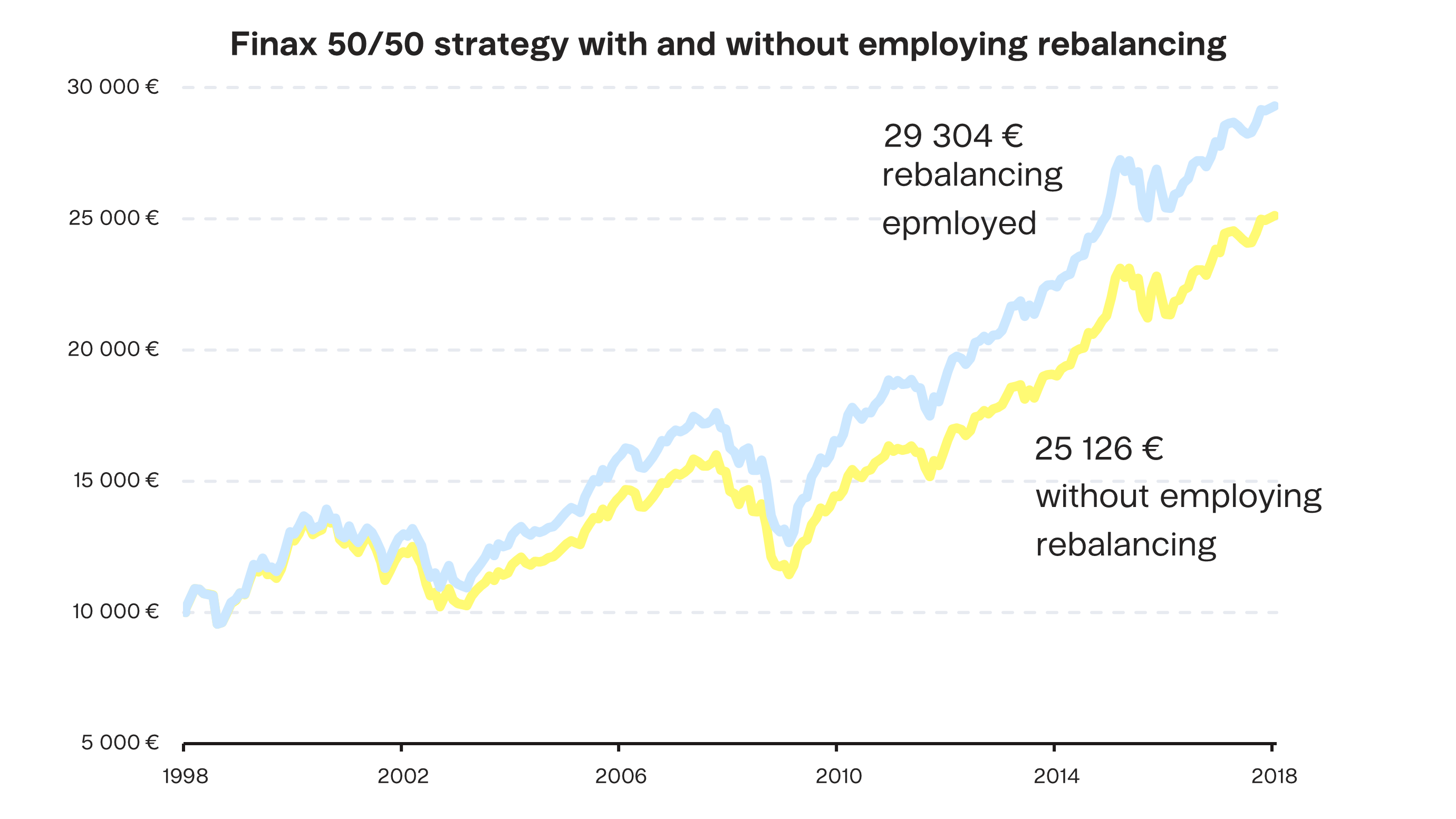
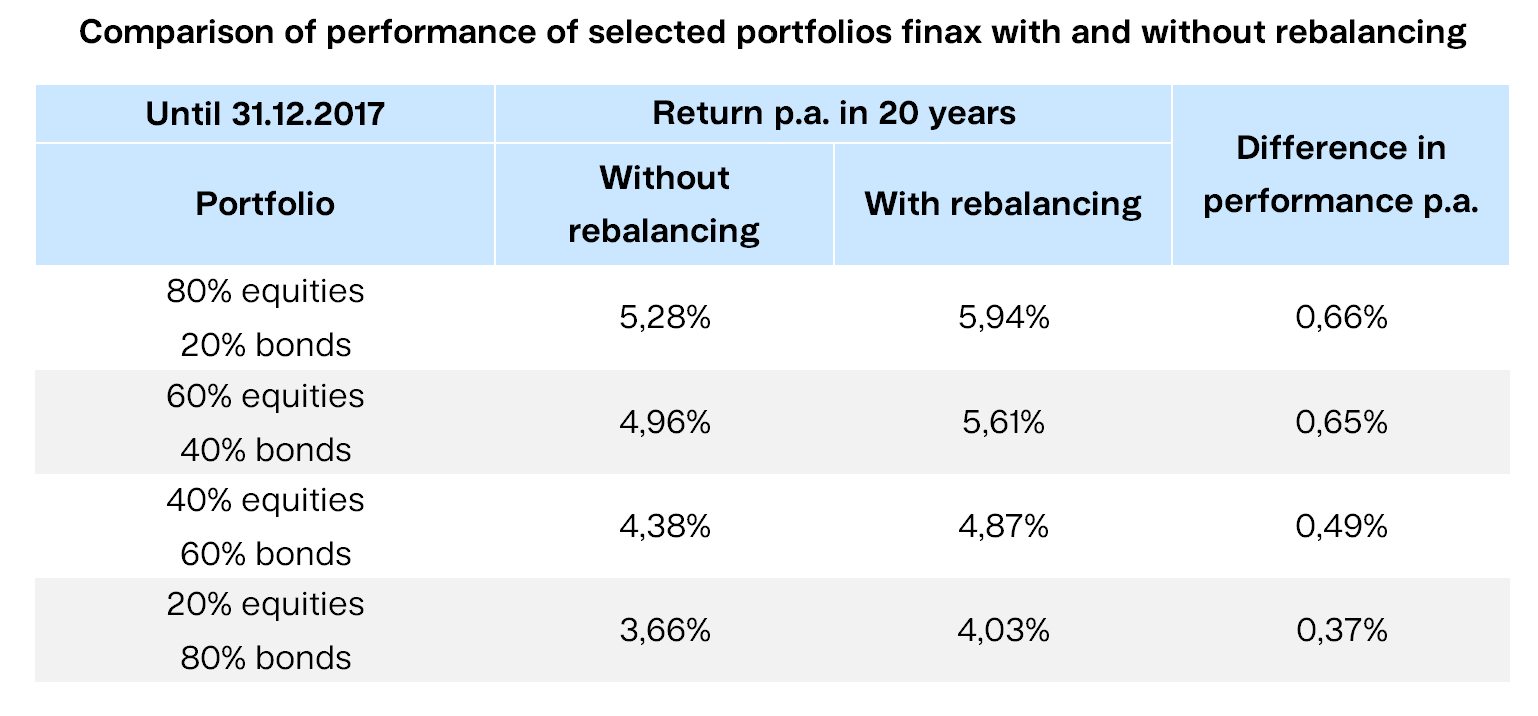
In a 30-year horizon, rebalancing increased the performance of dynamic, growth and balanced portfolios by an average of 0.41% per year. This effect is smaller for strategies with a larger share of bonds.
The benefits of rebalancing become more significant during the times of turbulence and of higher price volatility in the markets. Therefore, rebalancing has increased the returns of strategies with a larger share weight by 0.65% on average per year over the past 20 years.
Based on our research, we have created an interval of the weight of each instrument in the portfolio. Once the proportion of an instrument crosses the interval’s boundaries, it automatically rebalances the portfolio’s composition and returns it to the original state.
Our rebalancing is automated. The system monitors the composition of all clients' portfolios and if the portfolio structure changes significantly, it rebalances it.
We cannot foretell the carry-out of the rebalancing as it happens when the need arises and not on a set fixed date.
Rebalancing is always non-taxable. Thus, rebalancing can be postponed for several months if it would result into tax liability.
Finax carries out rebalancing without charging transaction charges or any other fees.

Secure a comfortable future and take advantage of the European pension benefits
How does rebalancing increase returns?
Our clients often ask how rebalancing can provide such considerable benefits, such increased returns up to 0,65% p.a. Even we were pleasantly surprised by the testing, so we studied the causes more thoroughly.
Firstly, rebalancing automatically employs another holy grail of investing - it sells when the prices are high (expensively) and buys when they are low (cheaply). It is an investment art that looks simple on paper, but in reality, it is done by only a few.
Rebalancing does what every investor should, but often fails at doing due to psychological temptations. Simply put, the investor takes profits from investment.
The weight of the sold ETF funds is relatively higher than the initial composition, which means that their value grew faster than the value of the underrepresented funds. The relative performance of the purchased assets is worse; therefore, they are cheaper compared to the assets sold.
Declines of the non-rebalanced investments are more significant and the rises lower than of the rebalanced portfolio.
If equity markets drop by 20% and you have 60% of stocks in your portfolio instead of 50%, the portfolio would depreciate by 12%, but only by 10% if the investment structure is set correctly. With 100% stock market growth, if stocks make up only 30% of your portfolio, the investment will increase by 30%, while in the optimal case of 50% equity portfolio composition, the investment increases by 50%.
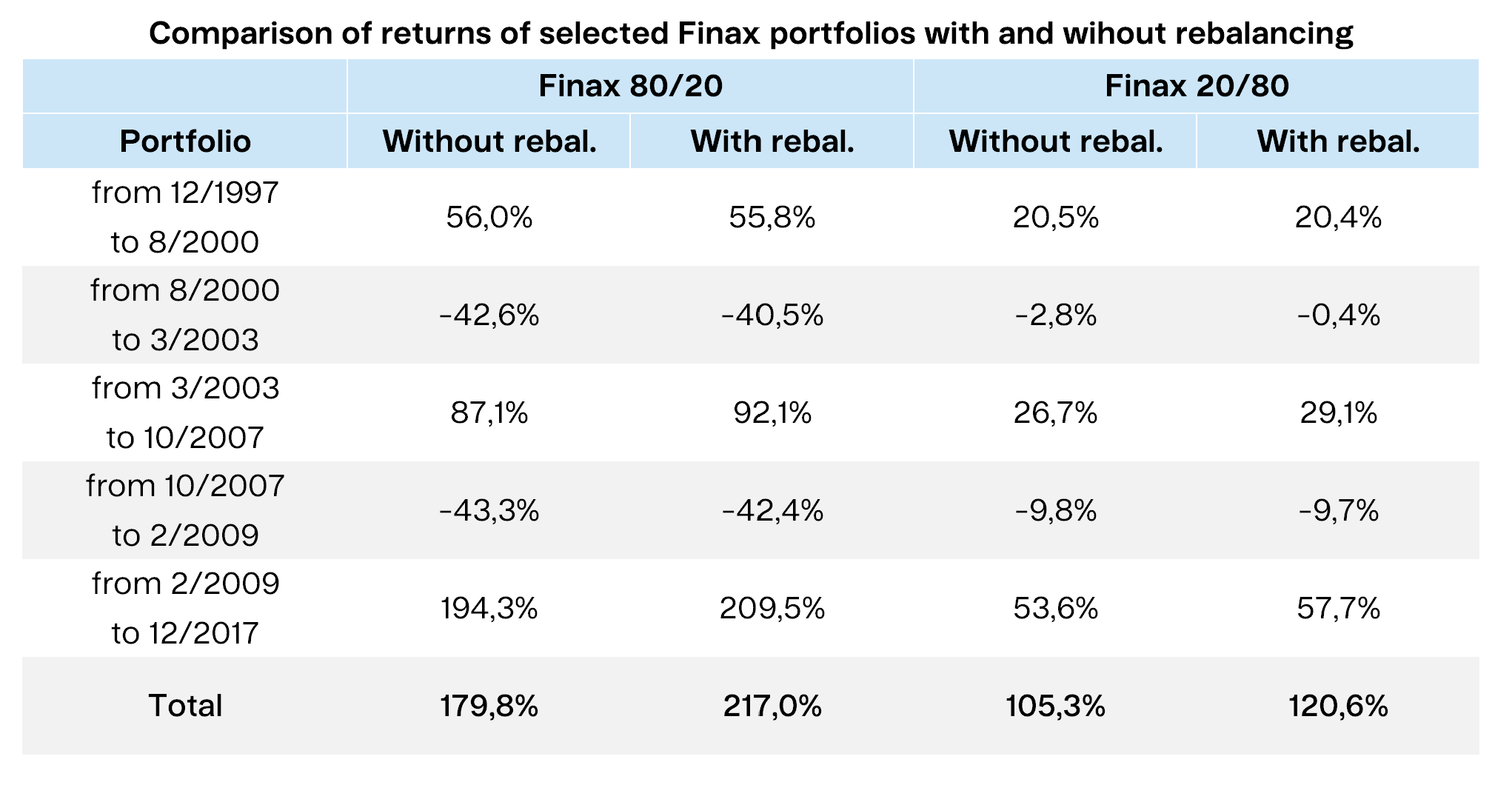
Rebalancing is a great instrument of passive investing, which is the best way to grow your savings. It takes measures that should be part of each investment strategy, but investors themselves tend to neglect them for various reasons - it maintains the risk of investment at the chosen level, sells expensive assets and buys cheap ones, increasing the return on investment and minimizing its risk.
Rebalancing is thus a huge asset and added value to every Finax portfolio — including PEPP. For Irish investors building retirement savings, this means your pension portfolio is automatically kept at the right risk level throughout your entire investment horizon, without you having to do a thing.
Frequently Asked Questions About Portfolio Rebalancing
1. What is portfolio rebalancing and why does it matter?
Rebalancing means resetting your portfolio back to its original allocation when market movements push it off balance. Without it, a portfolio designed for moderate risk gradually becomes riskier as stocks outgrow bonds — exposing you to more risk than you signed up for.
2. Does Finax rebalance automatically and does it cost anything?
Yes, Finax rebalances automatically at no extra charge. The system monitors all client portfolios continuously and rebalances whenever the composition drifts beyond set boundaries. You never need to do anything manually.
3. Does rebalancing apply to PEPP accounts too?
Yes. PEPP portfolios at Finax are rebalanced automatically in the same way as all other accounts. For Irish investors saving for retirement, this means your pension stays at the right risk level for your entire investment horizon — decades of hands-off, optimised growth.
Secure a comfortable future and take advantage of the European pension benefits