 Difficulty

Lagging behind the rest of the world, the U.S. stock market certainly did not see its best month. The large-cap S&P 500 fell by 0.9%, while the tech-focused Nasdaq dropped by 2.3%. The Russell 2000 index of small U.S. companies rose by 0.7%.
Note that the aforementioned returns are in US dollar terms, and since the dollar appreciated against the euro during the month, the decline was not as significant for our euro-based investors.
The weaker growth was partly driven by the release of new inflation data. Annual inflation accelerated from 2.8% in November to 2.9% in December (the data were released in February). As a result, the likelihood of another interest rate cut by the U.S. Federal Reserve fell significantly, and rates will probably remain in the 3.5% to 3.75% range for longer.
This particularly affected tech stocks, which are more sensitive to changes in interest rates than other sectors. Despite that, technology companies are doing pretty well. For instance, business activity measured by the ISM index rose in February at the fastest pace in the last three and a half years. Companies have adapted to high tariffs, while both sales and new orders increased. Business activity in the services sector also continued to grow, marking the 20th consecutive month of expansion.
At the same time, data pointing to continued strong growth in the U.S. economy may also suggest pressure for inflation to accelerate, which in turn lowers the likelihood of interest rate cuts. That’s why investors remained cautious toward technology and AI stocks, preferring more stable sectors such as utilities and construction.
In contrast, Europe and Japan posted solid results, supported by improving political stability and growing confidence in future economic growth.
The pan-European Stoxx 600 index delivered a return of 3.7%. The French CAC 40 and British FTSE 100 went even further and appreciated by 5.6% and 6.7% respectively.
Among the widely followed markets, Japan’s Nikkei 225 was one of the month’s top performers, rising 10.4%. South Korea’s KOSPI performed even better, surging 19.5% in February.
In all of these cases, economic and political stability played an important role. In Japan, the parliamentary election results confirmed a decisive victory for Prime Minister Takaichi’s government, which secured a two-thirds majority in the lower house of parliament. This significantly increased expectations for the adoption of pro-growth measures and for reform of Japan’s defense policy.
On the old continent, after months of political deadlock, the French parliament finally approved the state budget, which aims to reduce the deficit to 5%.
The rise in stocks was also supported overall by improving economic prospects. A key factor was the continuation of investment in the European defense industry, linked to the gradual shift away from U.S. suppliers, as well as expectations of continued price stability in the eurozone.
The winner among the ETFs included in our portfolios was the fund tracking emerging market equities, which rose by 6.4%. The fund tracking large U.S. companies in the S&P 500 was the only one to post a decline, falling by 0.4%.
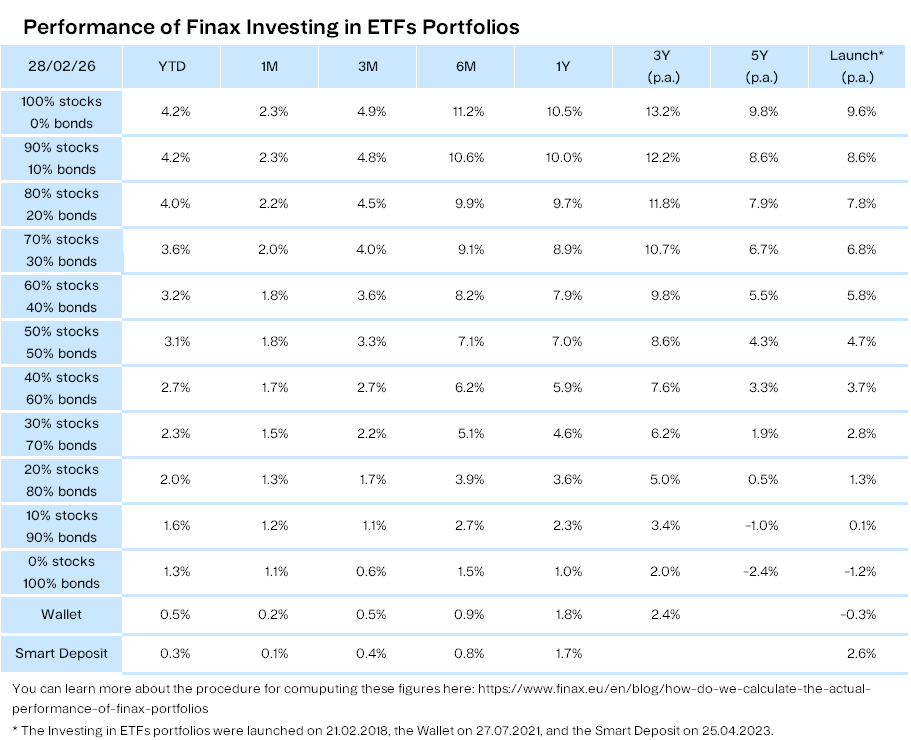
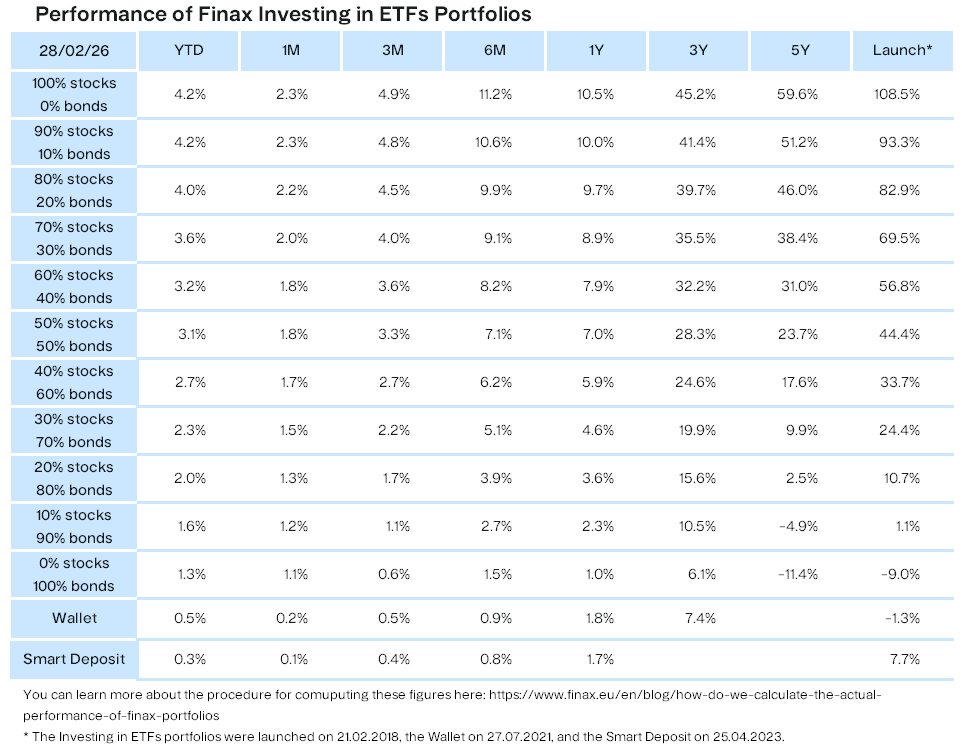
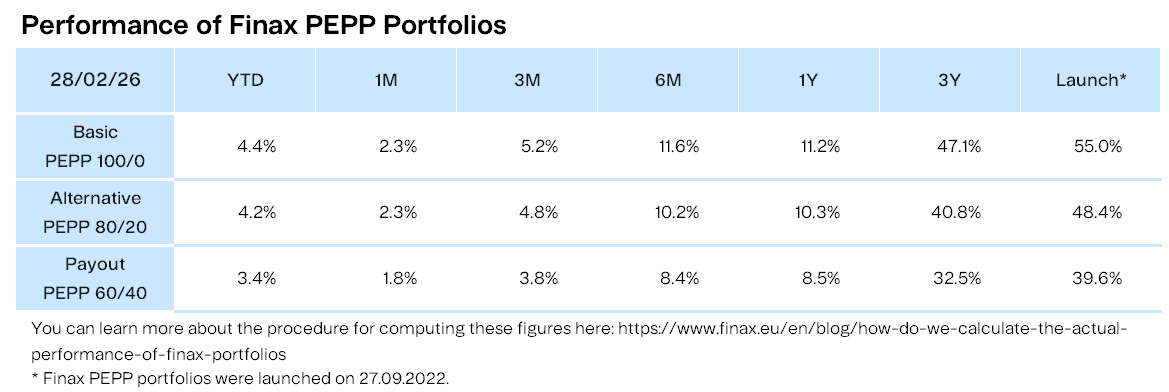
Among our ETF investing strategies, the best performer was the 100% stock portfolio, which rose by 2.27%. The lowest growth was posted by the 100% bond strategy, with a result of 1.07%. Wallet gained 0.19% and Smart Deposit rose by 0.12%.
February once again reminded us that when investing, we should:
- diversify our portfolio across the whole world,
- avoid betting only on countries and sectors that have performed well in the past,
- invest for the long term and in an automated way - simply, invest and relax.