 Difficulty
Those questions make sense. Most thing always come down to money. But for many new retirees a different, much quieter concern slowly rises to the surface: What am I going to do with all that time?
Retirement is a really like a book where you have to write the final chapter yourself. For decades, it was someone else who set the plot, the characters, and the pace. Then one day they hand you the pen telling you to finish the rest. And that’s where many people get lost for the first time.
When Structure Disappears, the Need for Meaning Doesn’t
According to Eurostat data the average working life in the EU is nearing 38 years. This means you have spent decades living in a rhythm that was not random.
Morning, work, obligations, people, deadlines. Even when it’s exhausting, that rhythm gives you a sense of belonging somewhere. When that framework disappears, the day suddenly becomes an empty space that needs to be filled.
And that brings us to the part that gets talked about least - the psychological transition.
American sociologist Robert Atchley described the six phases that most retirees go through as far back as the mid-20th century. The first, the so-called “honeymoon phase,” lasts from several months to about a year. Travel, rest, freedom. Everything that had been put off for years. But after the first phase slowly fades away, a significant number of people enter the phase Atchley calls disenchantment. That moment when the euphoria settles, the travel slows down, and you realize that Monday looks just like Tuesday.
If pre-built habits, hobbies, or social connections are not in place by that phase, the empty space does not fill itself.
Create an account and start investing today
The numbers make this very clear. A study from the Institute of Economic Affairs in the United Kingdom found that retiring increases the likelihood of a clinically diagnosed depression by around 40%, reduces the likelihood of self-rated excellent health by around 40%, and increases the risk of at least one diagnosed physical illness by around 60%. These effects grow the longer a person is in retirement.
A study published by the National Institute on Aging shows a similar pattern. The risk of depression and feelings of isolation rises significantly among those who haven’t developed any social activities outside of work after retirement. In other words, the problem is not free time. The problem is that this time has no structure.
And structure is not merely a matter of boredom. A major meta-analysis by Julianne Holt-Lunstad and her colleagues found that social isolation increases the risk of mortality by 29% and the feelings of loneliness by 26%. In other words, the low quality of social connections later in life has a similar effect on your health as smoking and obesity.
The OECD further confirms that older people who regularly take part in social activities are significantly more satisfied with their lives than those who are socially passive. It sounds logical. Yet very few people actually prepare for it.
It is mostly the financial aspect of retirement that receives the most attention, since state pensions across EU are largely insufficient for a comfortable life. But what is interesting - and somewhat unexpected - is that even people who are financially secure go through very similar emotional phases.
Because money can resolve the question of security, but it cannot answer the question of identity.

Secure a comfortable future and take advantage of the European pension benefits
If you spent 30 or 40 years being “someone” through your work, it is not easy to become “someone else” overnight. It is like taking off a jacket you have worn your whole life and suddenly feeling the cold you never noticed before.
Retirement Is Not the End of the Road, But the Beginning of a Relationship With Yourself
The biggest difference does not happen upon retiring, but much earlier. It shows in people who already have something of their own. A hobby. A community. A routine that does not depend on work. They do not step into the void - they simply change pace.
On the other hand, those who tied their entire identity to their job often step into silence that is louder than they expected.
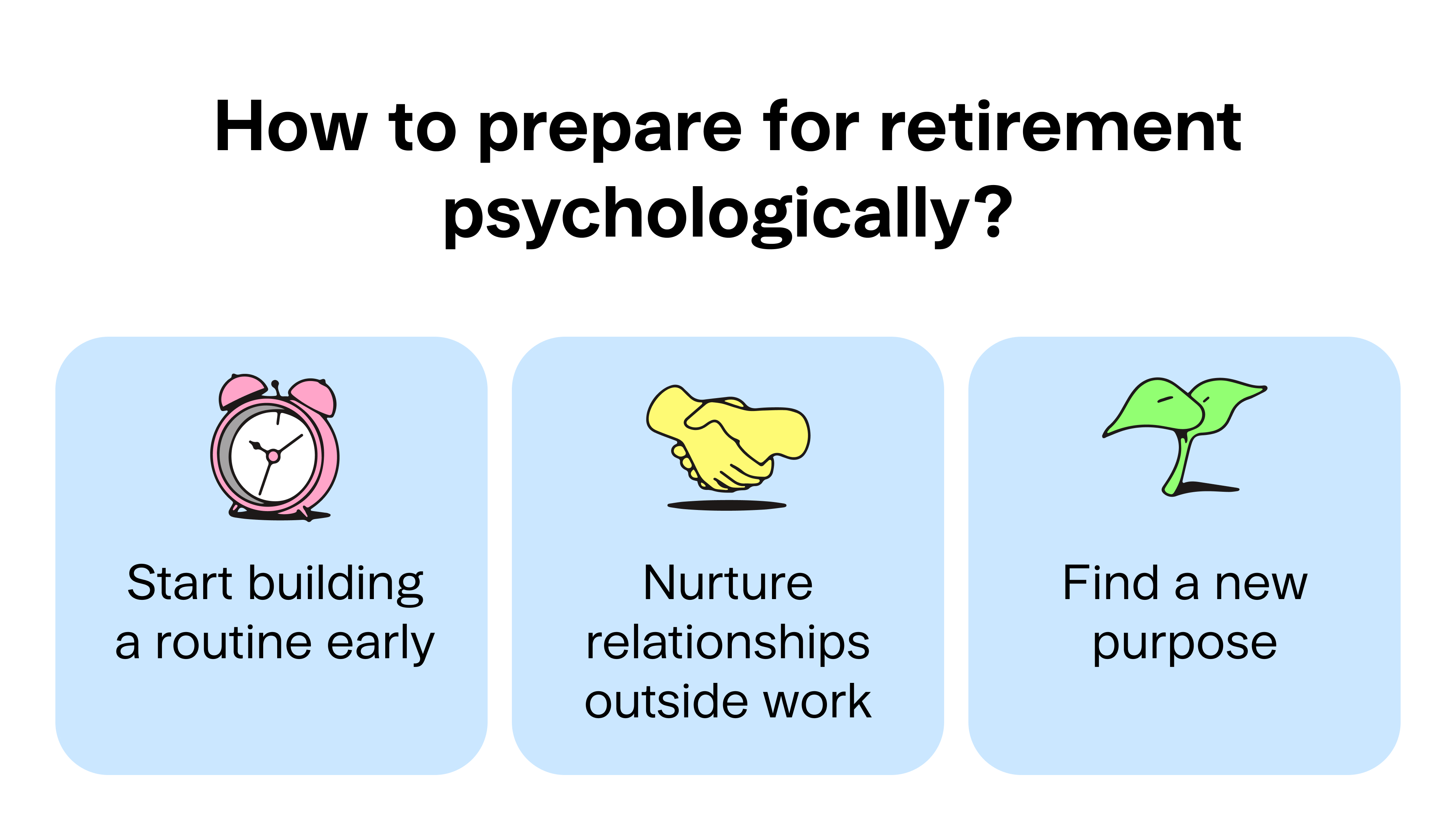
Atchley calls this period the reorientation phase, and research describes it as time when a person rebuilds purpose and structure, in this case without the support of an external framework such as a job or school. Those who navigate this phase successfully tend to share three things: they maintain regular social contact, they have at least one activity that gives them a sense of competence, and they have some rhythm to their week that is truly theirs - not imposed.
So, perhaps the most important question, isn’t how much you will have in retirement, but who you are going to be when you get there.
Take a moment and do a small thought experiment. Imagine you stopped working tomorrow - what would your week look like? Who would you have coffee with on a Wednesday morning? What would give you a sense of accomplishment on a Thursday? If the answers are unclear, it’s not a problem. It’s a signal. Not that you need to work more, but that you need to start building a life that isn’t dependent on work alone.
Retirement is not the end of the road. It is the moment you finally get to organize your life and time solely according to yourself. And that can either be the best or the worst position you can find yourself in. The difference between these two chapters of life is not decided in the last working year. It is built years before, in small habits, in connections outside the office, and in interests that are yours simply because you are you - not because anyone expects them of you.
Your most asked retirement questions
1. Will my state pension be enough?
Probably not. EU state pensions cover the basics at best. The gap between what the state pays and what a comfortable retirement actually costs is real - and widening. Building your own savings early is the only reliable fix. Find out what living 20 years without a salary really means.
2. Am I emotionally ready for retirement?
Retiring increases the risk of depression by 40%. The reason is simple - work gives you structure, identity, and social connection. People who retire well build a life outside work before they leave it. Money solves security. It doesn't solve identity. Ask yourself: are you ready for a life outside your job?
3. How do I start investing for retirement?
You don't need much. Finax starts from €10. What matters most is starting early. Compound growth does the heavy lifting over time. Right now, new clients get the first 3 months of portfolio management for free.
Saving is important. But it is equally important to invest in the life you will want to live once the routine is gone.
That choice, at least in part, is one you are already making today.