 Difficulty
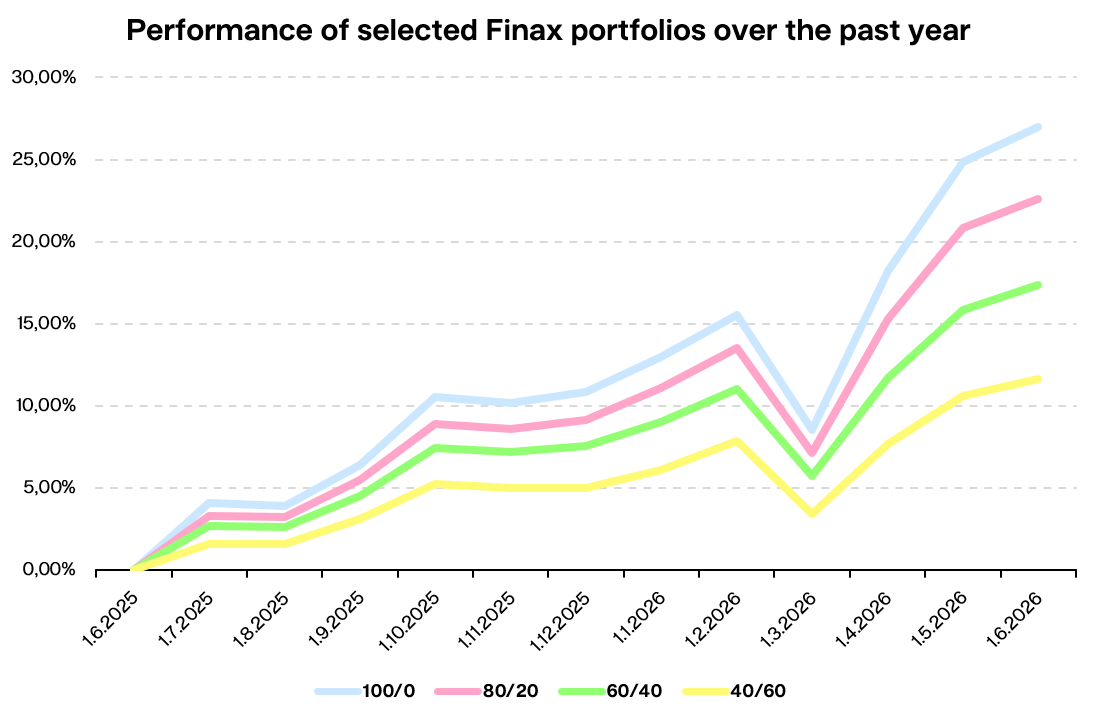
Equity investments have just had an exceptionally successful year. Over the past 12 months, Finax's dynamic strategies delivered returns of more than 20 percent. Years like this are exactly why we say that putting off investing can prove expensive.
Even so, the past year was not without its nervous moments. The end of February 2026 brought a shock in the form of armed conflict. Israel and the United States launched military strikes on Iran, killing the country's supreme leader, Ayatollah Khamenei. In retaliation, Iran blocked the Strait of Hormuz, through which roughly a fifth of the world's oil trade passes.
Markets did not take long to react. Within a few days, the price of Brent crude jumped from its usual level of around 70 dollars to above 120 dollars a barrel. Comparisons with the oil shocks of the 1970s and warnings of a global recession appeared immediately.
President Trump's statements swung from promising to “finish the job” to signalling a withdrawal of troops. He threw the market from one mood into another.
Despite the initial fears, the conflict ultimately did not escalate into a long war that would have threatened global oil supplies for years to come. Oil prices returned to their earlier levels over the spring, and global equity indices not only recovered their losses but reached new all-time highs by the end of June 2026.
The first lesson, then, is that it pays not to panic. Shocks like these are no reason to deviate from your investment strategy, that is, to stop contributing or withdraw out of fear. Very often, even events that look at first glance like the end of the world bring no significant fall in equity markets.
Wars, sharp swings in commodity prices and political uncertainty have always been part of investing. Not one of them has managed to permanently halt the growth in value of the world's equity markets.
You can see this in the chart below, which shows how some of our portfolios performed over the past year.
The war in Iran was not the only test of investors' nerves. Tension was also fed, for example, by pressure on the independence of the US central bank, as a Justice Department investigation and personal attacks on its chair, Jerome Powell, contributed to a weaker dollar and record gains in gold. On top of that came the longest government shutdown in US history, which lasted more than 40 days.
In the end, none of these events did any lasting damage to the performance of equity markets. So this year, too, it held true that coming up with a reason to panic was easy – but the investor who was ultimately rewarded was the one who stuck to their long-term plan.
There are two more interesting observations about the past year on the markets that I would like to highlight.
The first is that, for all the uncertainty, companies did exceptionally well. Most of the companies in the US S&P 500 index have already reported their second-quarter 2026 results, and it looks as though they raised their profits year on year by more than 50%. That is the fastest pace since the end of 2021 and the sixth consecutive quarter of double-digit growth.
It should be noted that a large part of this growth comes from the revaluation of stakes in AI companies such as Anthropic and OpenAI, so it is not sustainable cash income. Even without it, however, profit growth is well above average. The biggest boost to earnings came from spending related to artificial intelligence. Companies building data centers and technology infrastructure for AI reported some of the highest profits in their history.
Corporate profits are among the key drivers of share prices. Since shares represent stakes in companies, growth in those companies' profits is the most important factor driving the growth in share prices over the long run.
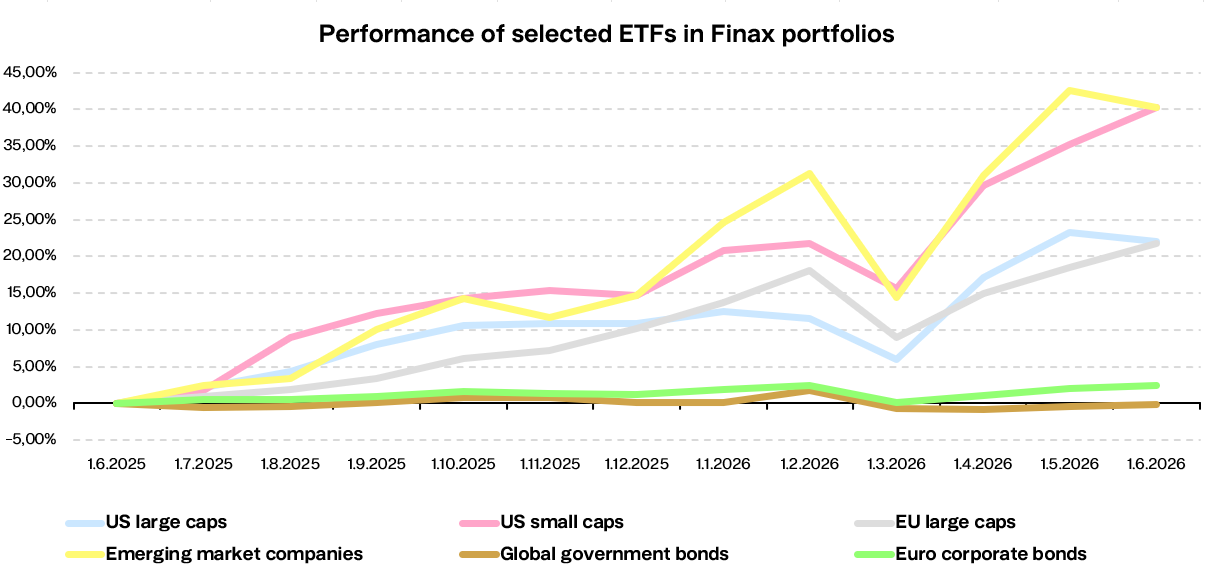
The second observation is that, after quite some time, we could see the value of international diversification. Among the various ETFs held in our portfolios, the biggest gains came from funds focused on small US companies (tracking the Russell 2000 index) and on emerging-market companies (tracking the MSCI EM index). The prices of both ETFs rose by more than 40% between 30.6.2025 and 30.6.2026.
In previous years these funds lagged behind. That is why we would occasionally get the question from clients as to why we hold them in portfolios at all, and whether it would not be enough to invest only in, say, the S&P 500.
Our answer is always that a portfolio should not be chosen on the basis of past performance, because different periods are dominated by different regions and sectors. Only by holding all of them do you guarantee that each year's winners will be in your portfolio. The past year confirmed that this approach is the right one. At Finax, you benefited from the growth of the companies mentioned above.
The S&P 500 itself gained more than 20%, which is a genuinely decent result for a single year. As I have already mentioned, though, it does not come anywhere near this year's winners.
You can see how selected ETFs from our portfolios performed over the past year in the chart below.
If the overview convinces you that investing with Finax would be the best place for your money to grow, transfer your investments from competing products to us. We will reward you with a discount for a documented transfer. We will apply no portfolio management fee to the first half of the transferred amount for two years. And if what you are looking for is a pension rather than an ordinary investment, read on – the European Pension (PEPP) adds tax relief on contributions on top of a reduced fee.
Notice on the data presented: All figures relating to the performance of Finax portfolios represent the actual after-fee performance achieved by sample portfolios. We have described how we calculate actual performance in the article How we calculate the actual performance of Finax portfolios? Past results are no guarantee of future returns, and your investment may also result in a loss. Find out what risks you take when investing.
Tax notice: The stated performance figures are before potential taxes. Taxation depends on the individual circumstances of each client and may change. Bear in mind the tax laws in your country of residency when calculating the return on Finax portfolios.
How the PEPP Strategies Performed
As always, we have organized the results by the pan-European SRI risk indicator. It can range from 1 to 7, where a higher number means a greater risk of fluctuations and falls in the value of the investment. The PEPP strategies fall into categories 3 and 4, meaning portfolios with a higher share of equities and correspondingly larger swings in value along the way.
We would also point out that the table always shows the return after fees but before potential taxes, as stated in the disclaimers above.
The other Finax strategies also had a strong year. Our fully equity Finax 100/0 portfolio rose by 27% over the year ended 30.6.2026, the mixed strategies in the SRI 3 category returned between 8.7% and 24.4% and the conservative bond portfolios between -0.1% and 5.6%, all net of fees.

Secure a comfortable future and take advantage of the European pension benefits
European Pension (PEPP)
PEPP takes the spotlight. It is the same Finax investing you already know from our classic portfolios: globally diversified ETFs with passive management, only held inside a pension product. In Ireland that makes a considerable difference to how much of your return you actually keep.
Contributions to a PEPP qualify for income tax relief at your marginal rate, so 20% or 40% depending on your income. In practice, €100 put into your pension can cost you €80, or €60 if you pay the higher rate. Relief is subject to the age-related percentage limits and the €115,000 earnings cap, and there is no relief from USC or PRSI. If your employer deducts the contribution under a net pay arrangement, the relief is applied straight away; otherwise you claim it from Revenue.
During the accumulation phase, the growth of your investment inside a PEPP is not taxed. When you retire, the permitted retirement lump sum is treated separately and the remaining withdrawals are taxed as income under the usual Irish pension rules. Tax treatment depends on your individual circumstances and can change, so it is worth checking the current rules on revenue.ie.
A PEPP also travels with you. It is a pan-European product, approved and supervised in Ireland by the Central Bank of Ireland, and if you move to another EU member state you can open a sub-account there and transfer your savings tax-free rather than leaving another dormant pension behind. If you have already worked in two or three countries, this is the practical difference from a purely domestic pension.
On top of the tax relief, we apply a reduced management fee to the PEPP strategies. You are therefore paying less for the same portfolios than in our standard products – and over a pension horizon of twenty or thirty years, a lower fee compounds just as reliably as returns do.
Finax offers three PEPP strategies. They differ in the share of equities, and therefore in expected return and in how much their value fluctuates along the way. Their performance to 30.6.2026 is in the table below. The PEPP portfolios were launched on 27.9.2022, so the figures since launch cover close to four years.
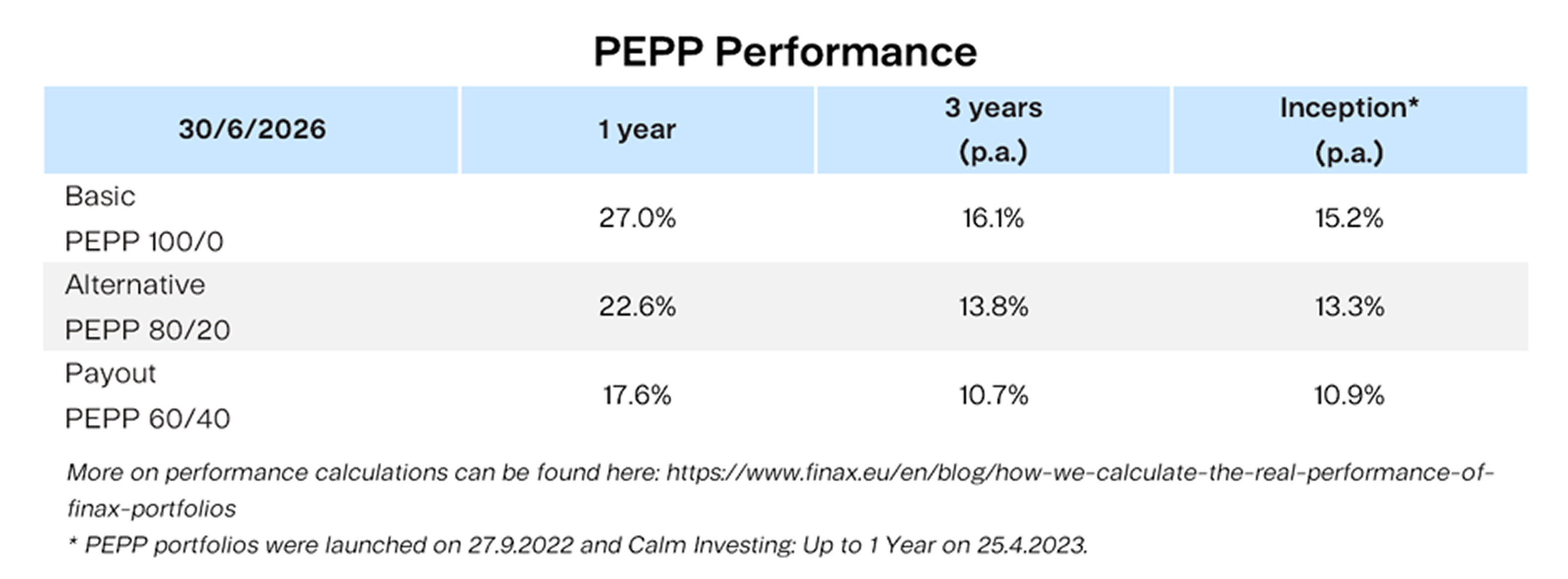
Basic PEPP 100/0, the fully equity strategy, gained 27.0% over the past year and has returned 15.2% a year since inception. It is built for savers with a long horizon to retirement, who have the time to sit out a year like 2022 without it changing anything.
Alternative PEPP 80/20 added 22.6% over the year and 13.3% a year since inception. The fifth of the portfolio held in bonds slightly dampens the swings, at the cost of a slightly lower expected return.
Payout PEPP 60/40 rose by 17.6% over the year and has returned 10.9% a year since inception. With the largest share of bonds, it is intended for the phase when retirement is approaching and you are starting to draw the money down.
The pattern is the familiar one: the more equities a strategy held, the better the past year treated it. Over three years the three strategies have compounded at 16.1%, 13.8% and 10.7% a year respectively. Over a pension horizon, though, the decisive factor is not a single year but the combination of the three things above – the tax relief on contributions, the reduced fee and a portfolio you can leave alone for decades.
The figures above show that Finax's strategies have had a good year. If you find their results attractive, we remind you of our generous discount for transferring your investment from the competition. And if your pension is still waiting to be sorted out, the PEPP with its reduced fee and tax relief on contributions is the simplest place to start – you can set it up online in a few minutes. We wish you relaxed investing without unnecessary stress and worries. Invest and relax.