 Difficulty
Finax builds its portfolios from ten low-cost, accumulating, euro-traded index ETFs covering approximately 75% of world market cap. These are included in multiple portfolios with varying risk levels.
Our core product is called Global investing. This was the first product we launched with eleven portfolios comprising the aforementioned ten ETFs. We have later expanded our offer with Calm investing, a short-term product consisting of two strategies depending on the length of the investment.
When designing a new portfolio, we generally begin by selecting the indices. Below, you can find the ten indices included in the strategies of Global investing. They suffice to create an efficient portfolio with solid returns and broadly diversified risk.
Selected ETFs cover most of the world's key regions, as well as areas of the economy, investing in more than 13,000 individual securities and corresponding to approximately three quarters of the world market capitalization. (The parentheses below contain the index that the ETF tracks).
- US Large Enterprises (S&P 500)
- US Medium Enterprises (S&P 400)
- US Small Enterprises (Russell 2000)
- European Large and Medium Enterprises (Euro Stoxx 600)
- European Small Enterprises (MSCI Europe Small Cap)
- Emerging-Market Enterprises (MSCI EM)
- Global Government Bonds (Citi World Government Bond Developed Markets)
- European Corporate Bonds (Bloomberg Barclays Euro Corporate Bond)
- European High-yield Bonds (iBoxx EUR Liquid High Yield)
- Emerging-Market Bonds (Bloomberg Barclays Emerging Markets Sovereign)
Broadening the portfolio further would be pointless – it would not outperform the current strategies of Global investing and, more importantly, more ETFs would only increase the administrative and transaction costs. In that case, we would not be able to offer one of the cheapest investment solutions on the market.
We also do not consider it appropriate to concentrate investments in specific economic sectors or regions, which are “trendy” at the moment. Our goal was to create a universal solution suitable for every investor, regardless of the amount they’re able to invest. An investment product that is good today and will be equally good and usable in 10 years as well.
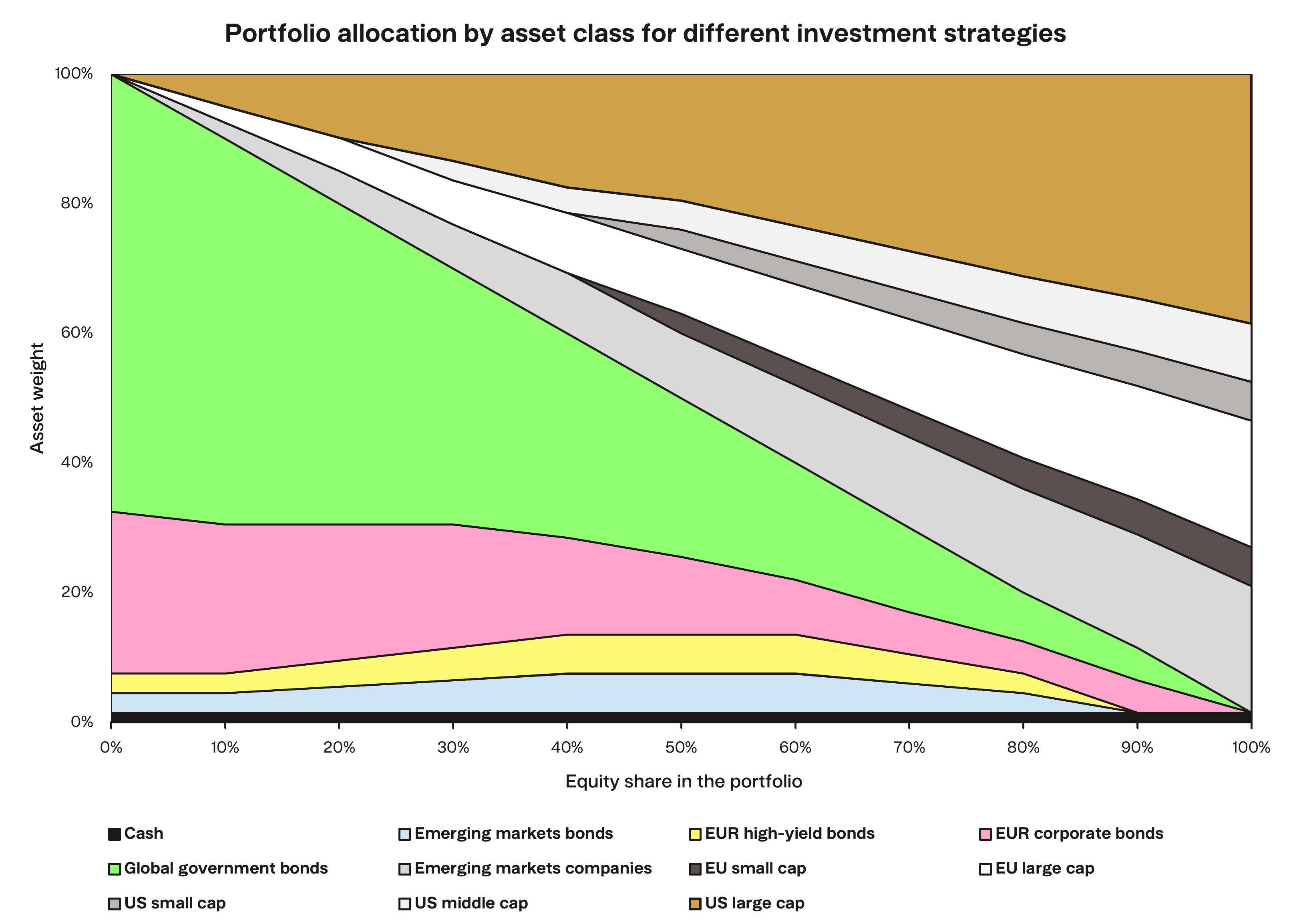
The proportions of individual asset classes in Finax's Global investing portfolios were determined by their share in the global market capitalization. Furthermore, the composition is adjusted to produce a lucrative yield with risk minimized to the greatest possible extent. The following graph illustrates the share of individual ETFs in the 11 strategies.
The portfolios contain safer, conservative investments in the form of government bonds, secure investments in the form of the largest multinationals, but also the icing on the cake in the form of shares of young companies, stocks and bonds of emerging countries, or high-yield bonds.
Calm investing strategies use different indices. Since they’re supposed to be low risk solutions, it was crucial to include short-term debt instruments with low probability of defaulting, as their prices are much more stable than those of other asset classes. For the strategy up to 3 years, we chose the following asset classes:
- Overnight deposits
- Government bonds with maturities of 1-3 years
- Corporate bonds with maturities of 1-5 years
The strategy up to 1 year contains the following asset classes:
- Overnight deposits
- Government bonds with maturities of 0-6 months
- Corporate bonds with maturities of up to 1 year
How Finax Chooses Its ETFs: Our 5 Criteria
There are currently around 17,000 ETFs in the world, with tens to hundreds of options available for some indices, such as the S&P 500. So, what were the aspects we considered when picking and choosing the individual funds?
Currency
The first clear-cut factor was the currency in which the ETF is traded. Since the right investment should be as simple and cheap as possible, we have avoided funds that would require the conversion of client money into different currencies. Foreign currency purchases of assets would increase administrative difficulties, create room for error, and increase costs.
As a company based in Slovakia, we have thus opted for euro-traded ETFs. For the time being, avoiding conversion does not apply to every client as not every country where we operate uses euro as a currency, e.g. Czechia, Poland, Hungary or Romania.
However, in order to partially overcome this issue, we have launched our first portfolios consisting of ETFs traded in Polish Zloty for our second biggest market.
Dividends
Another important factor was whether the ETF reinvests the dividends. If the fund is “a distributing ETF” it pays out dividends and it will result in a tax liability for the investors, something we want to avoid. Finax purchases accumulating ETFs, which do not pay out dividends and they reinvest them in the fund instead – which causes the ETF´s price to increase.
Reliable tracking
A very important factor in selecting specific ETFs was their ability to copy index performance. The term tracking difference indicates the deviation of the fund's development from the underlying index. Optimal is a positive deviation, when ETF outperforms the index, or a situation when the ETF lags behind the index as little as possible.
Replication approach
The fourth factor was the way in which the ETF replicates the index. There are two basic types of replication: physical and synthetic. Physical replication means that the fund is actually investing in individual shares and bonds of the index.
On the contrary, synthetic replication occurs mainly through financial derivatives. In most cases, we prefer direct physical replication over using derivatives, as the latter involve the extra risk that the issuers of derivatives will fail to repay their liabilities to the fund in the event of bankruptcy. This risk is substantially mitigated by legal requirements to secure derivatives by pledging high-quality assets. However, we still consider physical replication to be slightly safer.
For overnight deposits included in Calm investing strategies, however, physical replication is not possible. These ETFs essentially replicate the central bank’s deposit rate, which is not an asset you can directly invest in. Hence, derivatives must be used to replicate the interest rate. This is the only asset class in our portfolios where we use synthetic replication.
Fund Management
The fifth criterion was the fund issuer. We prefer investing through funds of reputable managers who have been on the market for decades and manage substantial amounts of money. In addition to higher security, the size of the fund itself is also a benefit.
The whole world in your portfolio – simple and cost-effective ETF investing
Only large funds will survive for a long time and more of their shares are traded daily – they have higher liquidity, i.e. finding a counterparty for a trade is no problem, even under non-standard market conditions. For large funds, the market price corresponds exactly to the net asset value of the fund.
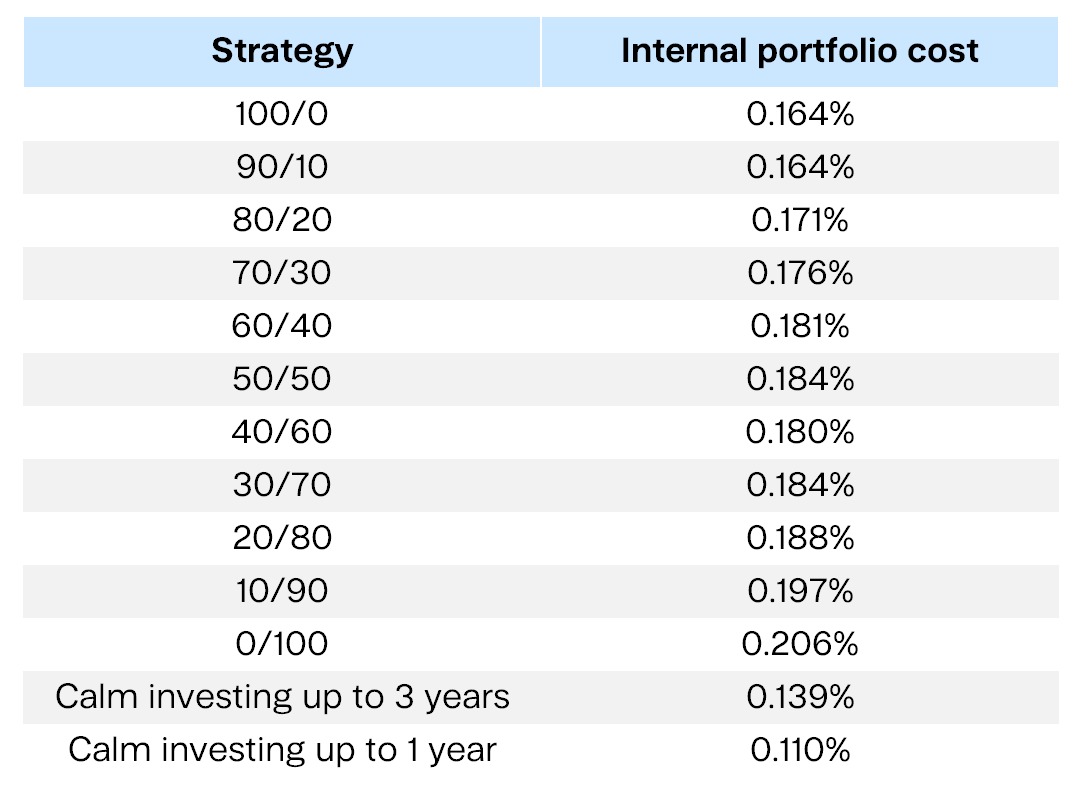
Almost every ETF has its internal fee which the investor pays directly to the administrator. The investor usually does not see it – the fee automatically lowers the ETF's price. Nowadays, these fees are relatively low, but they have also mattered in our selection. However, we did not necessarily choose the cheapest possible funds – the factors affecting security and stability were more important to us than a 0.05% difference in fees.
 Of course, the selection of individual funds is not indefinite. The ETF pool is growing and changing from month to month.
In any case, we will continue to work to ensure that our clients invest in the best possible funds and the changes made will always be to the benefit of the client.
Frequently asked questions
1. Which ETFs does Finax invest in?
Finax Global investing portfolios are built from ten core, broadly diversified index ETFs that together track more than 13,000 securities across the world’s main regions and sectors, from the S&P 500 to emerging-market bonds. We deliberately keep the pool tight, so your portfolio stays cheap, efficient and easy to understand. You can see the full list and the exact allocation for each risk level on our product page.
2. Are Finax ETFs accumulating or distributing?
We only buy accumulating ETFs, which reinvest dividends inside the fund instead of paying them out. This keeps your money compounding and avoids an unnecessary taxable event, which is especially useful for Irish investors. For the bigger picture on how tax and other risks affect your returns, read what risks are involved in investing.
3. Can I hold these ETFs in a tax-efficient pension in Ireland?
Yes. In Ireland, ETFs held in an ordinary account fall under the exit-tax and deemed-disposal regime, but the same globally diversified index ETFs held inside a pension grow free of that treatment. Finax offers the PEPP (Pan-European Personal Pension), which wraps these ETFs in a tax-efficient, PRSA-comparable pension. To see how our low-cost, passive approach works from end to end, read how investing with Finax works.

Secure a comfortable future and take advantage of the European pension benefits
Have you ever wondered why your portfolio is the way it is? See how Finax selects the ETFs for its investment strategies and find out.