 Difficulty
Tech pushed the market higher in September. In October, investors became more cautious and diversified into other sectors as well.
Rising interest rates were among the reasons why a growing number of investors began to ask whether tech stock prices are justified. Central banks in the US, the EU and Japan raised rates in September, with Canada and India following in October.
When borrowing is more expensive, investors look more closely at whether the billions poured into artificial intelligence will actually pay off for companies. Several tech giants also reported results below expectations, which sent their shares lower.
A good example is CoreWeave, an AI computing provider that owes almost $50 billion and lost a fifth of its value in a single day.
The US S&P 500 index fell by 0.9% in October. For our investors, however, the index delivered a gain of 0.25% thanks to the dollar strengthening against the euro. Because US stocks are traded in dollars, a stronger dollar brings a gain for our euro investors.
South Korea felt the caution the most: its chip-heavy KOSPI index fell by 16% in October.
Despite the October decline, investors are not panicking. Earnings growth of companies in the S&P 500 index remains exceptionally strong. We therefore see the October correction as a healthy reset of expectations, letting investors buy the largest companies at better prices than a few months ago.
However, the International Monetary Fund warned that the end of the AI investment boom could threaten both economic growth and financial stability. That is another reason why it does not pay to bet everything on a single sector.
In October, bonds fulfilled their traditional role as portfolio stabilizers. Most Finax investors use them as a complement to smooth out portfolio swings, or for short-term investments.
At the start of the month, government bond yields were at multi-decade highs. Since yields move opposite to prices, bonds were cheap and attractive to new investors.
But when the sell-off in AI stocks came, some investors moved into the safety of government bonds, pushing their prices up and their yields down. For example, the yield on the 10-year US Treasury fell from 5.29% to 4.94%.
How can bonds protect a portfolio? Imagine a portfolio worth €10,000. If it is entirely in stocks and they fall by 10%, you lose €1,000. If it has 60% in stocks and 40% in bonds that rise by 1%, the loss shrinks to €560. So bonds will not stop a decline, but they significantly cushion it.
In exchange for more stable prices, bonds have historically delivered lower returns than stocks. That is why they suit mainly shorter-term goals or investors who could not handle high volatility. For horizons of at least 10 years, stocks are the better choice.
Three risks continue to hang over the market:
- The first is expensive energy. Oil from the Persian Gulf is flowing again, albeit on the black market, but refinery outages in the Middle East and Russia are causing a diesel shortage. As a result, Brent crude climbed back above $100 a barrel.
- The second is France. The country was swept by protests against the high cost of living. However, the government has no room to spend more: France has not had a balanced budget since 1974, and the yield on its 10-year bond briefly exceeded 5%, the highest in 24 years. Fears of a new eurozone crisis are overblown for now.
- The third is politics. Elections in Brazil, Israel and Serbia showed that results can differ significantly from polls and that countries can change direction quickly.
Europe was also surprised by the resignation of European Central Bank President Christine Lagarde.
Among the ETFs in our portfolios, the fund of US mid-sized companies S&P 400 Mid gained the most, rising 3.15%. The biggest loser, on the other hand, was the MSCI Emerging Markets fund, down 6.4%.
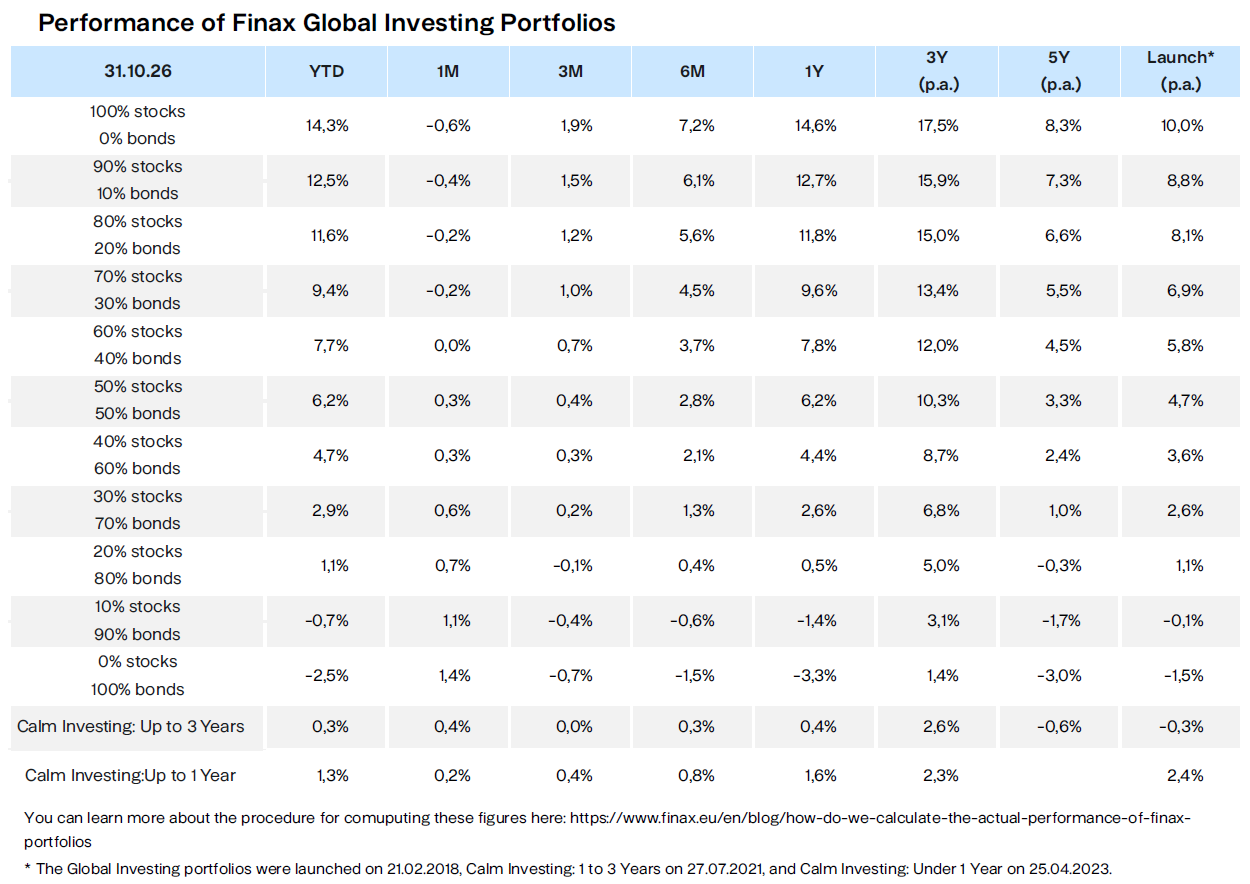
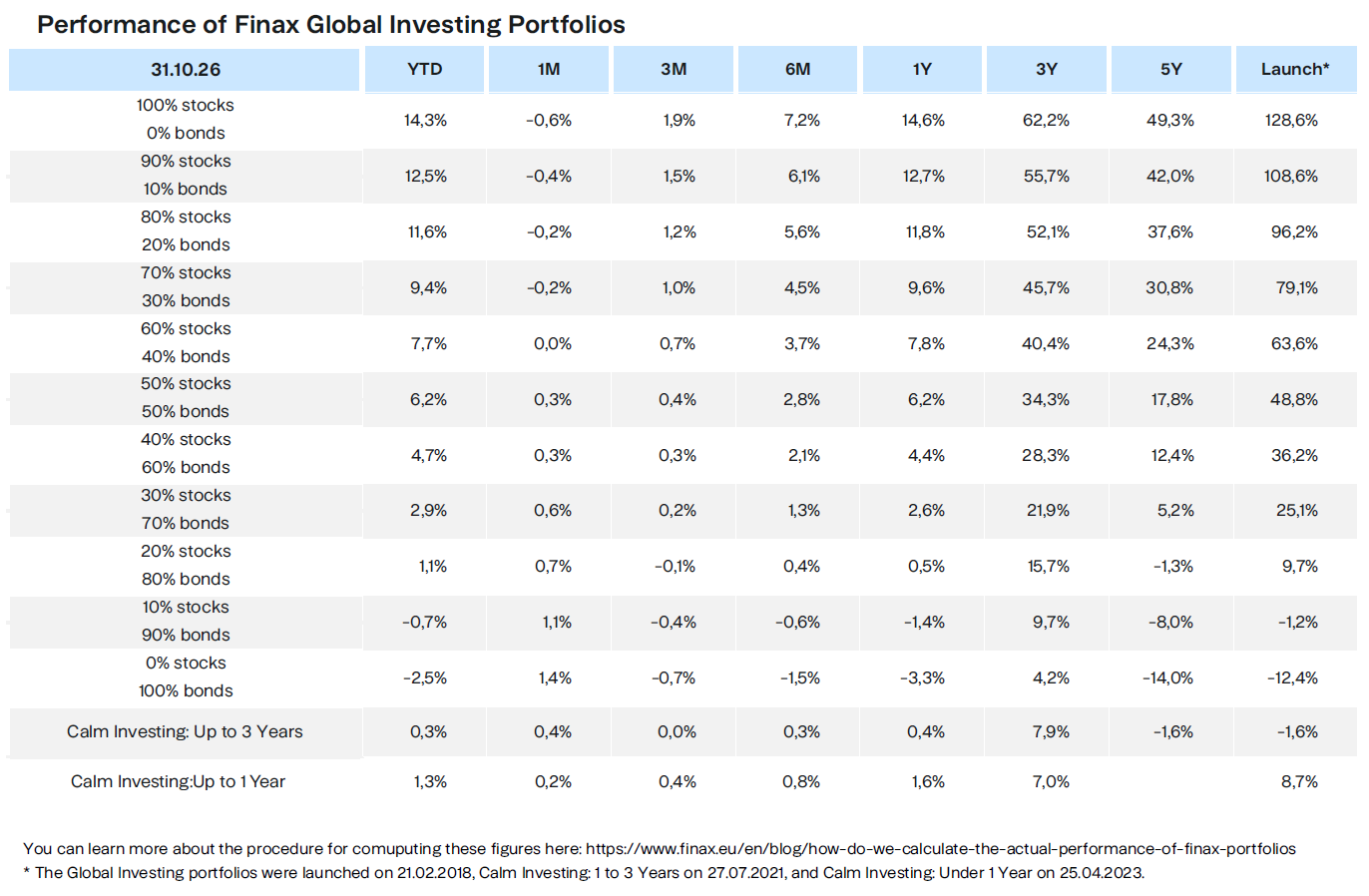
Among our Global Investing strategies, the conservative bond strategy posted the strongest gain, at 1.4%. The dynamic equity strategy fell by 0.6%.
In Calm Investing, the 1 to 3 Years strategy posted a gain of 0.4% and the Under 1 Year strategy 0.2%. As of 31 October 2026, their gross annual yields stood at 2.5% for the Under 1 Year strategy and 3% for the 1 to 3 Years strategy*.
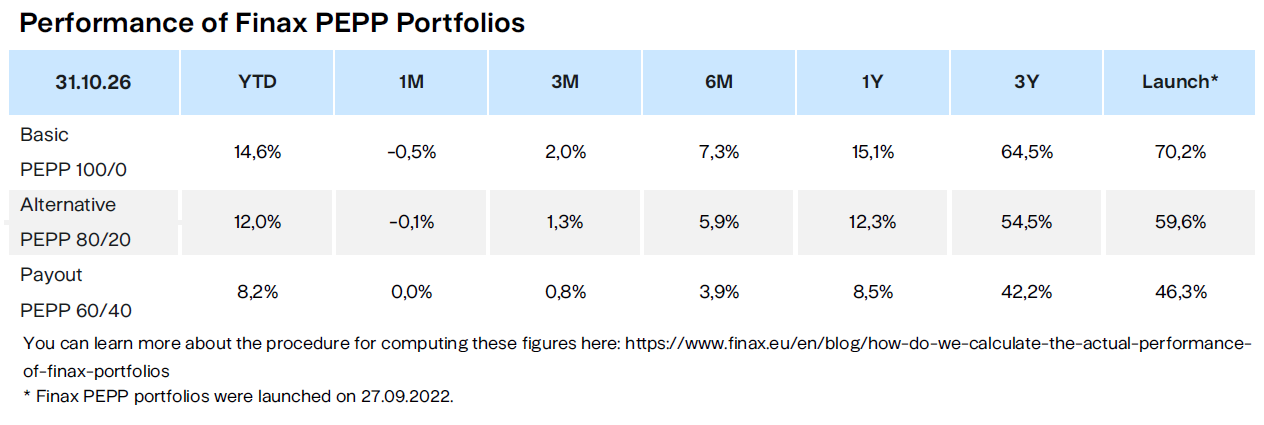
And when it comes to PEPP, our low-cost solution for your retirement, the Basic PEPP 100/0 strategy declined by 0.5% in October, alternative PEPP 80/20 declined by 0.1%, and Payout PEPP 60/40 remained unchanged.
For our Irish investors, Budget 2027 brought good news for savers: from 1 January 2027, the tax rate on gains from funds and life assurance policies will fall from 38% to 35%. On a €10,000 gain in a regular investment account, that means €300 more stays in your pocket. PEPP is even better off: as a pension product, its growth is not taxed in your saving period. At retirement, you can take up to 25% of your savings as a tax-free lump sum, up to a lifetime limit of €200,000. On a €100,000 PEPP, that is €25,000 tax-free. The rest is taxed as regular income, not at the 35% fund rate.
What should we prepare for in November? Markets will be digesting the results of the US midterm elections. The Democratic Party won by a wider margin than expected, which could signal a shift in the political direction of the US for global markets.
What can we take away from October?
- Over short- and medium-term investment horizons, bonds serve as a useful portfolio stabilizer.
- Even the most promising trend will not win forever. That is why we rely on diversification.
- Declines are an opportunity for regular investors. If you invest €200 a month and the price of an ETF falls from €100 to €80, you buy 2.5 units instead of 2, meaning a quarter more for the same money.
*This is the gross yield to maturity as of 31 October 2026, as stated by the ETF providers. It is variable, linked to the ECB's deposit facility rate and interest rates in euro bond markets, and does not include the Finax fee of 0.5%. This yield may change in line with interest rate developments and is not a reliable indicator of future performance.