 Difficulty
The article discusses:
- What "tax relief" actually means
- How PEPP relief compares with My Future Fund's top-up
- How much you can put in
- What happens when you take the money out
- Common questions
What "Tax Relief" Actually Means
Pension tax relief means the money you put into a pension isn't taxed as income. In practice, you deduct your PEPP contribution from the income Revenue taxes, so your income tax bill falls by your top rate of tax: 20% or 40%.
For the 2026 tax year, a single person pays 20% on income up to €44,000 and 40% on the rest. (Budget 2027 raises the 20% band to €46,500 from 1 January 2027.) Relief is given at the rate you'd otherwise have paid on that slice of income, so if a contribution takes part of your income below the 40% threshold, that part is relieved at 20%.
The tax you save is yours: you can keep it, or put it back into your pension, where it works a bit like a top-up on your own contribution. You claim relief from Revenue; self-employed people usually do this through their annual tax return. Two things to keep in mind: relief applies to income tax only, not to USC or PRSI, and it comes with limits, which we cover below.
Say you're a higher-rate (40%) taxpayer and you put €500 into a PEPP: you get €200 back in tax, so the contribution really costs you €300.
PEPP Tax Relief vs My Future Fund's State Top-Up
My Future Fund works differently. There's no income tax relief on your contribution; instead, the State adds €1 for every €3 you put in, worth about 25%, whatever your tax band. Employees also get a matching contribution from their employer, up to €80,000 of salary, which a PEPP doesn't guarantee.
Which gives you more depends on your tax rate:
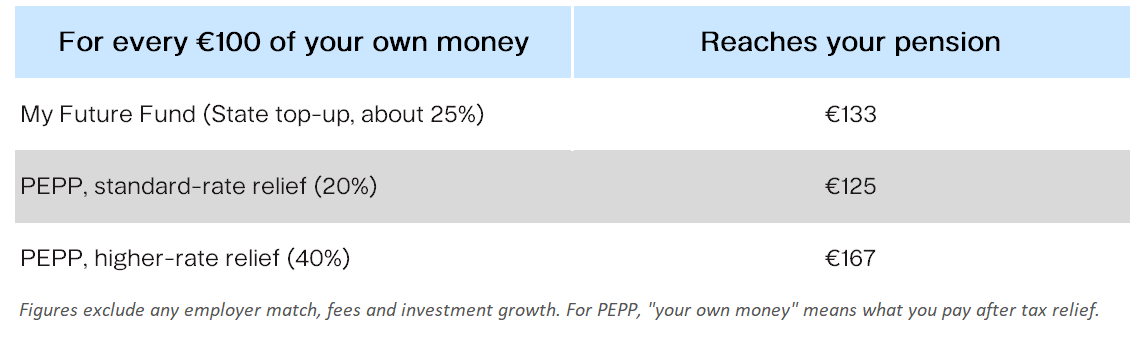
Figures exclude any employer match, fees and investment growth. For PEPP, "your own money" means what you pay after tax relief.
In plain words: at the 20% rate, My Future Fund's top-up puts slightly more into your pension than PEPP relief does. At the 40% rate, PEPP relief puts clearly more in. Add the employer match, and My Future Fund is hard to beat for a PAYE employee on standard-rate pay.
How Much Can You Put Into a PEPP?
The earnings caps differ too: PEPP relief counts earnings up to €115,000 a year, while My Future Fund matches contributions on earnings up to €80,000.
Within the PEPP cap, the share of your earnings that can be relieved rises with age:
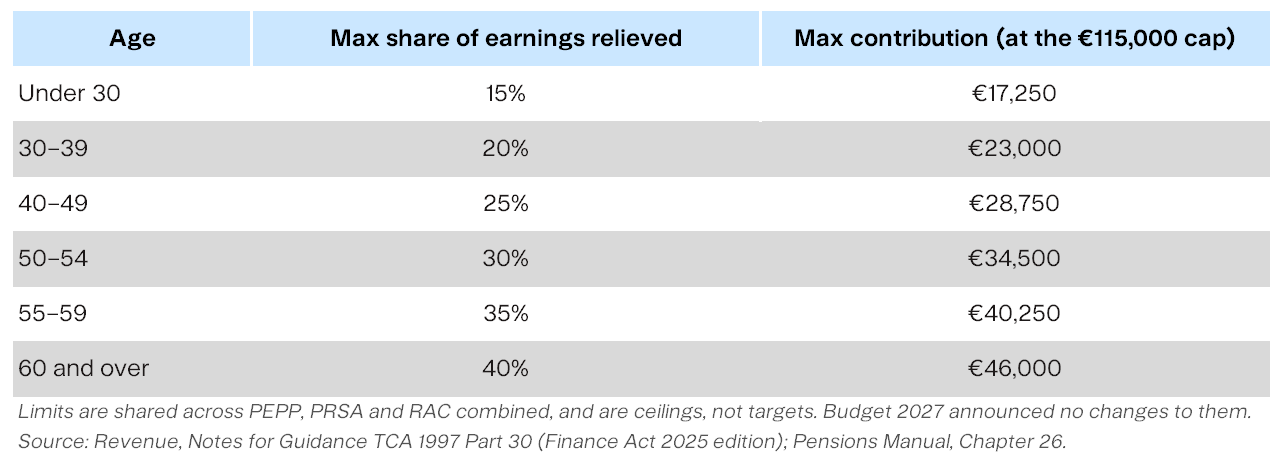
These limits are shared across PEPP, PRSA and RAC combined rather than applied to each, and they're ceilings, not targets. Most people contribute far less. Budget 2027 announced no changes to them.
Here are two worked examples:
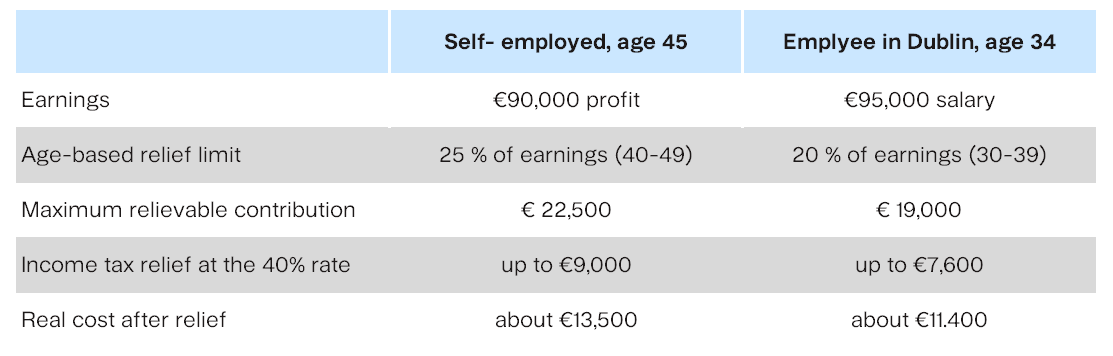
In plain words: the self-employed 45-year-old puts €22,500 into a PEPP for about €13,500, and the 34-year-old employee puts in €19,000 for about €11,400. Tax relief covers the rest. Both examples assume a single person in 2026, with all of the contribution relieved at 40% and no other pension contributions using up the limit. These are illustrations, not real clients.
What Happens When You Take the Money Out of a PEPP?
PEPP isn't tax-free, and it's worth being clear on that. Relief comes on the way in, and investment returns inside a PEPP are generally not subject to Irish income tax while you're saving. At retirement, 25% of the fund can be taken as a lump sum, but the tax-free treatment is capped, not unlimited:
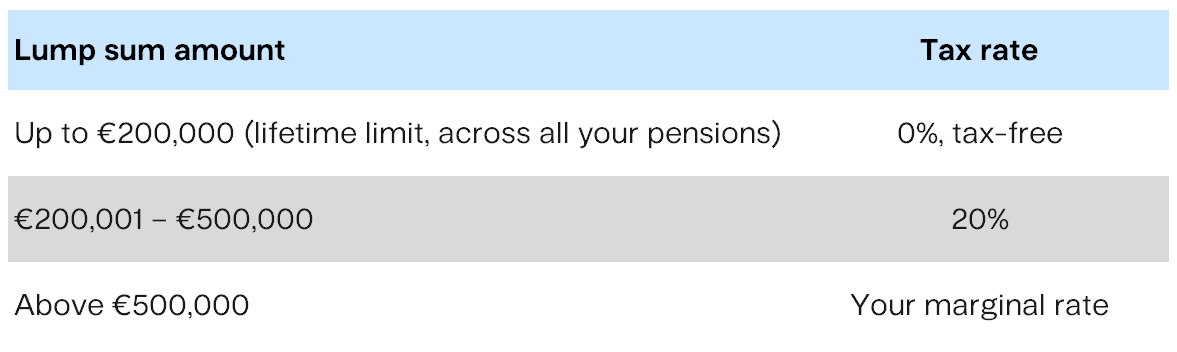
The rest of the fund, once you're past the lump sum, is taxed as income when you draw it down. If part of your savings sits in a subaccount in another EU country, drawing it is taxable in Ireland as a foreign pension if you're resident in Ireland at that point, subject to double taxation agreements. Some people find they're taxed at a lower rate in retirement than when they received relief, but that depends entirely on your income then, and the exact payout options follow each provider's terms.
Common Questions About PEPP Tax Relief
1. Does pension tax relief reduce my USC or PRSI?
No. It reduces income tax only.
2. Do self-employed profits count as earnings for relief?
Yes. Profits from a trade or profession count as earnings when working out how much you can relieve.
3. How do I claim the relief?
From Revenue. Self-employed people usually do this through their annual tax return.
4. Can I have a PEPP and My Future Fund at the same time?
Yes, if you pay into your PEPP yourself rather than through payroll. If you already pay into a pension through your payroll, you won't be auto-enrolled into My Future Fund for that job. If your PEPP sits outside payroll, you'll still be auto-enrolled if you meet the age and earnings criteria, and you can keep both: the State top-up on one, tax relief on the other. We look at who My Future Fund suits, and who it leaves out, in our article on why My Future Fund isn't for everyone.
5. Is a PEPP better than a PRSA for tax relief?
For tax relief, they're on a par. PEPP contributions get the same income tax relief as PRSA contributions, at 20% or 40%, and the age-related limits above apply to both combined. The difference is portability: a PEPP is an EU-wide product you can keep saving into if you move to another EU country, while a PRSA is an Irish product. Fees and investment options depend on the provider, so compare those too. We put the two side by side in PEPP or PRSA? How to secure your pension.
6. What happens to my pension if I move abroad?
It depends on which one you have. In My Future Fund, contributions stop when you emigrate: your pot stays invested, and you can access it at State Pension age (66). With a PEPP, you can keep paying into your Irish subaccount, or open a new subaccount in your new country if your provider offers one there. Each subaccount follows the tax rules of its own country, so check how your Irish tax relief is affected before you move. Read more in European Pension Plan Portability.
PEPP or My Future Fund: Where This Leaves You
If you're a PAYE employee on standard-rate pay, My Future Fund's employer match and State top-up are hard to beat. If you're self-employed, in the 40% band, or your work crosses borders, PEPP is the one that fits, and the tax relief is a real part of why.
Not sure how this applies to you? Book a free call with us, or open a PEPP account in about 10 minutes.

Secure a comfortable future and take advantage of the European pension benefits
Learn more: