 Difficulty
Let’s face it, if you are a human being, you will most likely have that subconscious fear of investing if you haven’t been doing so yet. However, this while this fear is natural, it is rather irrational. The main cause is the fear of a possible loss. These fears stem from the unknown. We naturally try to avoid things that we do not understand because we do not know what we can expect from it and how it would change our lives.
For many, investing is one of these unknowns. The perception of risk is very misleading and incorrect among small investors. We are afraid of things that are do not pose a long-term threat to our investments and, on the contrary, we overlook the factors that actually do.
Only when we understand the risk and account for it, we can successfully appreciate our assets and stop having nightmares. Risk is not a reason not to invest. Despite risk, investing is the best and easiest way to grow wealth. The numbers don't lie.
So, let's examine risk a little more in-depth. What is it, and what are the real risks that are involved in investing? Hearing about high yields you can achieve by investing in ETFs is great, but understanding the risks undertaken is crucial for a good night's sleep. And while any long-term ETF investment is a step in the right direction, the best investment you can make is in your own future. For Irish investors, PEPP (Pan-European Personal Pension Product) from Finax does exactly that - it builds your retirement wealth through ETFs in a tax-efficient way with PRSA-equivalent tax relief, avoiding the unfavourable ETF tax treatment in Ireland.

Secure a comfortable future and take advantage of the European pension benefits
Risk is nothing exceptional, nor should it be perceived as a threat. It is a natural price for higher yields. Risk is an integral part of investing, and every investor must learn to live with it.
Yields and risk are best friends, they go hand in hand, and their relationship has never been broken in a fundamental or in a long-term way. If you want to appreciate your assets you have to take risks. If you are not willing to take risks, your returns will remain low and inflation will decrease the value of your financial assets.
Money doesn’t grow on trees and there is no such thing as a free lunch in the real world. Investments must earn revenue by capitalizing on underlying business earnings. Every business brings some form of uncertainty.
Investment managers are not magicians who can conjure up returns. Profits must come from something, interest must be paid from something, and it is usually only from the turnover of the company, its income, i.e. the sale of goods or services. Always bear this in mind when considering any investment.
Risks shouldn’t be feared and must be seen as a concession for long-term above-average profits. Risk can be managed. There are ways to reduce it by employing the fundamental principles of investing. If you follow these rules the investment risk is then out of the question.
Risk is generally defined as the uncertainty of the achievement of your investment goals. In other words, it is the likelihood of an undesired outcome of an investment.
Every proper investment process begins with the definition of an investment goal. This may sound amusing, but it will help you avoid disappointment later on. Every goal, including the investment one, is achievable in several ways, but every one of those ways carries a certain amount of risk, i.e. a different probability of reaching the target.
The first and one of the most important risk management methods that should be used even before getting started with investing, is choosing the right portfolio composition. Investments should adapt to the goal, its parameters, conditions and the nature of the investor such as the investment horizon, financial situation, expected returns and risk tolerance.
Based on these factors, the investor chooses the right composition of the investment (allocation), i.e. the proportion of different classes of assets carrying different returns and risk. In general, bonds are a safer investment with less price fluctuations, but also with lower long-term returns, and equities are a more volatile investment with higher long-term returns.
Of course, an investor must ensure to remain grounded and keep their expectations realistic and achievable. The probability of meeting the investment goal should be as high as possible when the right portfolio composition is chosen, i.e. risk is kept as low as possible.

Create an account and start investing today
Risk-free investments in the financial world are considered to be government bonds of developed countries, especially the USA, Japan and Germany. Bank deposits for individuals up to 100 thousand euros can be equally considered risk-free investments as they are insured by the Deposit Guarantee Scheme, i.e. the state.
However, yields also correspond to low risk. German 10-year government bonds offer a 3.06% annual yield as of May 2026, i.e. how much the largest European economy pays its lenders for borrowing money from them. To put that into perspective, the annual expected inflation in the Eurozone for April 2026 is 3%. So, in reality, you would have earned only 0.06% on your investment.
Deposits in banks today offer practically zero interest, thus making you effectively lose money due to inflation.
If your target is to at least outperform inflation with the return, you have no choice but to take on risk. In general, any return above the risk-free investment level carries some degree of risk.
We divide investment risks into two main groups:
- Non-systemic risks (specific)
- Systemic risks (market)
Specific risks
This category includes the individual subjective risks related to a particular security and its issuer (issuer - company or state). It is specifically related to the business to which you lend money through the purchase of a bond or in which you invest directly by buying its shares. Here we also include the risks inherent to the investor themselves or their investment manager.
Risk of business is the most common risk of an individual security. This may be any event or reason that will hinder the company’s expected economic results or when its value falls.
Example of this are low quality of products or services, low demand for them, high expenses, weak market share, industry development, company management, bad accounting, bad business strategy, failure to achieve plans, scandals, violations of law, lack of innovation and anything else that lowers the company earnings, profitability or leads to the sale of shares by investors and decline in value of the company.
A certain subset of risk of a business is credit risk that is only applicable to bonds and other debt securities such as bills of exchange, certificates and others. Credit risk is the probability that the entire principal of the bond or that the bond coupon interest will not be paid out.
The causes of non-payment correspond to the risks of business. Every debtor borrows money in order to finance a business, from which they must inevitably return the deposited funds and, in addition, the agreed interest. If they fail, credit risk is realized.
The most efficient method of minimizing or even eliminating the risk of business is diversification, that means distributing your investment among a large amount of various securities.
The risk of business can also be eliminated by thorough and fundamental investment analysis and the application of an efficient investment strategy, but as history and experience show, their effect is not sufficient and carries other specific risks.
These are human risks and investment strategy risks. Although most of us deny it, we are mainly driven by our emotions, which also happen to be the biggest enemy of investing and high returns. We think that our decision-making is rational, but it is primarily controlled by the psyche.
Human decisions are often prone to error due to our feelings, which ultimately leads to weaker long-term performance of actively managed investments.
However, even professional investment managers are also prone to these errors. This is perhaps the most underestimated and at the same time the most significant investment risk.
The solution to the risk of business or similar specific risk may be a specific investment strategy to which the investor adheres to. However, no strategy is universal and each one works under certain conditions, but lags behind or brings greater risk in others.
The most efficient way to eliminate the risk of human decision-making is a passive approach to investment, i.e. investing in the entire market without actively selecting securities or trying to buy and sell investments at the right time.
Systemic risks (the market)
This is an objective, general risk arising from the development of society, stock markets and the economy. It is not in the power of the investor to influence it significantly. Economic cycles, i.e. alternation of expansion and correction, are natural.
Systemic risks can include general market sentiment affecting index movements, macroeconomic developments, as well as political risks (currency and fiscal levels). Some more specific risks are currency, inflation and interest rate risks.
Market risks are completely natural and unavoidable at the same time. The funny thing is, that they are the least harmful risks to your investment as long as you follow the basic principles of investing, yet most of us are mainly concerned about them specifically.
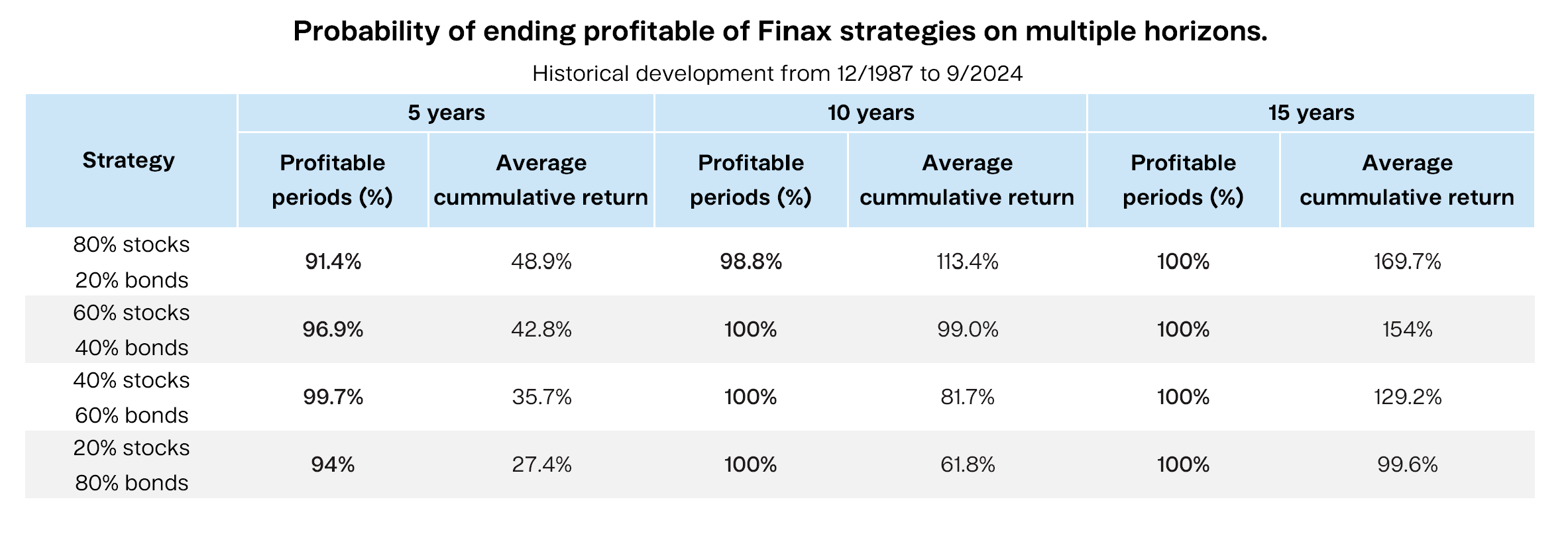
Market risks are always taken care of by time. This risk decreases to zero as the investment horizon increases. Financial markets have always recovered from every recession and have always reached new highs. Sufficient time is fundamental and most important condition for a successful investment.
As Pavel Škriniar from the University of Economics in Bratislava says: “Investing is like baking a cake. You will not take it out of the oven after 5 minutes and eat the cake unfinished. You also have to be patient with the investments and let them be in an oven for the time required, not eating them before the horizon."
The constant changes in the value of the investment are what causes the anxiety. We are worried about a possible price drop of securities that we hold. Nevertheless, you are fully flexible when it comes to trading with them. You can always react quickly to a change in your life situation, or you can change the investment itself.
At any time, you can sell or even buy an additional investment, and you can be certain that it is fairly valued at any moment by a huge number of market participants. Because of this you always know how the market perceives your investment.
Many, on the other hand, subconsciously and erroneously prefer non-volatile investments, such as private bond issues. But which investment carries more risk? Investing in the 7,000 largest global companies with trillion euros worth of turnovers worldwide, or lending money to a local apartment building company with limited capital and zero assets?
The 7,000 biggest companies will not disappear from the world map. With a sufficiently diversified investment, you can never lose everything and the decline in value is always temporary. But once the company you lent money to goes bankrupt and doesn't pay the bond principal back, no one will be able to retrieve the money lost. So, what is a riskier investment?
Another useful market risk management tool is the right allocation (portfolio composition) already mentioned at the beginning. Unless I am willing to bear the risk and cope with the fluctuations of the investment, I cannot expect high returns. Similarly, if I am not able to give the investment sufficient time, I cannot invest dynamically.
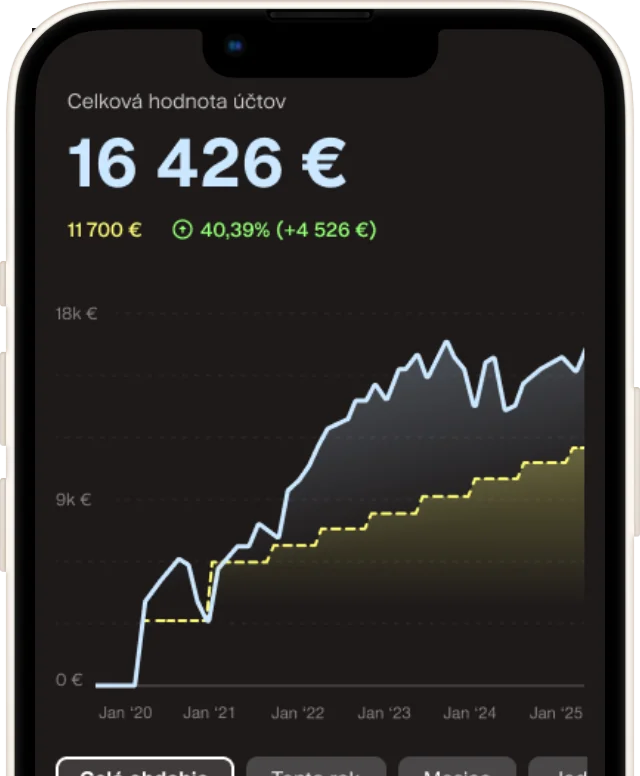
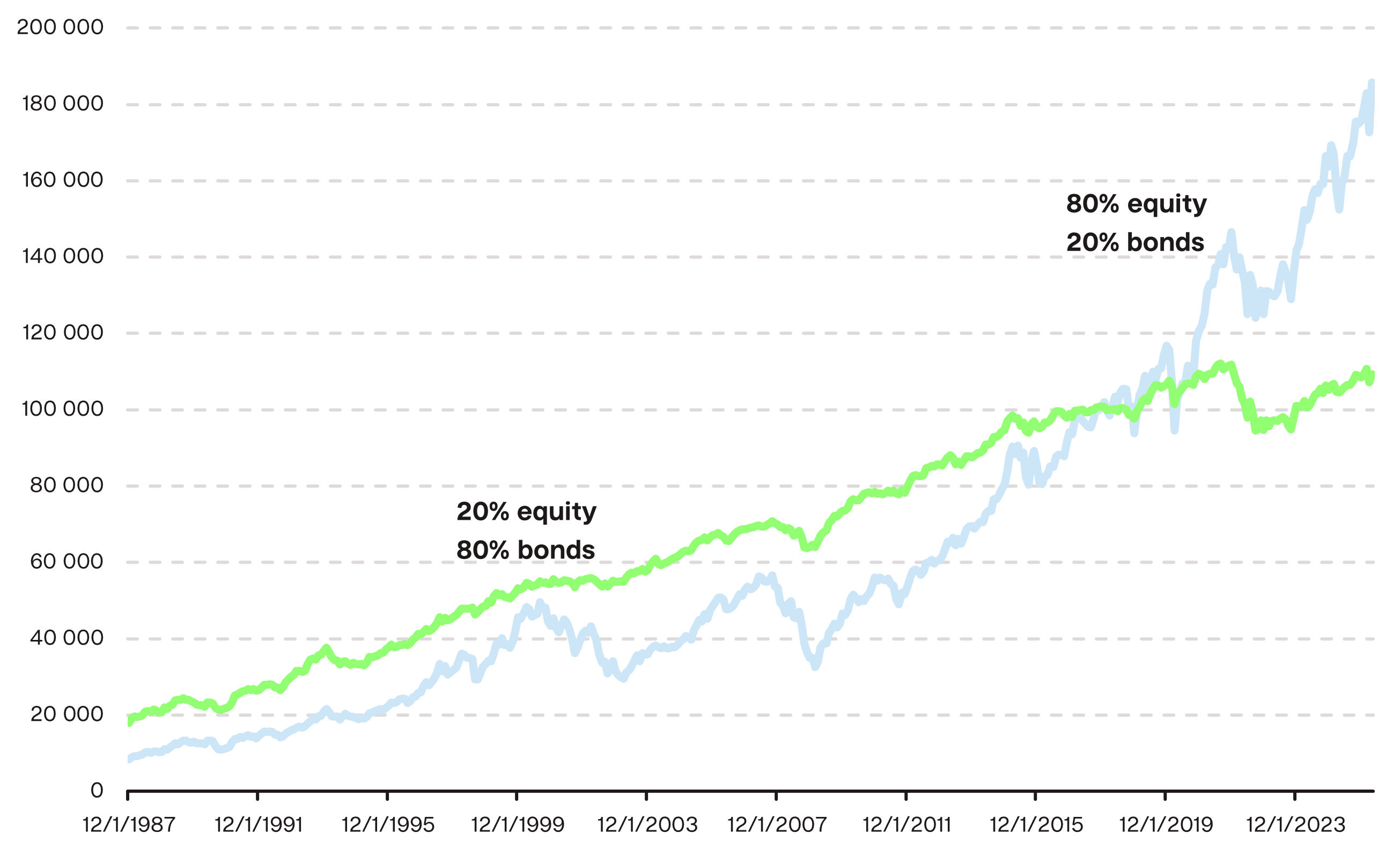
But these are no reasons not to invest. We can invest with different risks. Portfolios with a higher proportion of bonds are suitable for shorter periods and for more cautious investors because they have significantly lower value volatility. This can be seen in the following graph.
It is also advisable to deal with market risk by investing regularly, because of this the purchase prices will average out in time. As a result, we buy more shares and increase our financial assets.
Other market risks such as currency, political and interest rate risk are effectively eliminated again by sufficient diversification.
What risks do you take on with Finax?
When we founded Finax, we’ve already had plenty of experience in investments and financial markets. When designing our product we haven’t turned our back on risk, since it is an integral part of investing.
Our portfolios have been designed with great emphasis on minimizing most risks:
- Risk of business and credit risk are virtually zero – We offer a broadly diversified portfolio, containing over 13 thousand equities and bonds from all over the world and areas of the economy.
- Passive investing, a philosophy Finax is established on, completely removes any human and investment strategy risks.
- Broad diversification means we purchase securities from 92 countries on all continents significantly reducing political and currency risks;
- You do not have to worry about choosing the right allocation based on your goals, risk profile or horizon - our platform will select the appropriate risk-based portfolio that will suit your goals.
- Invest monthly starting at just €10 – all you have to do is to set up a standing order.
- The only risk left is the market risk that can be eliminated by investing in the long run.
- Then all you have to deal with yourself is to correctly assess your life situation, your plans, expectations and your character, give at least part of your savings enough time to work, maintain discipline and not succumb to emotions prematurely.
The ideal investment achieves maximum yield with minimal risk. We hold the opinion that in this regard we are among the best.
Create an account and start investing today
In the upcoming months, we will continue to publish more articles and webinars about the proper setup and management of personal finances, investment plans, as well as the risks of various types of investments.
If you want to invest with minimal risk and get the most out of it, move your investments to Finax and get a discount - 50% of the value of the transferred investment will be managed for 2 years free of charge.
Frequently Asked Questions About Investment Risk
1. What is the biggest risk when investing?
Ironically, not investing at all. Keeping money in cash means inflation silently erodes its value every year. Market risk - the fear most people focus on — is temporary and has been overcome after every downturn in history.
2. Can I lose all my money investing with Finax?
No. Finax invests across over 13,000 equities and bonds from 92 countries. With that level of diversification, a total loss is not possible a temporary decline in value is, but it has always recovered over a sufficient time horizon.
3. How can I reduce investment risk?
Three tools: diversification, time and the right allocation. Spreading investments across thousands of securities eliminates company-specific risk. A long enough time horizon eliminates market risk. Choosing a portfolio that matches your goals and risk tolerance keeps everything manageable from day one.
4. What is the lowest-risk way to invest for the long term in Ireland?
The longer your money stays invested, the more time it has to grow and recover from any short-term market drops. That is why investing for retirement is one of the most risk-efficient strategies available — your money has decades to compound. For Irish investors, PEPP from Finax is built exactly around this principle. It combines long-term ETF investing with PRSA-equivalent tax relief, meaning lower risk through time and better returns through tax efficiency.