 Difficulty
Statistics show, that an average person living in Ireland is expected to live 82.9 years. With the standard retirement age of 65-66 years, you can expect to spend approximately 18 to 19 years in retirement.
This means that most of us will get to enjoy almost two decades in retirement, underscoring the importance of timely planning for our future pensions. The amount of income we’ll be able to draw after retiring greatly depends on the savings accumulated over the course of our working lives.
At Finax, we place a lot of importance on pension planning. Our typical clients fall between the ages of 30 and 40. Therefore, in this blog post, we will explore what their pensions could look like if they begin saving in their thirties or forties.
The Sooner the Better
According to the European Commission, the Irish can expect to receive roughly 35% of the average gross salary via state pension. Considering that the Irish pension system is quite stable and with the decreasing working population, this is unlikely to change in the future. This means that people who are currently in their 30s can expect to receive no more than a third of their working-age salaries from the state once they retire.
These figures mean that it will be difficult to maintain the standard of living you were used to before retiring from the state pension alone. While you will likely be able to cover the basic needs from this income, you will need some extra funds to secure a higher degree of comfort. I don’t think any of us want to be unable to treat our grandchildren to an ice cream or a day at the zoo.
Former U.S. President Thomas Jefferson once said, "do not leave for tomorrow what you can do today." Therefore, it's crucial to begin retirement preparations early to secure additional income sources.

Secure a comfortable future and take advantage of the European pension benefits
In the realm of investing, the power of compound interest can generate unbelievable results, particularly when given ample time to grow. This mechanism essentially means that investments grow faster and faster over time, like a snowball that takes on more and more snow as it rolls downhill. Let’s break down the exact numbers this can bring you in the following sections.
New Trends
However, the future isn't all bleak. There's a noticeable shift in awareness about the importance of taking the future into our own hands. Unlike our parents' generation, we are fortunate to have a plethora of retirement savings options at our disposal, thanks to technological advancements, globalization, and the easy access to information. Today, you can kickstart your retirement journey for a better tomorrow in just 10 minutes.
However, the pension landscape across the EU still isn’t ideal. This prompted the European Union to act and introduce the Pan-European Personal Pension Product (PEPP) as a competitor to existing options, aiming to address some of the gaps present in the current offering (such as low returns, high fees, or a lack of transferability across member states).
Finax has proudly emerged as the first PEPP provider in Europe with its European pension product. You can read about the great results these portfolios delivered last year by scrolling towards the end of this blog.
Beginning in the 30s
Now that we've outlined the pressing need to address the current pension challenges, let's delve into practical solutions. Let’s assume that the average gross pay in Ireland is €4,000 a month and that the average state pension is equal to 35% of that, so €1,400.
The reason why we are using gross instead of take-at-home pay is actually quite simple – The aforementioned 35% figure is stated in terms of gross income and because pension income is taxed just like ordinary income. Therefore, operating with net income in the calculation, would produce skewed results.
Nonetheless, we need a clear plan on how much to save and invest to support a comfortable lifestyle over 20 years of retirement.
In investing, longer horizons mitigate risks, allowing for more dynamic strategies, primarily investing in stocks. Research, empirical evidence, and Finax's strategy testing consistently confirm that allocating 100% of your portfolio to stocks during the savings phase and at least 60% during the payout phase is the best solution. Hence the composition of the European pension portfolios.
It's crucial to consider that during the savings phase, while incomes increase, inflation chips away a portion of their value. Additionally, individual preferences vary – some require more, others less, to sustain their lifestyle. We will assume our savers want to maintain the same income they were used to receiving before retiring.
First, we have to take inflation into account. For simplicity, let’s assume that the average inflation until our savers’ retirement will be 2.5 % per year. We will further assume that both the average salary and the average pension will increase at a pace matching this inflation during the period before retirement.
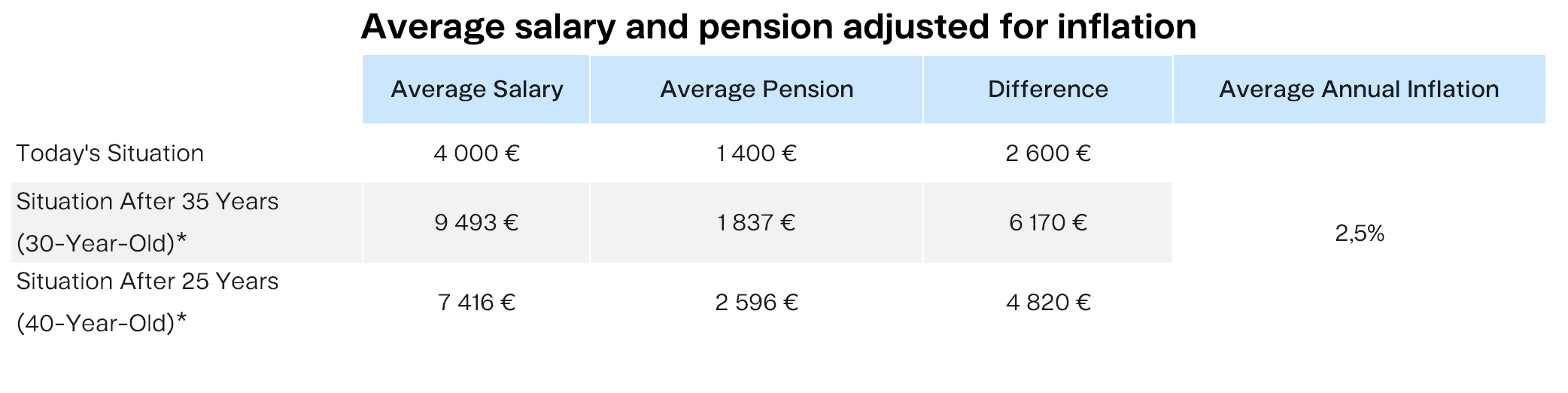
*Due to inflation, we will need more money to buy the same purchase, that is, if we adjust the future value by expected inflation, the future amount corresponds to today's value.
In this scenario, let's consider a saver who invests in a 100% stock portfolio until retiring at 65. At the age of 65, the portfolio will have a 60:40 allocation (equities: bond ETF funds) during the payout phase, maintaining this ratio for the next 20 years.
During the saving phase, the assumed annual return for the 100 % ETF stock portfolio is 7.95 %. For the payout phase with the 60:40 strategy, the return used in the calculation is 5.97 %.
Note: All data related to the historical development of Finax portfolios are modelled and were created based on data backtesting. We have described the method behind these simulations in this text: How do we model the historical development of Finax portfolios? Past performance is no guarantee of future returns, and your investment may result in a loss. Inform yourself about the risks involved in investing.

If you're 30 years old, you have 35 years until retirement. Over this time, the difference between the average pension and salary would grow to €6,170. This is the amount we will need to draw as a supportive income from our pension savings over the following 20 years.
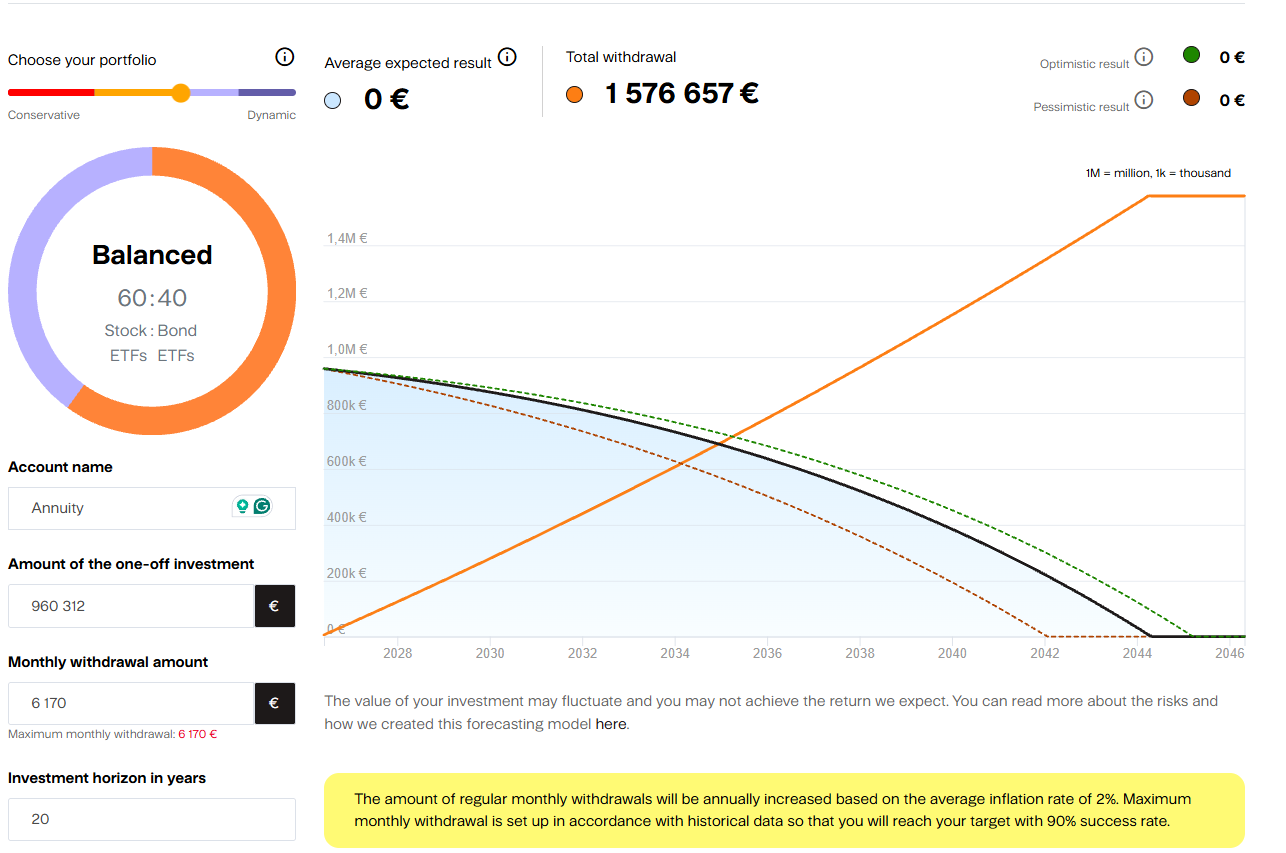
According to the calculations of Finax algorithms, you will need to save up a total of roughly €960,300 to draw a monthly income of €6,170 during retirement.
Once you save up this amount and retire, you will transfer it into the mentioned 60:40 payout portfolio. As we can see in the graph below, the total amount paid out at the end of the period will be €1,576,657 which clearly shows that we are expected to earn some extra money by keeping the savings invested.
It is important to note that this calculation assumes that your monthly pension will increase every year to match the long-term inflation, enabling you to maintain the desired standard of living throughout retirement.
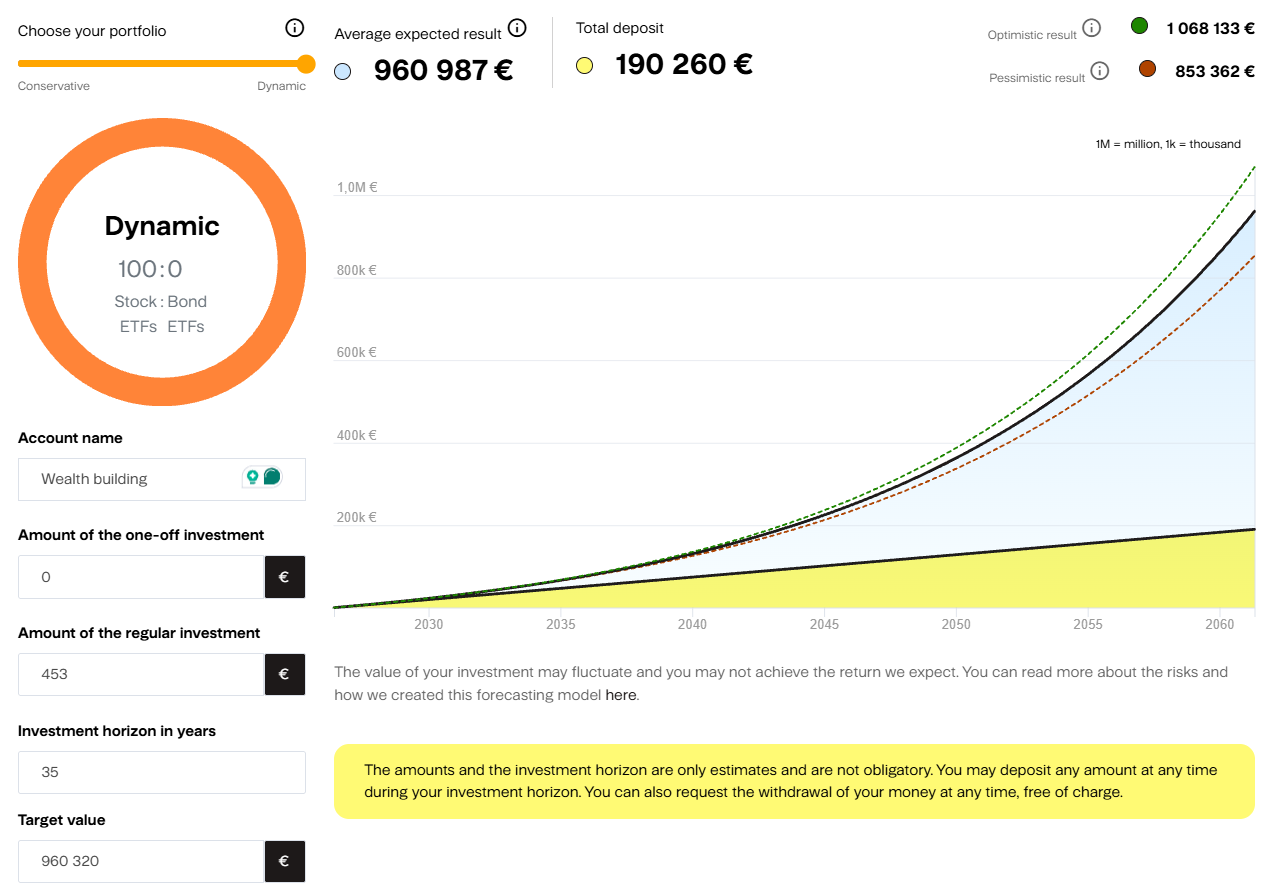
Let’s now use Finax algorithms to calculate how much you need to set aside to accumulate €960,320 by the age of 65. As can be seen in the picture, this goal should be reached if you invest €453 every month over the next 35 years.
By making relatively smaller contributions now, we can enjoy financial security later. You can also apply the well-known 50/30/20 rule, a popular budgeting method that divides your monthly income into three main categories:
- 50% of income - necessities: This part of the budget covers our necessary expenses, such as housing, food, transportation, childcare...
- 30% of income - wants: the difference between needs and wants is not always clear and can vary. In general, wishes are extras that are not necessary for life and work, and often include various monthly subscriptions, trips, entertainment, restaurants...
- 20% of income - savings and debt repayment: use this part of the budget to pay off existing debts and create a financial cushion. For example, savings for retirement, emergency fund...
Our example confirms that this method works, as monthly pension savings of €453 represent around 15% of a €3,000 monthly take-at-home pay.
Beginning in the 40s
Investing early offers a significant advantage thanks to the power of time, making it crucial to start as soon as possible. But if you haven't had the chance to begin earlier, don't lose hope. There's still time to prepare for retirement, though it's important to recognize the valuable time that's already slipped away, during which your investments could have been growing. This means you'll need extra discipline moving forward.
As retirement age approaches, our focus naturally intensifies. Suppose we start investing for retirement at age 40, giving us 25 years until retirement (plus 20 years in retirement). The principles remain as before: during the savings phase, we invest in a 100/0 portfolio, and after reaching the age of 65, the portfolio allocation will change to 60/40, remaining so until the end of retirement.

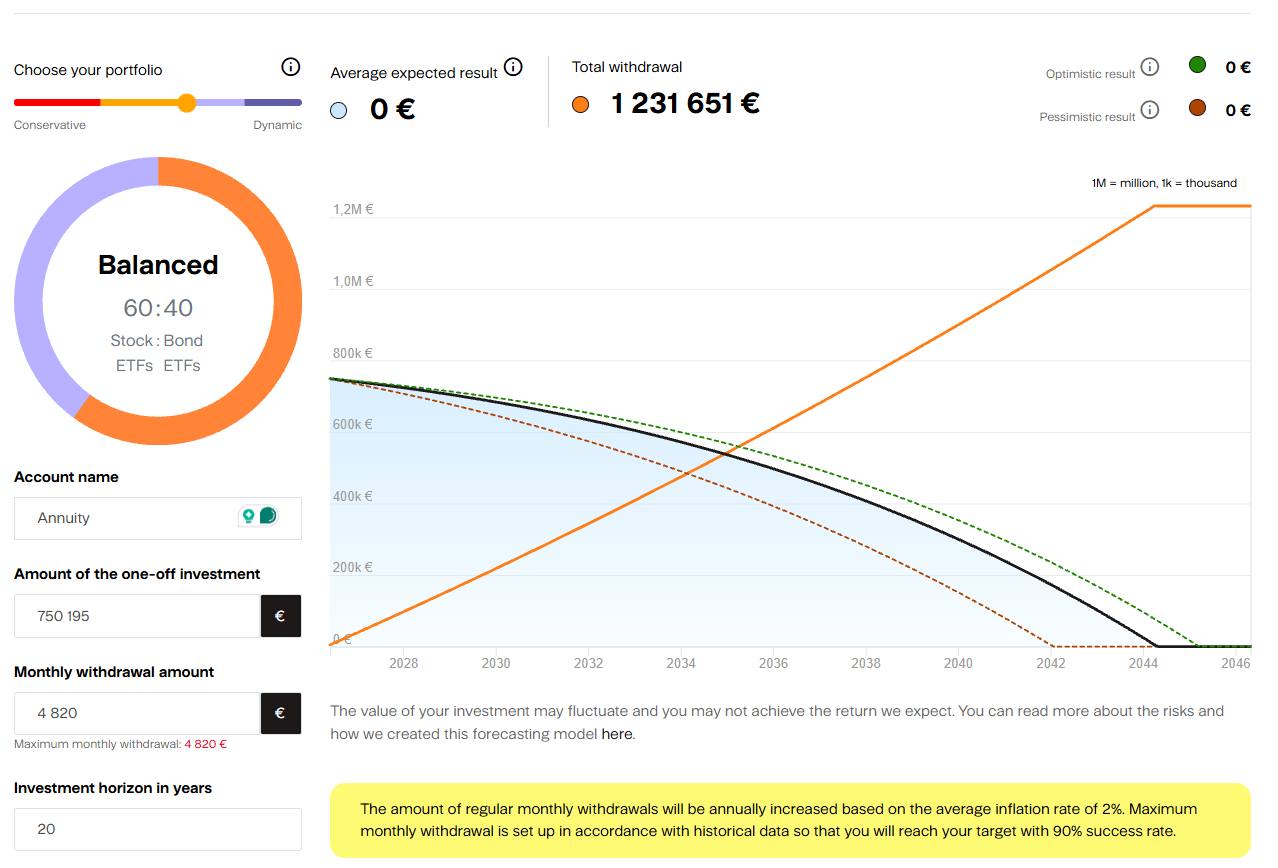
In 25 years, the difference between the average pension and salary will amount to €4,820. You may be wondering why the monthly amount is lower than when investing at 30 years old. The reason is that a person who starts saving at age 30 has 10 more years until retirement, during which inflation will further increase the difference between your salary and the state pension.
In this scenario, we aim to have €750,200 by the start of our retirement payout phase (at age 65). As illustrated in the graph below, the total payout at the end of the period would be €1,231,651, indicating a potential earning of almost €500,000 thanks to keeping the savings invested during retirement. Similar to the previous example, our monthly payout increases annually to match the inflation rate.
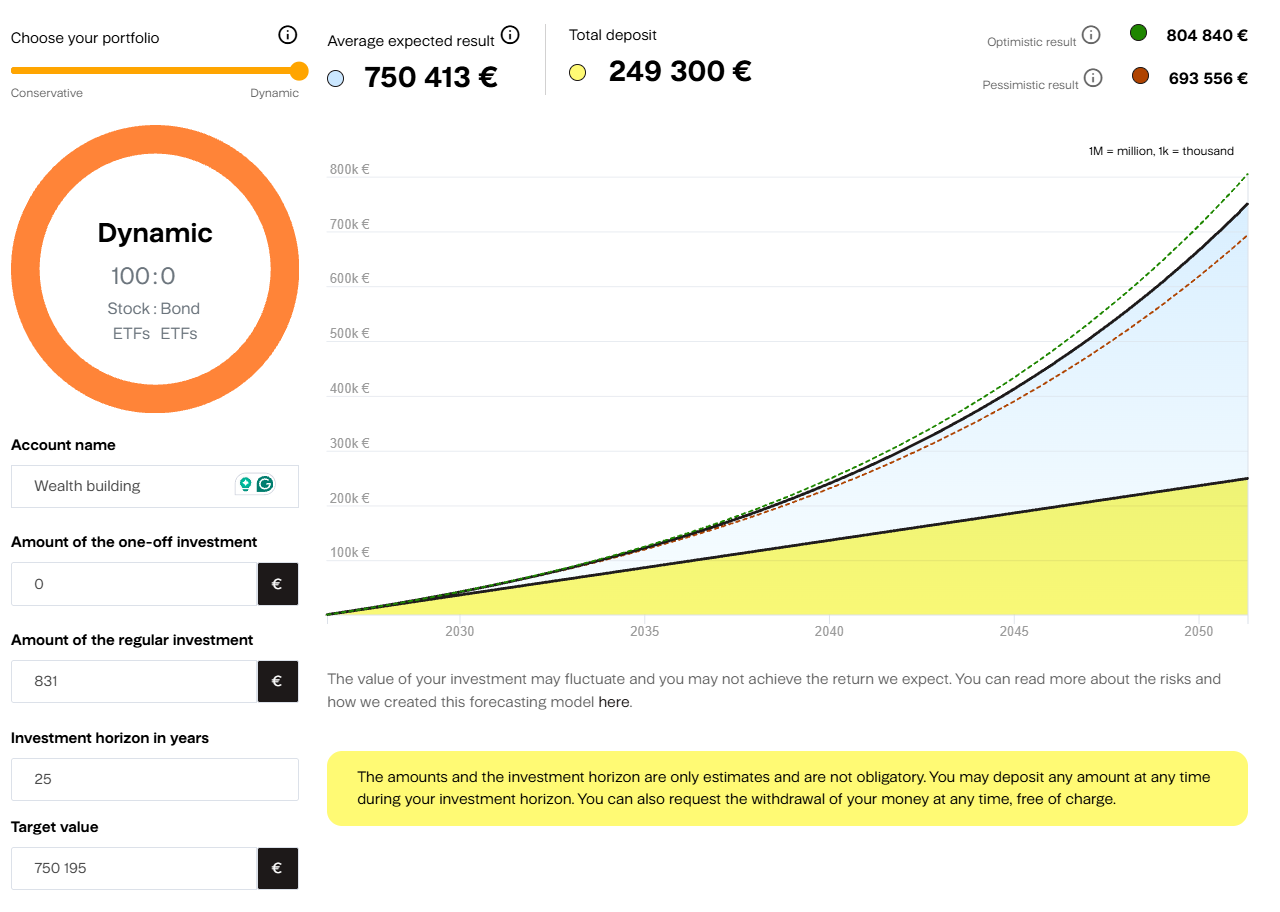
As we delve deeper into the evolving trends of retirement savings, we encounter a significant shift. At the age of 30, our calculations suggested a monthly saving of €453 was sufficient, but by the time we reach 40, the target jumps to €831 per month. This incremental increase aims to ensure we manage to accumulate the required amount over a shorter period of 25 years. Just imagine the substantial savings if one starts investing at 20! Even Einstein stated that compound interest was the 8th Wonder of the World.
While this may seem like a larger amount, it's important to note that income typically rises with age, peaking statistically around 50. According to the US Bureau of Labor Statistics' survey of American earnings by age group, the median wage in the United States reaches its peak between the ages of 45 and 54. This means that although you will need to set aside more in later years, your ability to save also increases as your income rises.
Better Late than Never
Although it is mathematically and statistically most profitable to start looking after your retirement as early as possible, it is never too late to start. A person who starts saving in their 30s can accumulate €960,300 by the age of 65 by investing €453 per month in a 100% stock portfolio, which is more than enough to provide them with an extremely comfortable retirement.
After retiring, it is recommended to switch to a 60:40 ratio of stocks and bonds to ensure that your pension savings continue to grow, allowing you to increase your monthly pension by the rate of inflation.
For those who start saving in their 40s, monthly savings during the productive age should increase to €831, reaching €750,200 by retirement. Despite the higher monthly contributions, creating such savings should be manageable due to career progress and income growth.
Overall, a disciplined savings and investment strategy that takes inflation into account and is tailored to individual preferences is key to maintaining a comfortable lifestyle in retirement. The 50/30/20 rule can help you manage your money effectively, making it easier to allocate funds for your retirement.
It's never too late to take your future into your own hands.
Secure a comfortable future and take advantage of the European pension benefits
Finax is the first investment broker in the entire EU to have been authorized for the provision of the Pan-European Personal Pension Product (PEPP) with the European pension.
The smartest thing you can do is start investing right now. If you decide to wait, you might deprive yourself of the decent golden years full of trips with grandchildren we all long for. As we have established here, don't leave for tomorrow what you can do today. Every additional year of investing can mean a huge difference in your standard of living tomorrow.
Frequently Asked Questions About Pension Savings in Ireland
1. How much should I save each month in my 30s to have a sufficient pension in Ireland?
If you start at 30, saving €453 per month in a 100% stock ETF portfolio gives you roughly €960,300 by retirement age 65. This is enough to draw a monthly income of €6,170 over 20 years of retirement, supplementing the Irish state pension which covers only around 35% of your average gross salary.
2. Is it too late to start saving for retirement in my 40s in Ireland?
No. Starting at 40 still works, but monthly contributions need to increase to €831 to accumulate €750,200 by retirement. The good news is that income typically peaks between 45 and 54, so higher contributions are more manageable at that stage of your career.
3. What is the best pension savings product for people in Ireland in their 30s and 40s?
PEPP (Pan-European Personal Pension Product) from Finax is built specifically for this. It combines a 100% stock ETF portfolio during the savings phase with PRSA-equivalent tax relief, meaning more of your monthly contribution actually works for your retirement instead of going to the taxman.