 Difficulty
The year 2025 taught us several important investment lessons. Perhaps the most influential event came at the beginning of April, when Donald Trump, during “Liberation Day,” announced imposing tariffs on all trading partners who had been allegedly draining the U.S. economy. Global equity markets and the value of the dollar sharply declined at the time.
In situations like these, we always repeat one key message: Above all, don’t panic. Declines caused by political instability have always been part of investing. So far, they've never prevented equity markets from recovering and continuing to grow in the long run. Humanity’s drive to innovate, solve problems, and improve living standards has not been stopped by wars, pandemics, inflation shocks, or madmen in politics.
Furthermore, market recoveries often come quickly and quite unexpectedly. Therefore, if you sell during a downturn, you are exposing yourself to the risk of simply missing the subsequent rebound. This year showcased this marvelously. In the end, most of the tariffs weren’t even imposed. Investors even coined the term TACO (“Trump always chickens out”).
By the end of June, U.S. indices were already back at their highs. It went on to show, once again, that investments should not be adjusted based on personal assumptions about future development. Would you have guessed in April that the U.S. economy would grow by 3.8% in the second quarter and by 4.3% in the third quarter (on an annualized basis)?
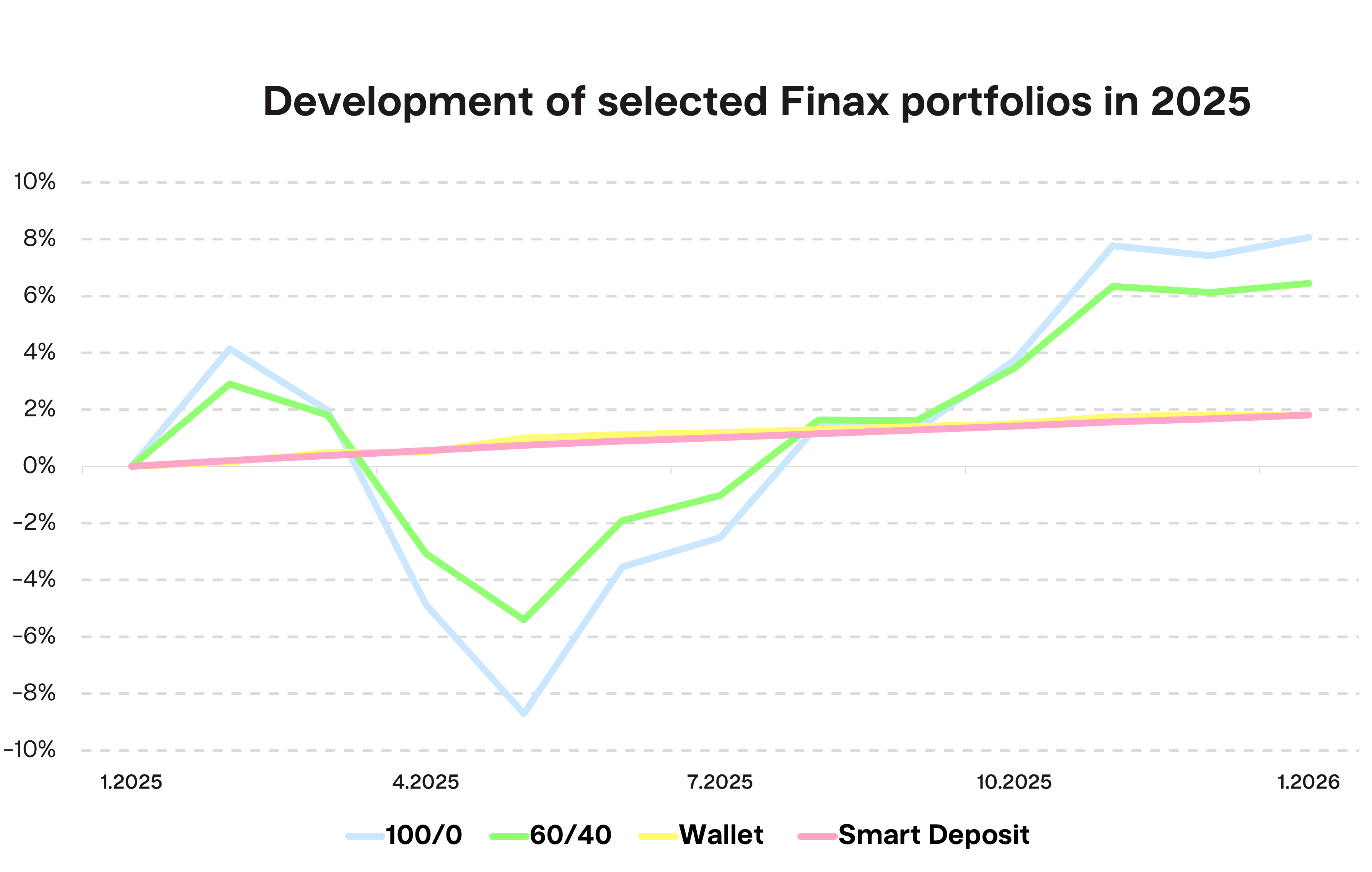
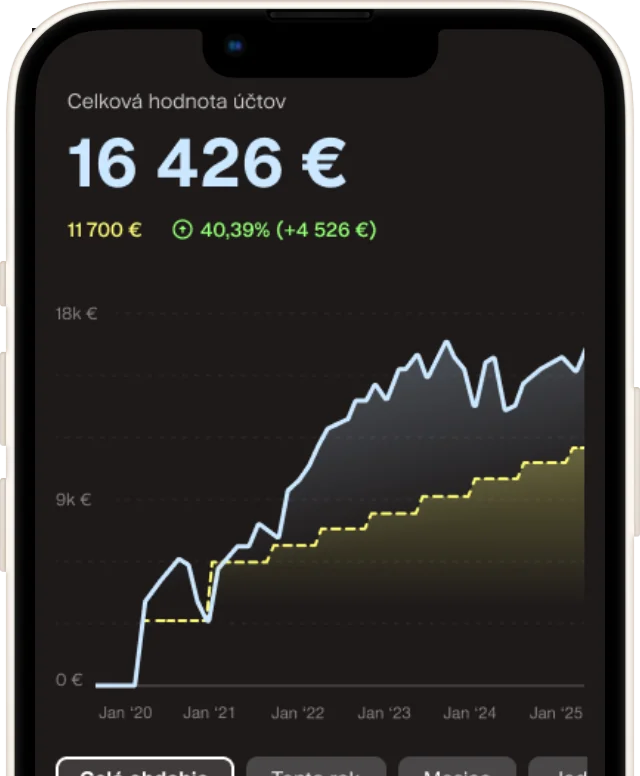
The sharp decline after “Liberation Day” and the subsequent recovery are clearly evident in this chart showing the performance of selected Finax portfolios over the past year. It also clearly illustrates how market turbulence had virtually no impact on the development of the Smart Deposit and the Wallet, which are designed for storing short-term savings without significant value fluctuations.
The second lesson from 2025 serves as a reminder of how important diversification across all countries worldwide is. Trump’s erratic actions were reflected in the performance of U.S. assets compared to other regions.
While ETFs focused on U.S. equities delivered euro-denominated returns ranging from −3.6% to 4.7%, emerging market equities rose by 17% and large European companies by as much as 21%. The rest of the world outperformed the U.S. by the widest margin since 1993.
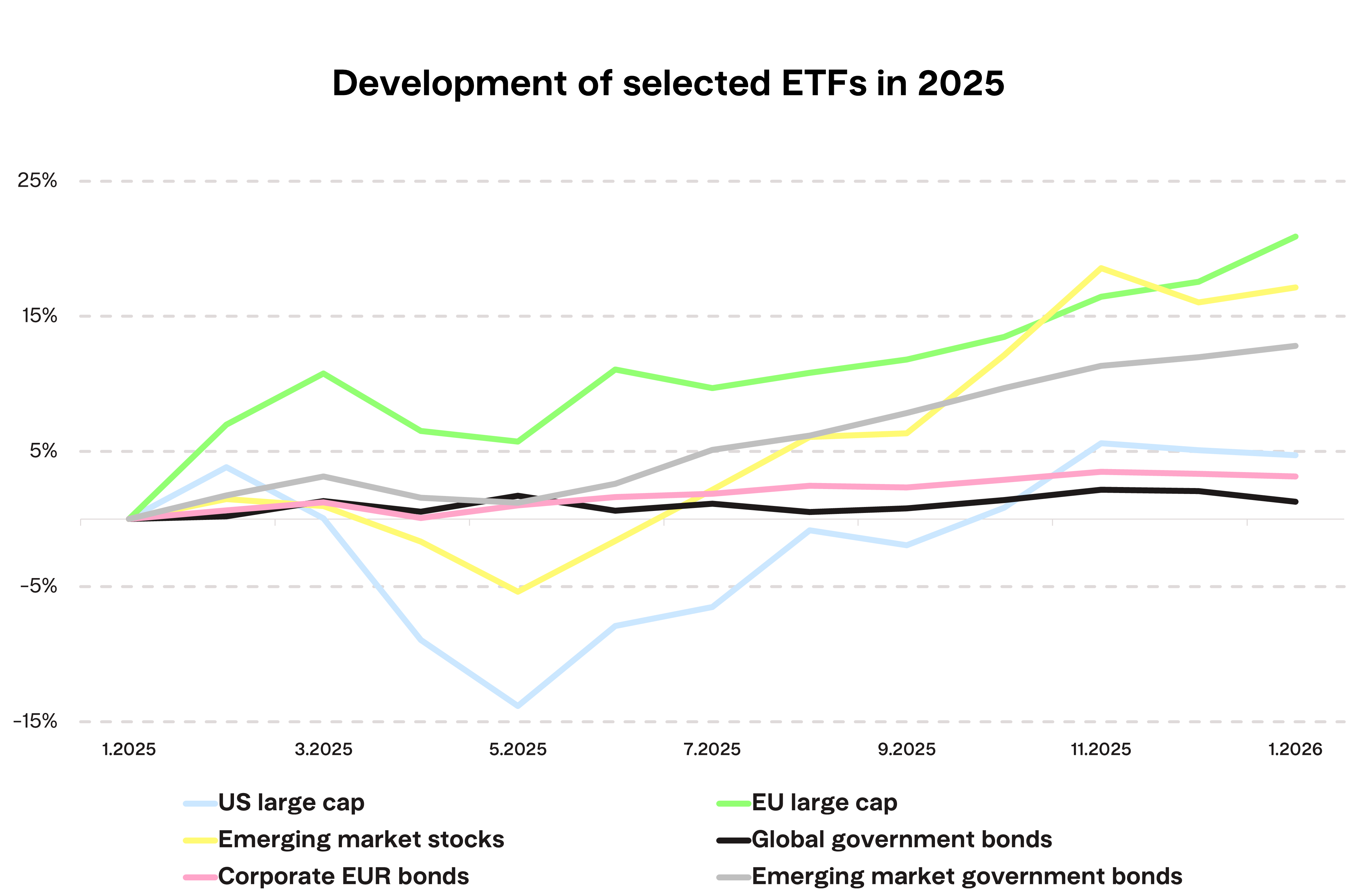
In recent years, we have been often asked why we don’t invest all money solely into the U.S. S&P 500 index, which had been outperforming competitors from other parts of the world.
We always have a simple answer to that one: You should not be tempted by past performance. Different periods can be dominated by different regions, and only by holding them all can you be sure that future winners will be included in your portfolio.
Something similar happened this year as well. Europe was driven by defense companies (supported by commitments from European states to invest more in defense) and banks (supported by strong profitability). Over the past five years, the European banking index delivered 2.5 times the return of the technology-focused Nasdaq 100 index.
Of course, this does not mean that this trend shall persist in the future. However, it does offer an important lesson: You should not bet all your savings on past winners. In the future, there may also be long periods during which American technology giants underperform or fail to meet investors’ extremely high expectations.
The loser of the year can be considered the U.S. dollar, which weakened against the euro by almost 12%. Since we hold our U.S. positions in dollars without currency hedging, a weaker dollar reduces the final return for our investors (just as a stronger dollar would increase it). So although you may read in the media that the S&P 500 achieved a double-digit return in dollars, our euro-denominated ETFs rose much less.
There is no need to be overly worried about this fact. In some years, the dollar boosts our performance (for example in 2021 and 2022), while in others it weakens. Over the long term, it usually returns to its average level and therefore should neither significantly help nor harm returns. If we decided to eliminate the impact of currency fluctuations, it would cost you a portion of long-term returns.
If our results convince you that Finax would be a better place for your existing savings than other products, transfer them from the competition to us. We will reward a documented transfer with a discount. We will manage up to half of the transferred amount completely free of charge for two years.
Data disclaimer: All data related to the performance of Finax portfolios represent the actual achieved performance of model portfolios. The method of calculating actual performance is described in the article How do we calculate the actual performance of Finax portfolios? Past performance is not a guarantee of future returns, and your investment may result in a loss. Stay informed about the risks you undertake when investing.
Tax disclaimer: The tax regime depends on the tax residence, individual circumstances of each client and may change
Dynamic Strategies
As always, we ordered the overview according to the pan-European risk indicator SRI. This indicator ranges from 1 to 7, with a higher number representing greater risk of volatility and potential declines in investment value. As a result, each table contains portfolios with a similar level of risk.
At the same time, we note that the returns shown in the tables always represent the investor’s final return after fees.
Our highest-risk portfolio, 100/0 (equity/bond ETFs), is currently the only one that falls into the SRI 4 category. This category includes investments that are mostly composed of equities and are suitable for long-term investing, ideally for more than 10 years.
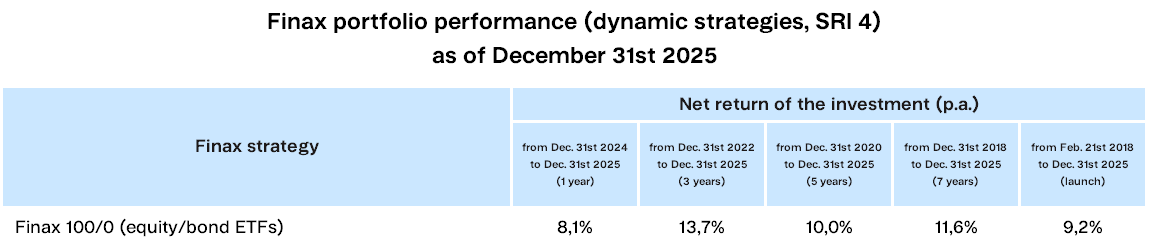
Over the past year, it achieved an 8.1% after-fee return despite mid-year declines due to tariffs. Over a longer horizon of the past seven years, it has delivered a respectable double-digit average annual return of 11.6%. Given that global equity markets have historically returned 8–10% annually (over long horizons), this can be considered a very attractive result.
Balanced Strategies
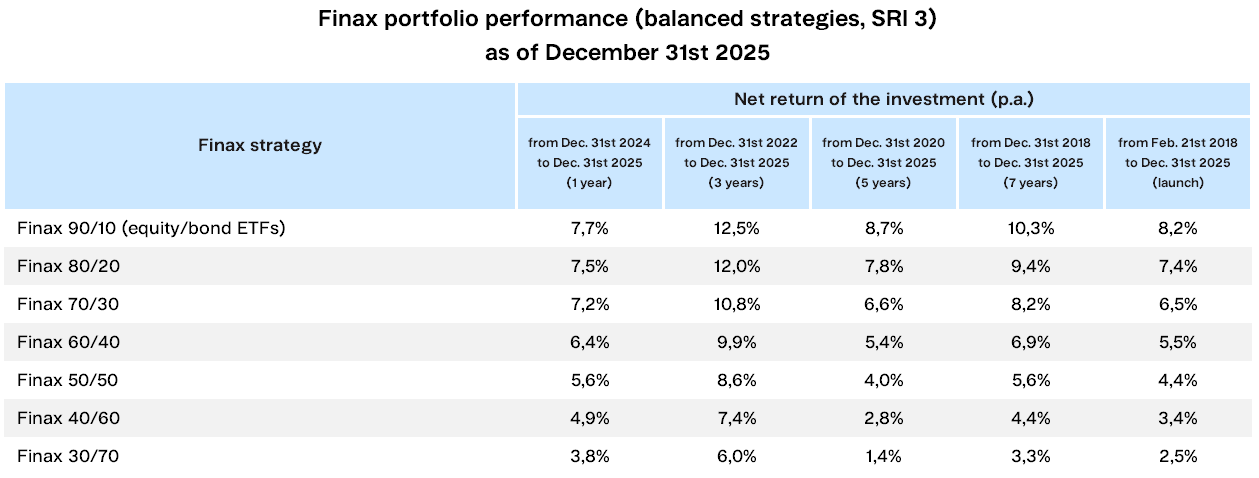
In the next table, we look at the SRI 3 risk category. It includes portfolios mixed from equity and bond ETFs. They carry a moderate level of risk and are therefore suitable for medium-term investing (in most cases, at least 3–7 years).
Their 2025 returns ranged from 3.8% to 7.7%. Over the longer-term horizon of the past seven years, the picture is similar, with average annual returns ranging from 3.3% to 10.3%. Thus, we can proudly conclude that all of these portfolios have so far delivered returns exceeding the long-run rate of inflation (typically 2–3%).
Conservative Strategies
Finally, we look at the SRI 2 risk category. This includes strategies based primarily on bond ETFs, which carry lower risk and are generally suitable for shorter-term investing. Over the past year, they have posted gains ranging from 0.9% to 3.2%.
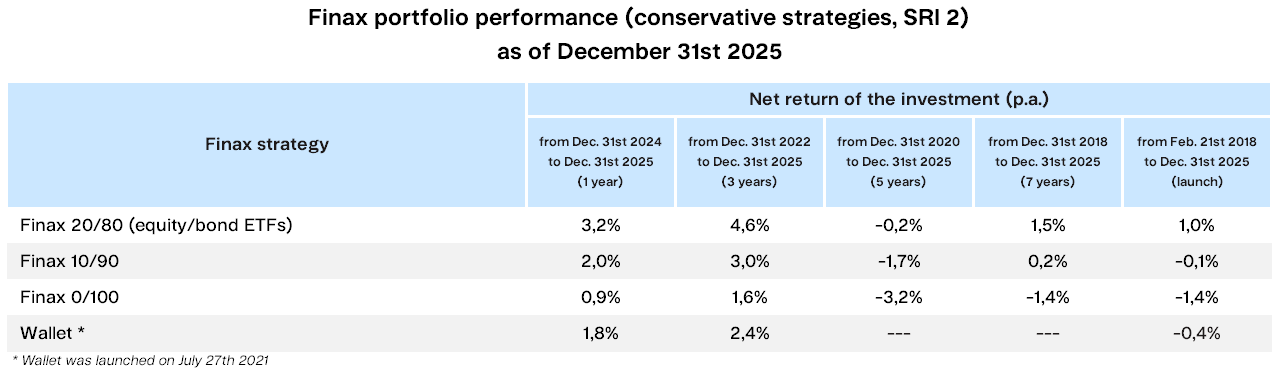
Since our conservative strategies are bond-oriented, their long-term returns are nearing zero, even falling into a slight loss. This is due to steep interest rate hikes in 2022. Increases in interest rates cause a decrease in bond prices, pushing these portfolios into declines. This situation has thus, naturally, affected Finax bond strategies as well.
The European Pension and Smart Deposit
To make this overview complete, we have also included the performance of additional products, which you can find in the table below.
A reduced fee is applied to European Pension (PEPP) strategies, which is why they achieve even higher performance than the Investing in ETFs portfolios. In 2025, they recorded returns ranging from 7.1% to 8.9%, and over a three-year horizon, they maintain an attractive double-digit annual performance.
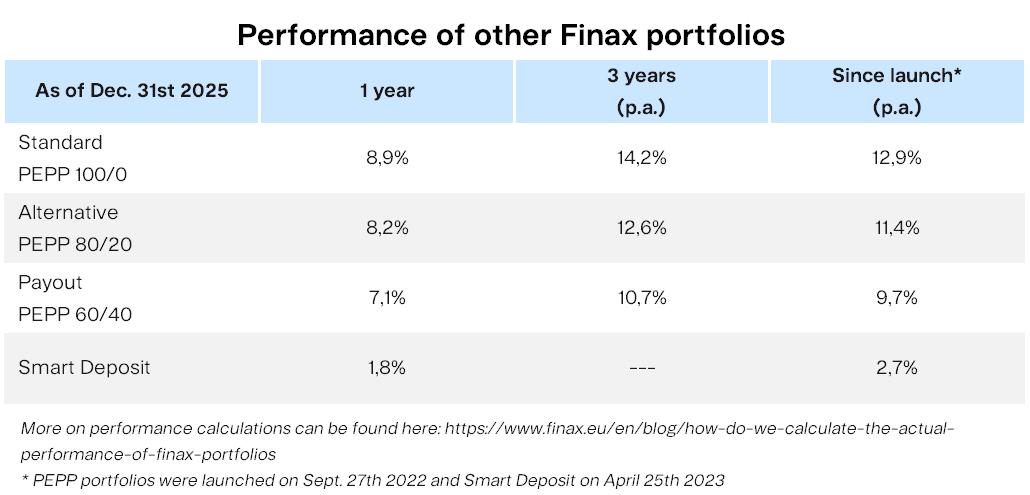
In the bottom row, you will find the returns of the Smart Deposit. This is our most conservative solution, which tracks the European Central Bank’s deposit interest rate with virtually zero volatility. It is therefore suitable for storing savings that you will need within one year, or for funds where you do not want to see any value fluctuations.
If you found these results convincing, we would like to remind you of our generous investment transfer discount. In 2026, keep investing with peace of mind, patience, and relax.