 Difficulty
When My Future Fund's first opt-out window closed on 31 August, fewer than 4% of enrolled workers left. That number got reported as a vote of confidence in the scheme, and for most of the roughly 800,000 people it was built for, that's a fair read.
But "most people" isn't everyone. If you're self-employed, that 96%-stayed statistic never included you, as you were never eligible to join in the first place. And if your work or life crosses a border, staying enrolled doesn't mean what you might think it means. The good news: there's a pension built for exactly that.
This isn't an argument against My Future Fund. It's about who it wasn't designed for. If that includes you, the European Pension (PEPP) might be the alternative you're looking for.
The article discusses:
- Which groups are left out of My Future Fund
- The situation of the self-employed
- The situation of those working across borders
- Why PEPP fits, and what it offers
Self-Employed or Working Across Borders? You Might Have a Problem
My Future Fund, Ireland's auto-enrolment pension scheme, runs entirely on payroll. Eligibility, contributions, the employer match, the State top-up, every part of the mechanism assumes you have an Irish employer processing an Irish payslip. That's not a flaw; it's the design. It's what lets the scheme auto-enrol people with zero paperwork.
But a mechanism built entirely around payroll has an edge, and two groups of people sit right on it: people with no payroll to plug into, and people whose payroll doesn't stay Irish for their whole career.
If You're Self-Employed
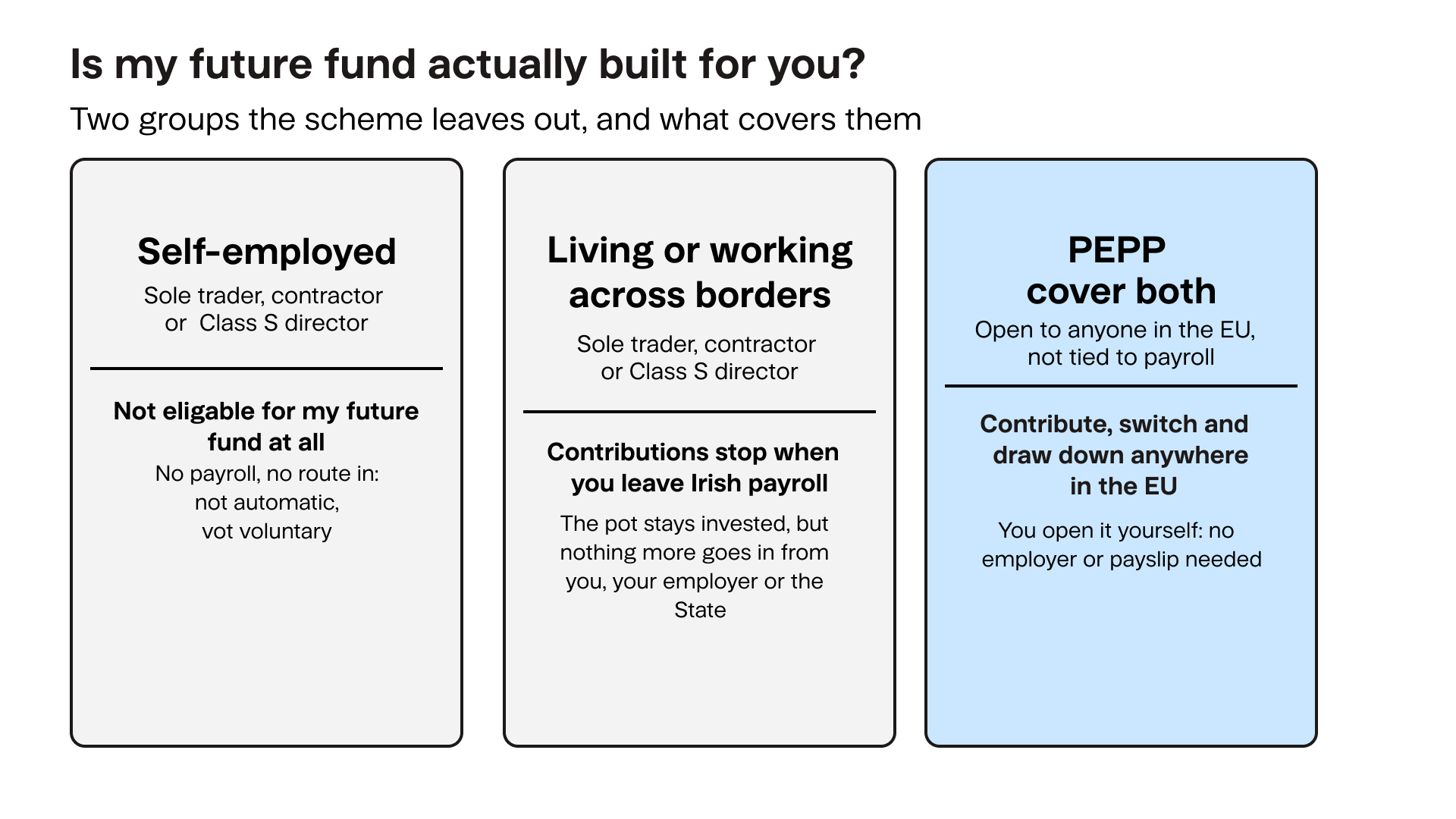
There's no route in, not automatic, not voluntary. Sole traders, contractors, and company directors taxed under PRSI Class S are excluded from My Future Fund entirely, in its current phase. It isn't that you're a lower priority; the scheme simply has no payroll to attach a contribution to.
That leaves a real gap for a group that already saves less than employees do. Every year, Ireland's CSO asks workers whether they have a pension on top of the State Pension, and the self-employed have trailed employees in every one of the last four surveys:
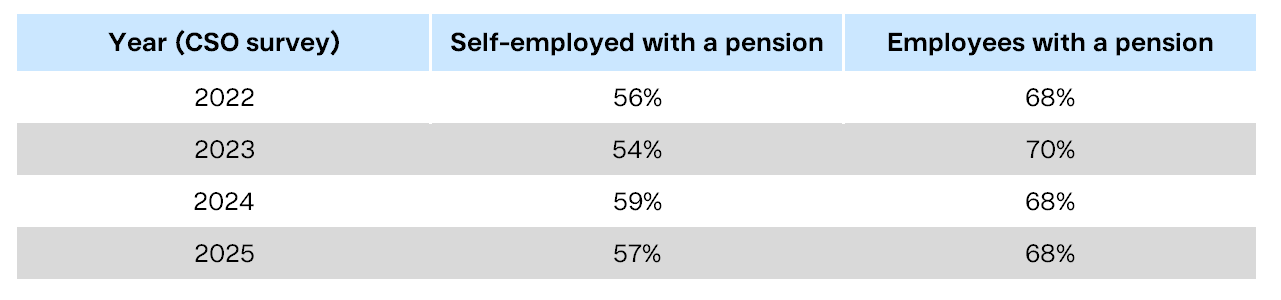
"Pension" here means a pension on top of the State Pension.
That's where the European Pension (PEPP) comes in. PEPP stands for the pan-European Personal Pension Product, an EU-regulated personal pension that you open yourself, so it doesn't depend on an employer or a payslip. It isn't tied to employment status at all: you can hold one whether you're self-employed, between contracts, or running a company.
The contribution shape fits how self-employed income works, with no fixed percentage of salary to keep up every month, just an amount you choose, adjust, or pause as cash flow allows, from €10 upward. So you can save at your own pace, without worrying about a month when income dips.
And there's a tax advantage: PEPP contributions qualify for the same income tax relief as a PRSA. In plain terms, Revenue refunds part of what you put in, at your tax rate. At the 40% rate, for example, a €500 contribution costs you about €300 once relief is claimed.
If You Live or Work Across Borders
When a worker moves to another country, traditional domestic pensions remain tied to the original country, which can lead to a fragmented retirement portfolio. That's true of My Future Fund, and it plays out differently depending on your situation. Two common ones:
1. You're Moving to or From Ireland
Take an Irish engineer offered a job in Zagreb. If he's enrolled in My Future Fund, the day he leaves is the day it stops: his pot stays invested in Ireland, but nothing more goes in from him, his employer or the State.
A PEPP works differently. It's one pension with one provider, with a separate subaccount for each country you live in, because pension tax rules are national and the subaccount is what applies a country's tax treatment to your contributions. He doesn't have to leave his pension behind. He can keep saving into his Irish subaccount from Croatia, though Irish tax relief depends on having Irish taxable income, so it may no longer apply. Or he can open a Croatian subaccount, so new contributions follow Croatian rules. Finax already runs PEPP in Croatia, so that option is there from day one. He decides which subaccount to feed. An Irish employer can even keep contributing from abroad, though that can affect which local tax reliefs apply. If he comes home later, he simply carries on with his Irish subaccount.
The mirror image is just as common. A Polish software developer in Dublin, in her thirties, earning €95,000, expects to head home in three to five years. While she's here, her contributions to a PEPP can attract Irish tax relief (we'll walk through the numbers in our upcoming comparison). When she moves back to Poland she can open a Polish subaccount, so new contributions follow Polish rules, while her Irish subaccount stays in place. Her My Future Fund pot, if she has one, stays in Ireland and stops receiving contributions the day she leaves.
And if you're arriving in Ireland from Poland, Slovakia, Croatia or the Czech Republic, you may already hold a PEPP: Finax runs it in all four countries as well as in Ireland, so you can keep contributing to your existing subaccount or add an Irish one. (Both examples are illustrations, not real clients.)
2. You Live in One Country and Work for an Employer in Another
My Future Fund doesn't have an answer for this at all: it only runs on Irish payroll, full stop. A PEPP subaccount is tied to where you live, not where your employer is based, so if you're resident in Ireland but your pay cheque comes from a Dutch or German company, you open an Irish subaccount and your employer can still contribute to it directly.
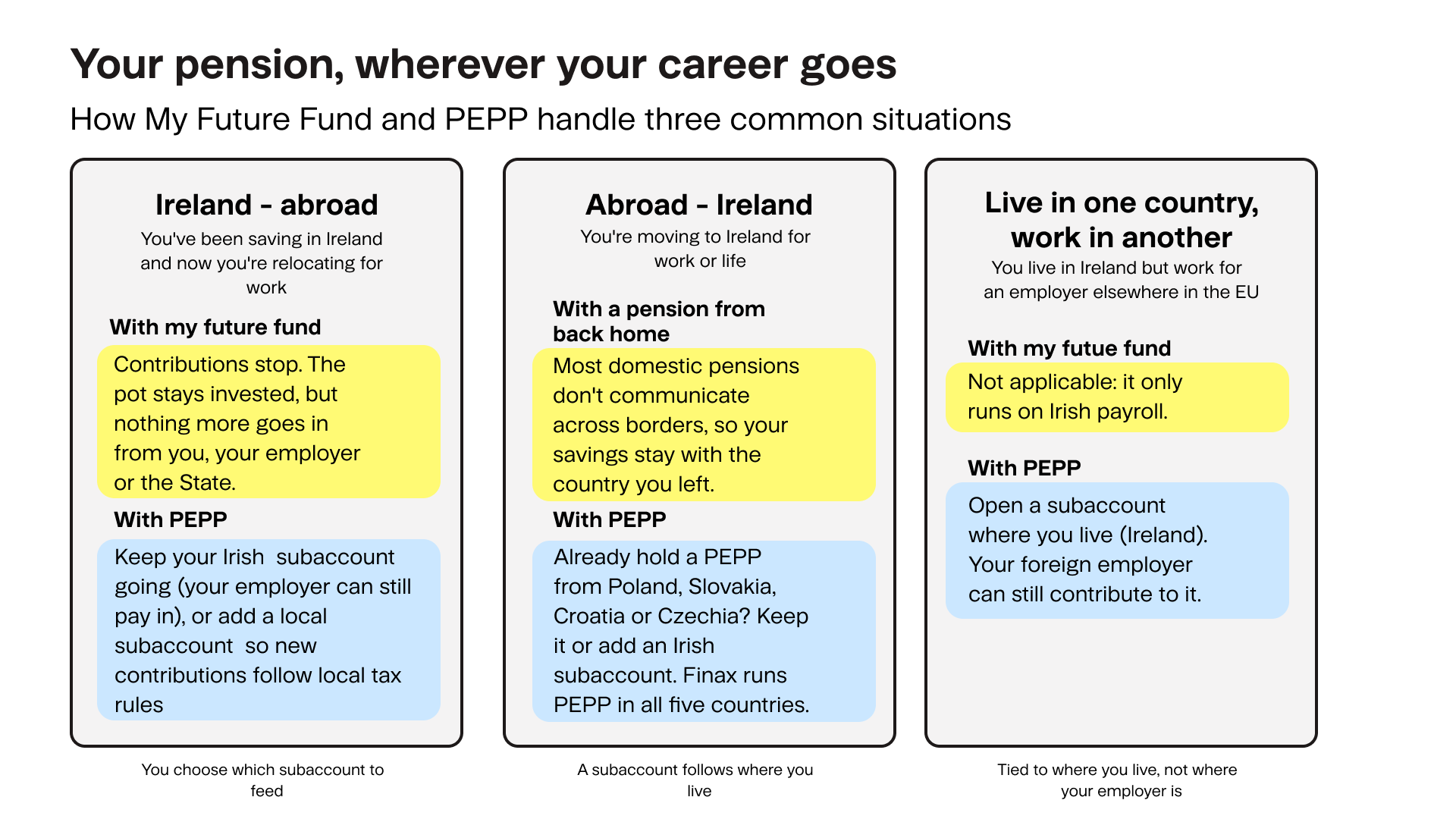
These are the most common patterns, not the only ones. If your situation is more layered (several countries over a career, retiring somewhere different from where you saved), we've worked through the fuller set of scenarios in European Pension Plan Portability.
Why PEPP Fits These Situations
Both problems above come from the same design choice: My Future Fund is built around an Irish payslip. PEPP is built around you.
- It doesn't need a payroll. You open it yourself, online, in roughly ten minutes. Self-employed, between contracts, or running a company: your employment status doesn't decide whether you can hold one.
- It moves with you. One PEPP, one provider, and a subaccount for each country you live in. You decide whether to keep saving into the old one or open a new one, so a move doesn't force you to start over with a new pension product.
- You set the pace. Contributions start from €10, and you can change or pause them. There's no fixed percentage of salary to keep up.
- It comes with tax relief. Contributions qualify for income tax relief at your marginal rate, within age-related and earnings limits.
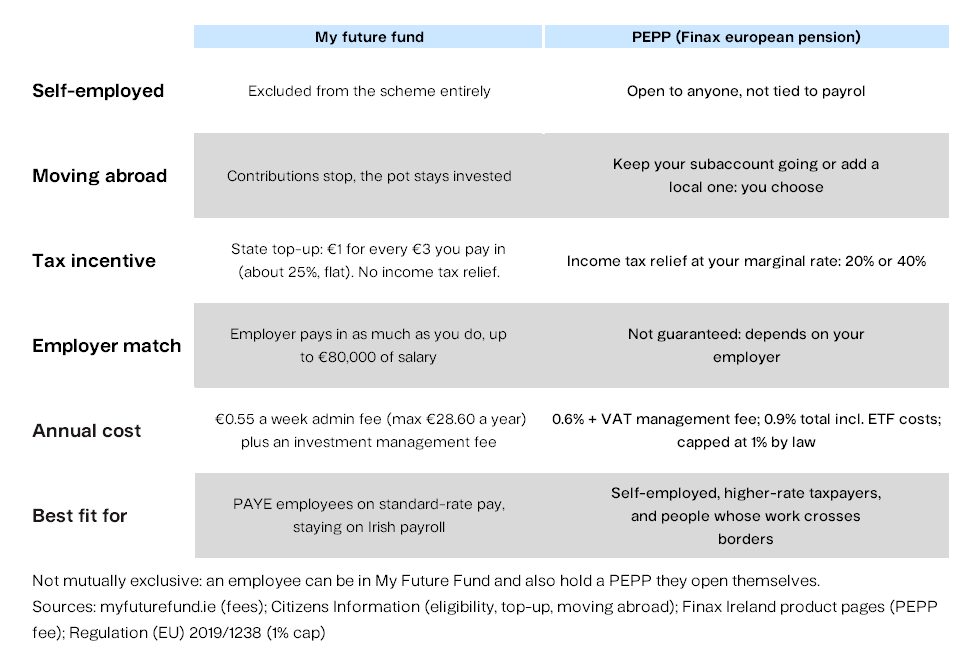
A Few Questions Worth Answering Upfront
1. Can I have both My Future Fund and a PEPP?
Yes. A PEPP you open yourself, outside payroll, doesn't stop you being in My Future Fund. They're not mutually exclusive.
2. I'm a Class S director. Can I really get a PEPP even though I can't get My Future Fund?
Yes. A PEPP isn't restricted by employment status. Being excluded from My Future Fund has no bearing on whether you can hold one.
3. I'm only going abroad for a year or two. Is switching to PEPP still worth it?
That depends on your specific situation, and it's worth working through the scenarios in our portability post rather than assuming. Short postings and long-term relocations don't always call for the same approach.
If you're interested in learning more about PEPP, cross-border pensions, and investing abroad, subscribe to our newsletter using the form below. We'll regularly send practical tips, updates, and insights to help you make informed financial decisions.

All news from Finax and the world of investments twice a month.
4. Does my employer have to offer this for me to use it?
No. Unlike My Future Fund, a PEPP isn't something your employer sets up on your behalf. You can open one yourself, with or without an employer contribution.
5. I already have a PEPP from another EU country. Can I keep it going once I'm in Ireland?
Yes. You can continue contributing to your existing subaccount or open an Irish one. It depends on which option suits your tax position better, and it's worth checking against your specific circumstances rather than assuming.
Where This Leaves You
My Future Fund is a strong default for PAYE employees on standard-rate pay, where the employer match and State top-up are hard to beat. If you're self-employed, or your work crosses borders, it was never really answering your question, and now you know what does.
If that's you, the European Pension is Finax's PEPP product in Ireland, built for these situations.

Secure a comfortable future and take advantage of the European pension benefits
Frequently Asked Questions About My Future Fund and PEPP
1. Who is eligible for My Future Fund?
You're automatically enrolled in My Future Fund if you're aged 23 to 60, earn €20,000 or more a year across all your jobs, and don't already pay into a pension through payroll. Employees outside the age or earnings criteria can opt in. Self-employed income doesn't count at all, because the scheme only works through Irish payroll. If that rules you out, a personal pension such as the European Pension (PEPP) is open to you whatever your employment status.
2. How much tax relief do I get on pension contributions in Ireland?
Revenue gives income tax relief at your marginal rate, 20% or 40%, up to an age-related share of your earnings: 15% under 30, 20% at 30 - 39, 25% at 40 - 49, 30% at 50 - 54, 35% at 55 - 59 and 40% at 60 or over. Earnings above €115,000 a year don't count towards the limit. PEPP contributions get the same tax treatment as a PRSA, so at the 40% rate a €1,000 contribution costs you about €600. Before you start, it's worth knowing what risks you take on when investing.
3. What's the difference between a PEPP and a PRSA?
Both are personal pensions you can open yourself, and in Ireland both get the same tax relief. The main difference is portability: a PRSA is an Irish product, while a PEPP is regulated at EU level, so you can keep saving with one provider if you move within the EU, with a separate subaccount for each country. Fees on the Basic PEPP are capped at 1% a year by EU law. We compare the two in detail in PEPP or PRSA? How to secure your pension, and explain how moving countries works in European Pension Plan Portability.