 Difficulty

What Is Diversification?
Diversification, a strategic allocation of risk across various smaller investments, stands as an effective approach to mitigate potential risks associated with specific securities.
The familiar saying "Don't put all your eggs in one basket" aptly captures the essence of this investment philosophy. By avoiding concentration on a single investment, the impact of a downturn in one area is cushioned by the performance of other assets in your portfolio, preserving overall stability.
Imagine your investments as a basket of eggs. If that basket were to fall, placing all your eggs in it could result in a significant loss. However, by spreading your eggs across multiple baskets, the loss of one of them becomes more manageable, as you’re still left with enough intact eggs.
Diversification operates on the principles of primary school mathematics. For instance, if you evenly distribute your investment portfolio among the stocks of four companies, with three yielding a 20 % return each and one facing bankruptcy, your overall investment might incur a -10 % loss.
Contrastingly, by diversifying across a hundred enterprises, where 99 experience an average growth of 10 %, and one faces bankruptcy, your overall return remains positive at approximately 8,9 %. This exemplifies the essence of diversification – the dispersion of risk.
In a well-constructed portfolio, risk is not concentrated, and exposure to individual securities is minimized. This approach is highly effective in mitigating the risk associated with specific companies, issuers, sectors, or countries, known as non-systemic risk, thereby enhancing the overall stability of the portfolio.
By diversifying across assets with lower or negative correlation, investors can further enhance the risk-reducing benefits. Correlation, represented by the correlation coefficient, signifies the relationship between the performance of two assets.
For instance, if the average growth of Facebook shares is accompanied by a corresponding 0.5 % increase in the S&P 500 index, the assets exhibit a positive correlation with a coefficient of 0.5. On the other hand, assets like government bonds may show a negative correlation to stocks. For instance, they might fall by 0.2 % when Facebook shares grow by 1 %, resulting in a correlation coefficient of -0.2. In such cases of negative correlation, diversification becomes even more effective in minimizing risk.
Investing in assets that tend to evolve differently, with some increasing while others decline or exhibit a different degree of fluctuation, results in a lower overall volatility of the portfolio's value. This not only reduces potential losses but also lowers the overall risk associated with the investment. In essence, diversification serves as a powerful tool for investors seeking to optimize risk management and enhance the resilience of their portfolios.
Negative Aspects of Diversification
One could find diverse opinions on diversification in the world of investing. Undoubtedly, when it comes to managing risk, diversification stands out as one of the most effective methods for risk mitigation. However, historical scrutiny has sometimes criticized its returns and associated costs.
A prevalent investment myth contends that to maximize returns, one should concentrate investments in a narrower group of selected assets with the highest profit potential. While this assumption holds some truth in essence, it is very difficult to implement it successfully.
Advocates of this approach argue that diversified portfolios yield only average results, as they capture the average return across various smaller investments, thereby depriving investors of potential windfall profits earned by a handful of winning stocks. Broad diversification often mirrors market returns, which investment managers strive to surpass with their carefully chosen, high-potential investments.
In reality, the pursuit of beating the market and selecting outperforming securities often remains a lofty aspiration. Most fund managers struggle to even achieve market returns, primarily due to the unpredictable nature of asset prices. Concentrated portfolios, while initially tempting for potentially higher returns, tend to lag the market, while involving a significantly higher risk exposure.
Historically, widespread risk diversification was also criticized for elevating the investor’s costs. Managing many assets necessitates numerous transactions, each incurring fees. However, the advent and popularization of Exchange-Traded Funds (ETFs) have addressed this concern. Index funds with diversified portfolios now enable investors to access a broad array of securities at minimal cost, effectively mitigating individual issuer risks.

Create an account and start investing today
Why Does Diversification Work?
A common error made by novice investors is attempting to only invest in winners. Typically, they explore various investment approaches to identify stocks or mutual funds with the highest growth potential, often relying on past performance as the primary guiding factor.
Among small investors, the prevailing strategy involves perusing lists of mutual funds and choosing the one with the most significant historical appreciation. This approach is fuelled by the erroneous assumption that current growth trends will persist into the future.
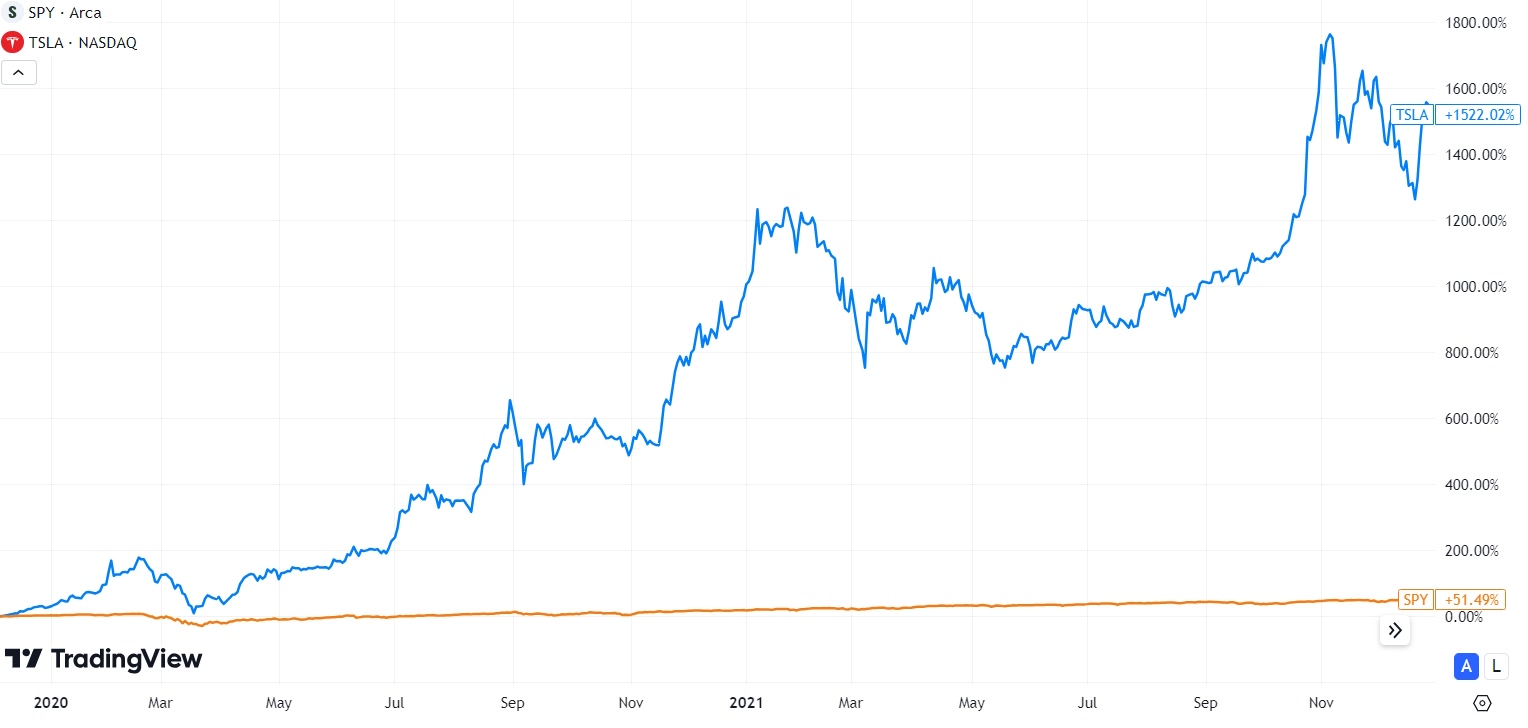
Examining the trajectory of Tesla's stock prices from 2020 until the close of 2021 alongside the performance of the US S&P 500 stock index during the same period provides valuable insights.
During this period, Tesla stood out as a dominant performer, significantly benefiting its investors and users. With revenues reaching nearly 53.8 billion U.S. dollars in the 2021 fiscal year, its stock achieved an unbelievable four-digit return over our observed period, a truly exceptional result. There seemed to be no indication of a deviation from this upward trajectory.
Source: TradingView
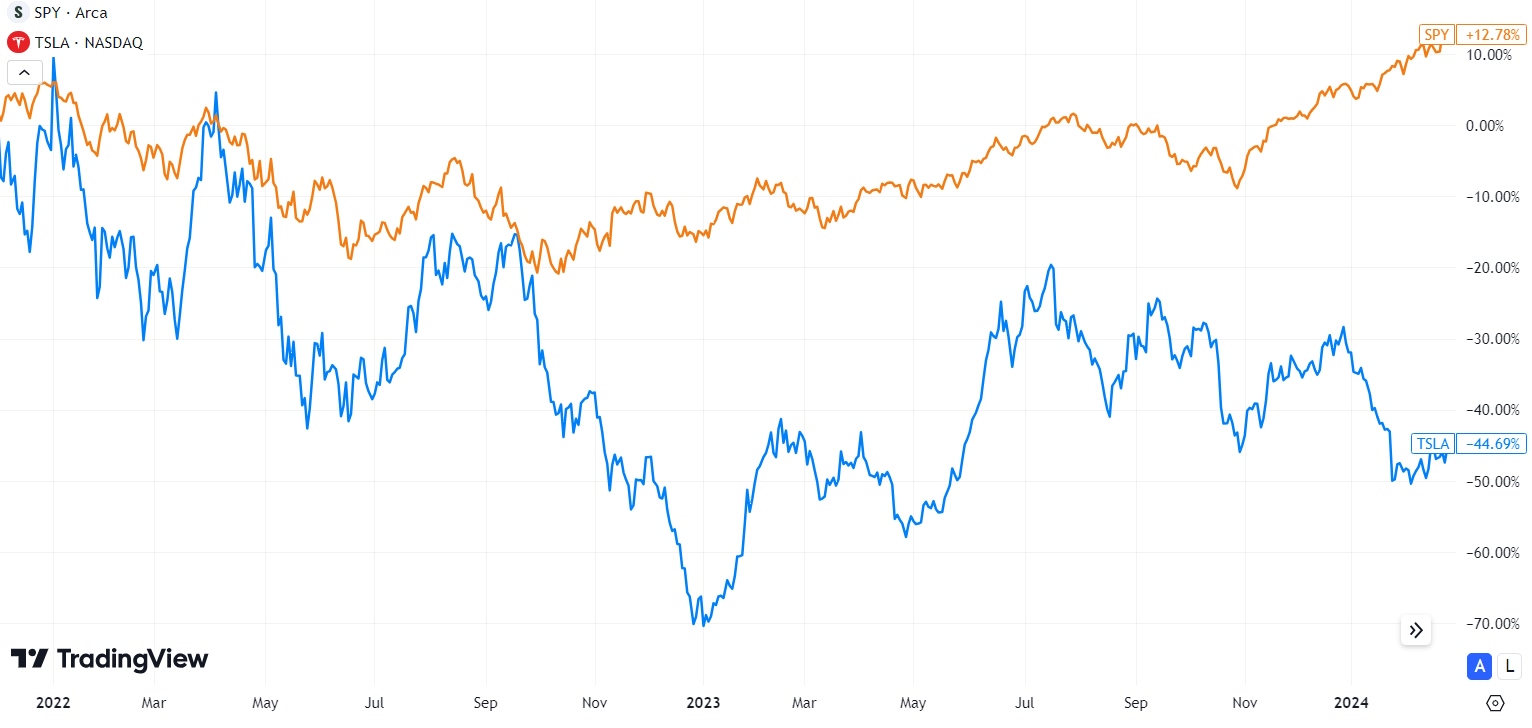
If an investor had to make a choice between investing in Tesla shares or the broader market represented by the S&P 500 based on the provided graph and prevailing market sentiment, they would likely have favoured Tesla's shares at the onset of 2022.
However, over the subsequent two years, investors would’ve encountered the inherent risks associated with individual stocks. In an unforeseen turn of events, Tesla's investment lost nearly a third of its value within a year, while the S&P 500, representing a diverse array of the largest US companies, gained almost 4 %.
Source: TradingView
Standing at the beginning of 2023, many investors might have considered the updated data and conclude that times were too dangerous to invest in volatile tech stocks like Tesla, especially with the potential threat of new competition in the EV sphere from foreign countries like China. This might have led many to sell these stocks and increase their exposure towards the index.
However, over the course of 2023, Tesla shares doubled in value, surpassing the S&P 500 index, which achieved only a 24 % gain during the same period. And that was again not a good reason to sell the index for Tesla at the beginning of 2024, as the company missed its earnings call (losing a quarter of its market value), while S&P500 kept growing since January.
In the annals of financial markets, numerous instances akin to the Tesla case dot the historical landscape. Pinning one's hopes on a concentrated investment in a single or a handful of securities inevitably amplifies the associated risks.
The principle of diversification extends its influence not only across individual assets but also within economic sectors and geographic regions. This holds true especially for extended investment horizons, which form an essential foundation for successful investing. It underscores the challenge of accurately predicting the long-term trajectory of traded assets.
Consider the current investor preference for U.S. stocks, driven by their stellar performance in the past decade. Sectors like technology, biotechnology, and healthcare are in vogue. Yet will these sectors continue to lead in the years ahead, just as they do now? Can investors accurately predict the reversals in these trends?
Examining the development of six indices forming the basis of Intelligent Investing portfolios over the decade until 2017 sheds light on the popularity of U.S. stocks. They currently stand as the most lucrative option.
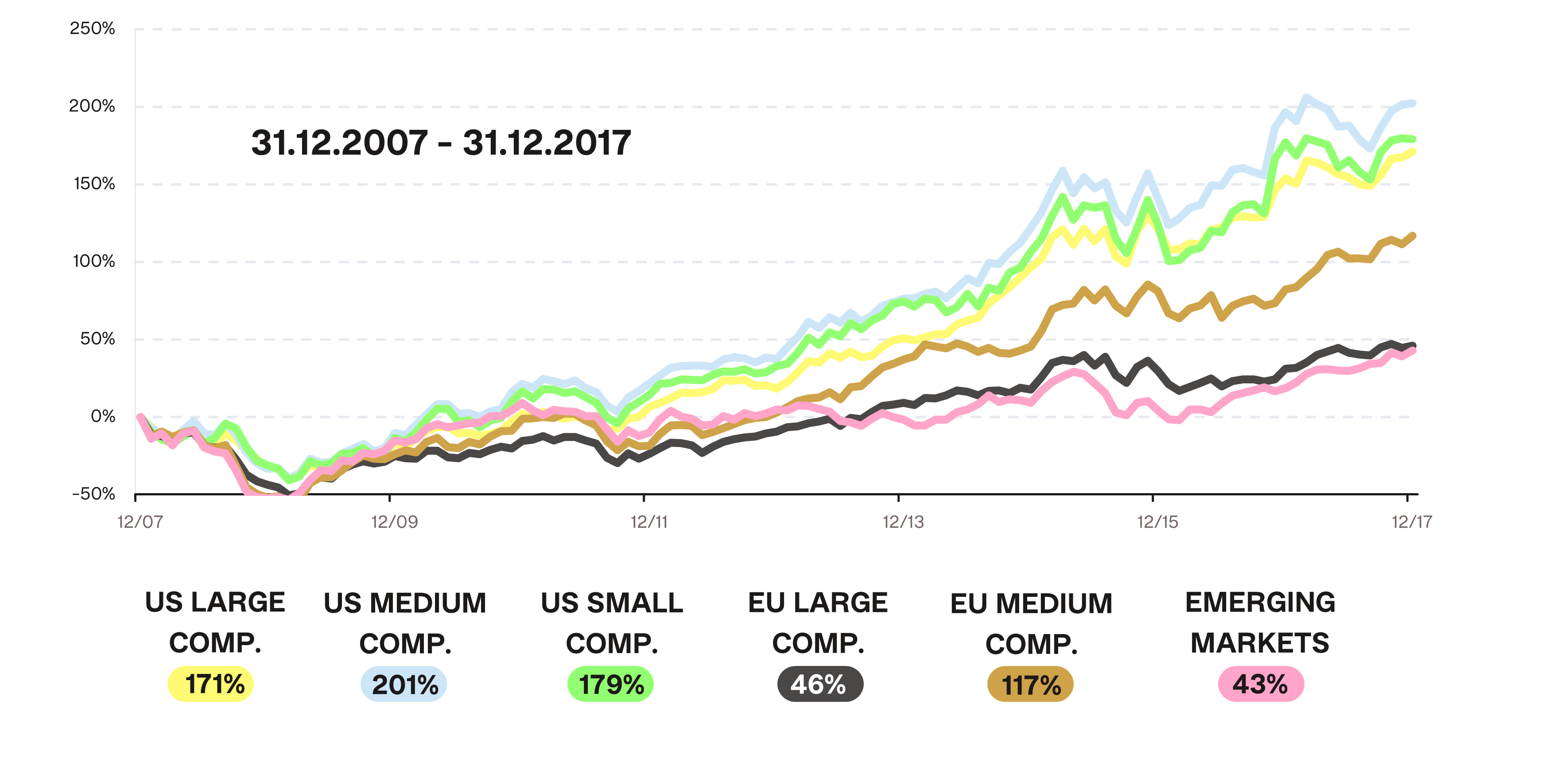
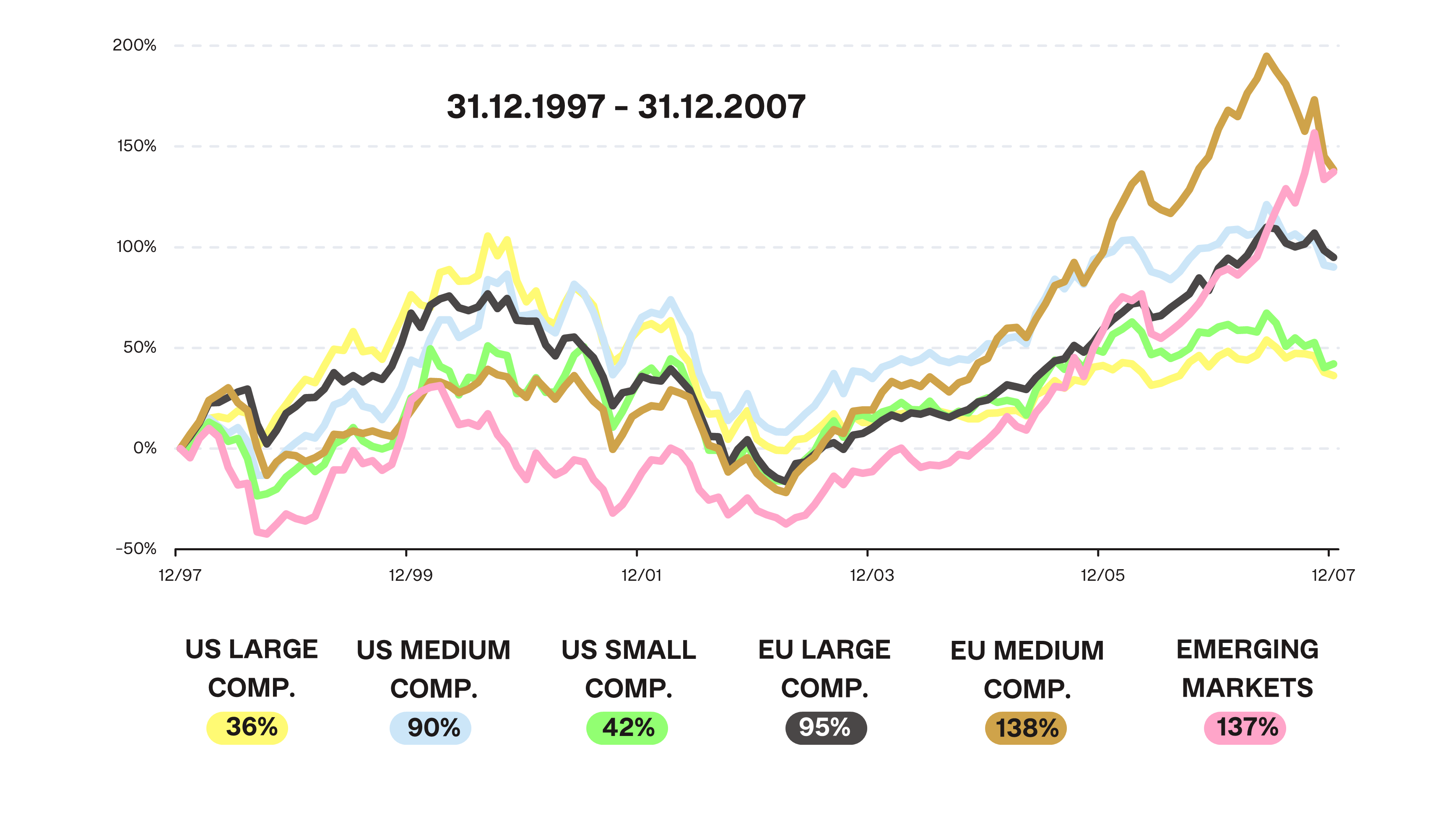
However, a glance at these same asset classes a decade earlier, spanning the period from 1998 to 2007, reveals a different narrative. Winners and losers underwent a complete reversal within two decades.
In the period before the financial crisis, stocks from emerging markets dominated the scene. Fifteen years ago, when Finax's founders entered the financial sector, emerging markets enjoyed widespread adoration. Most people held major portions of their portfolios in these stocks.
This era even birthed the investment class BRIC (Brazil, Russia, India, and China), championed by a renowned economist at Goldman Sachs. BRIC was omnipresent, heralded as the future, and BRIC assets experienced substantial capital inflows.
Yet, in the end, these investments proved disappointing. Stocks from emerging markets suffered the worst performance among the asset classes shown above over the past decade, while U.S. stocks, previously lagging between 1997 and 2007, now reign supreme. This historical perspective emphasizes the dynamic nature of markets and the unpredictable trajectory of investment landscapes over time.
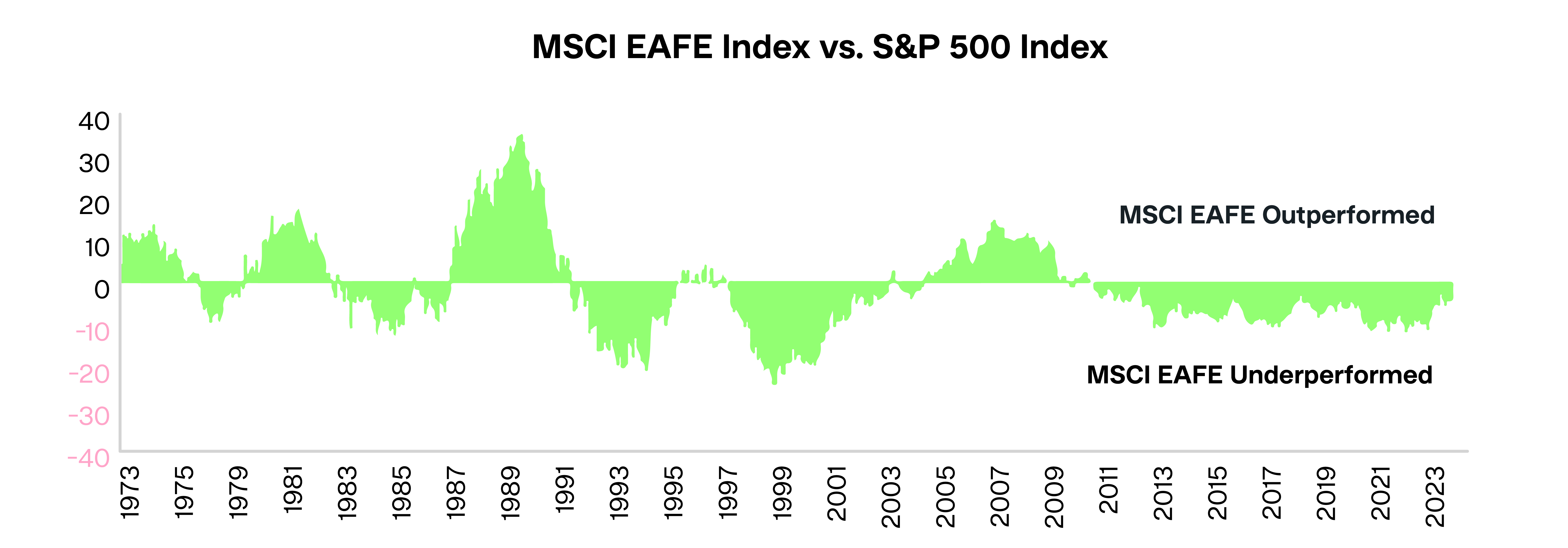
Let's delve into another illustrative example that vividly captures the dynamic shifts in the MSCI EAFE (Europe, Australasia, Far East) and S&P 500 indices over the past five decades. To understand the discrepancy between U.S. and international performance, we must start with a careful examination of sector composition. Over the last decade, the U.S. has enjoyed a positive influence due to its sector weightings, driven by substantial index allocations in the top-performing technology, consumer discretionary, and health care sectors. Conversely, the international landscape has faced challenges, primarily stemming from higher weightings in financials and industrials.
The U.S. has further reaped the rewards of robust fundamentals, particularly in the post-global financial crisis (GFC) era. Noteworthy factors include an exceptional period of sales growth, albeit concentrated in a few companies, and the unique position of the U.S. and Japan as the only major economic blocs where profit margins increased following the GFC.
However, there is no guarantee this domination will last forever. For instance, one can make a compelling case for considering international equities, especially if inflation exhibits resilience and enduring secular themes like infrastructure development, automation, defence spending, and renewable energy continue to unfold.
This is not to say it has to occur in the coming years, I’m definitely not recommending you sell all U.S. stocks and concentrate heavily on international markets. My aim is to highlight that a single region will not necessarily continue to dominate forever just because it offered superior performance over the past couple of years. Anything can happen in the global economy.
A historical analysis, depicted graphically, illustrates the ebb and flow of the two regions discussed above, showcasing their alternating and complementary performances over the decades. While the S&P 500 has outperformed the MSCI EAFE index in the past two decades, you can see that in the period before the late 1990s, it was more common for EAFE stocks to outperform the U.S. The two indices switched the leadership role many times over the observed 50 years.
This uncertainty underscores the importance of diversification in investment strategies. Instead of relying on a single winner, a prudent approach involves spreading investments across the entire market. This mitigates the risk of missing out on potential gains in case the MSCI index experiences a resurgence. Diversification ensures a well-positioned portfolio, capable of benefiting from the diverse performances of various sectors, providing a balanced and resilient investment strategy.
Source: T. Rowe Price
The significance of diversification is vividly illustrated through our preferred periodic revenue table, inspired by the renowned Callan company. Despite its initially complex appearance, this table provides a clear overview of the trajectory of various asset classes throughout a given year.
The Finax table below tracks the performance of the 10 ETFs forming the foundation of the Intelligent Investing portfolios. Each column within the table corresponds to a specific year, and the consistent color-coding for each asset class allows for an easily digestible representation of their respective yields, arranged from highest to lowest.
The primary objective of the periodic table is to emphasize the alternating pattern of colours at the summit and base of each column. It illustrates that for every asset class prosperous periods are succeeded by phases of comparatively lower performance. No single colour dominates the pinnacle of the yield ladder for an extended period, highlighting the dynamic nature of investment outcomes.
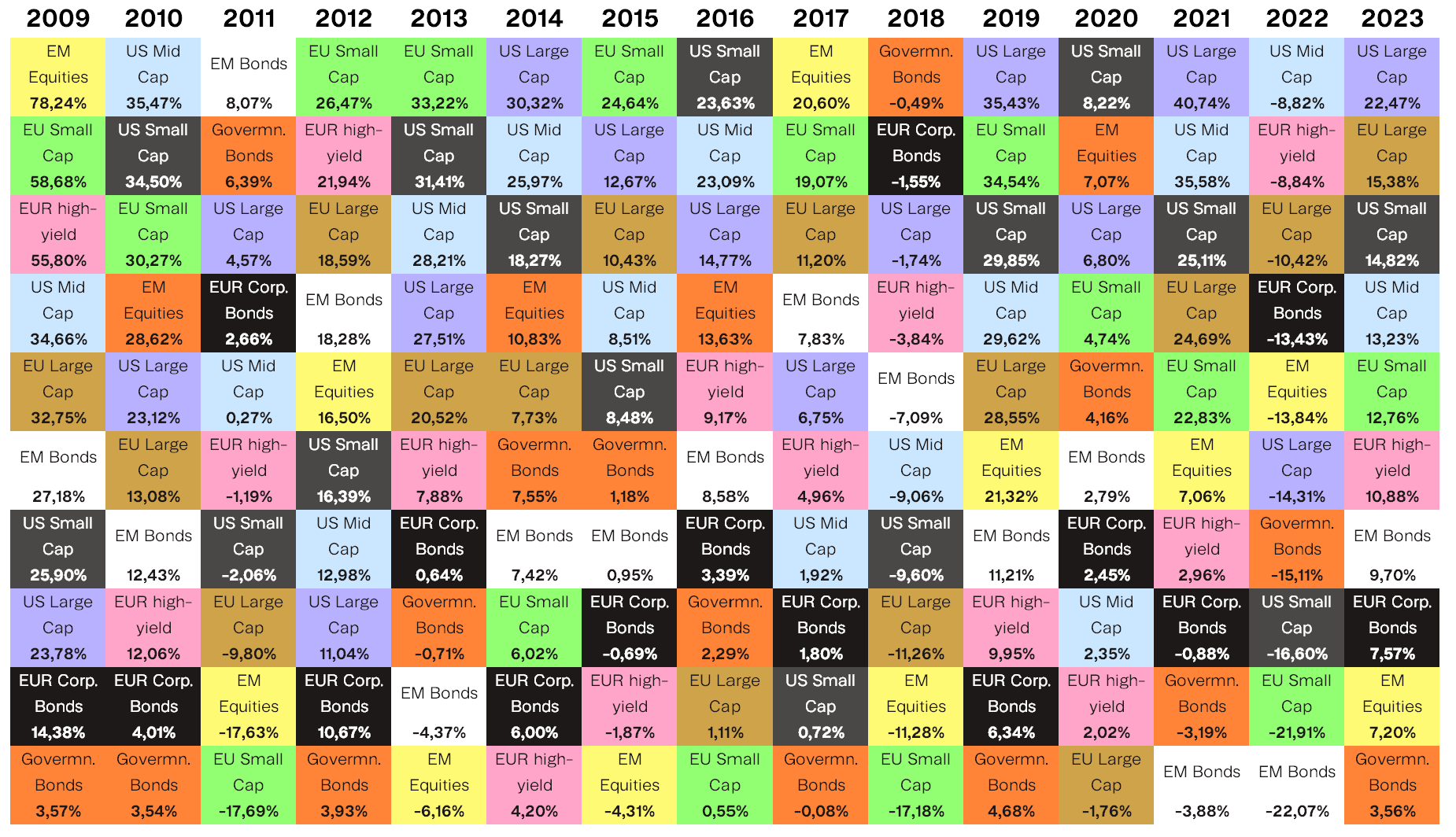
Investing wisely involves strategic decision-making, and analysing past performance can be a useful tool. For instance, if you consistently invested in the fund with the highest yield from the previous year, you could expect an average annual appreciation of 8,1 %. If you were to spread your investment equally between the previous year’s two best funds, your average return would decline to 6,9 % per year.
In contrast, employing a diversified approach, such as diluting your investment across the 100 % Finax equity portfolio with automated regular rebalancing, could yield a substantial appreciation of nearly 9,8 % per year (cumulative 268 %) during the same period. These examples vividly illustrate the advantages of diversification in optimizing returns.
It's crucial to recognize the limitation of relying solely on past performance. Historical data offers limited insights into future developments, and forecasting future market movements with confidence remains a challenge for most investors and fund managers.
Therefore, diversification serves a dual purpose. Beyond risk mitigation, it functions as a tool for enhancing and stabilizing long-term returns. Its significance lies not only in minimizing risk but also in achieving a favourable ratio between appreciation and risk. This, ultimately, forms the bedrock of a successful investment strategy.
Create an account and start investing today
What Level of Diversification Does Finax Offer?
Finax's portfolio creation was guided by the pivotal principle of risk distribution. Our objective was to introduce a versatile strategy that stands the test of time tailored for today, a decade from now, and applicable even to investors from a decade past.
Contrary to active portfolio management, where trends and market fluctuations are closely tracked, we at Finax embrace a passive approach. Steering clear of predicting asset class development, we find such practices counterproductive over the long term, as substantiated by numerous studies and our own investment results.
In our view, passive investing, involving mirroring index compositions, offers the most fitting balance between returns and risks. Successful passive investing hinges on ample diversification, and Finax proudly provides an unmatched level of risk spreading. For as little as 10 euros, you can have around 13 400 securities - 7 400 shares and 6 000 bonds.
For Irish investors, this level of diversification is also the foundation of PEPP — Finax's tax-advantaged pension product built on the same globally diversified ETF portfolios, with PRSA-equivalent tax relief.

Secure a comfortable future and take advantage of the European pension benefits
When onboarding with us, rest assured that your investment aligns with thriving businesses and assets poised for future growth. Exclusive benefits include:
- Diversification across financial asset classes: Lowering market risk with various stocks and bonds.
- Currency and interest rate diversification: Investing in assets across different currencies, from euro and dollar to exotic currencies of developing countries.
- Regional diversification: Engaging in securities from over 92 countries worldwide.
- Sector diversification: Featuring shares from all sectors of the economy and government securities.
- Size diversification: Acquiring shares from small promising companies to large established multinational corporations.
- Investment approach diversification: Inclusion of stable dividend companies, value stocks, and expanding growth stocks.
Frequently Asked Questions About Diversification and Investing
1. What is diversification in investing and why does it matter?
Diversification means spreading your investment across many different assets, sectors and regions instead of concentrating it in one place. It reduces the risk of a single company or market collapse wiping out your savings, while still capturing the long-term growth of the global economy.
2. Does diversification reduce returns?
No — done properly, it improves them. Finax data shows that a fully diversified portfolio with automated rebalancing delivered nearly 9.8% per year, outperforming strategies that chased the previous year's top-performing funds.
3. How many securities does Finax invest across?
Finax portfolios hold around 13,400 securities - 7,400 equities and 6,000 bonds - across 92 countries, all economic sectors, currencies and company sizes. This is one of the highest levels of diversification available to retail investors.
4. Is it better to pick winning stocks or invest in a diversified portfolio?
History consistently shows that picking winners is a losing strategy long term. Even professional fund managers rarely beat the market. The Tesla example in this blog illustrates perfectly how last year's top performer can become next year's biggest loss. A diversified index portfolio removes this guesswork entirely.
5. What is the most diversified way to invest for your long-term future in Ireland?
For Irish investors, combining broad diversification with tax efficiency is the smartest approach. PEPP from Finax is built on the same globally diversified ETF portfolios described in this blog, while also offering PRSA-equivalent tax relief — making it one of the most efficient ways to build long-term wealth in Ireland.
Secure a comfortable future and take advantage of the European pension benefits
Finax ensures that, regardless of market or economic fluctuations, your portfolio remains resilient. The foundational passive approach of Intelligent investing forms the bedrock of successful portfolios and wealth accumulation. Unless you seek speculative ventures or have specific investment goals, this stands as the optimal, low-risk solution.
If uncertainties surround your current financial product or you're dissatisfied with your returns, entrust your investments to Finax. Transferring underperforming investments to Finax comes with a discounted portfolio management fee, enhancing the efficiency of our investment product.