 Difficulty
However, stock markets did face geopolitical shocks during the month. In mid–January, the world was unsettled by the U.S. President's remarks regarding the annexation or purchase of Greenland, accompanied by threats of increased tariffs on goods from the European Union. Tension also persisted in the Middle East when Trump expressed interest in involving U.S. armed forces in the protests in Iran.
Investors, however, have largely grown accustomed to such rhetoric over the past year. Trump has repeatedly used the threat of high tariffs or military operations as a scare tactic, though it has consistently been followed by a willingness to negotiate. It was a similar story with Greenland, where the United States, instead of annexation, settled for an agreement to increase its influence in the autonomous Danish territory within the framework of NATO cooperation.
Investors therefore focused their attention primarily on economic indicators, which proved encouraging. The GDP of Europe's economic powerhouse, Germany, increased by 0.3% in the 4th quarter after a long period of stagnation (Destatis), while projected growth in the United States showed a robust increase of 4.2% (according to the Federal Reserve Bank of Atlanta).
The S&P 500 index of large U.S. companies improved by 1.4%, while the Stoxx 600 index of large European companies rose by 3.1%. Economic health, especially in Europe, was reflected in growth across sectors, not just in traditionally strong banking and technology. However, the tech sector is simultaneously facing discussions about the possible overvaluation of investments in AI industries.
When comparing the United States and Europe, we continue to see a trend of lower interest in American assets in favor of European ones. This development was also reflected in currencies – the value of the dollar against the euro fell by approximately 1% during the month. Since we hold securities focused on U.S. stocks in dollars without currency hedging, this movement caused a decline in the U.S. component of our clients' portfolios.
Asia is taking advantage of the escalating tension between America and Europe. The Asia index (excluding Japan) rose by 6.1% as capital flowed toward emerging economies. Asia was driven primarily by South Korea and Taiwan with their advanced semiconductor industries, which are essential for the development of artificial intelligence. Growth was also supported by the weak U.S. dollar – since they can obtain more dollars for their own currency, existing loans become cheaper.
Bond markets had mixed performance in January. With bonds, it is important to remember that yields move inversely to their prices – when yields rise, bond prices fall, and vice versa.
In the United States, yields on government bonds rose slightly during the month, which meant a decline in their prices. The yield on the 10-year U.S. bond increased to approximately 4.26%. Thus, January was not particularly favorable for U.S. bonds.
Several factors were behind the rise in yields: increased geopolitical tension, renewed discussions about a possible weakening of Fed independence in connection with the investigation surrounding Jerome Powell, and strong economic data, such as the projected decline in the unemployment rate (Federal Reserve Bank of Chicago). These reduced expectations that the central bank would lower interest rates more aggressively.
Despite this, bond ETFs ultimately ended with a slight gain, as yields in other regions of the world fell and bond prices rose. The weaker performance in the USA was thus offset by better results in other parts of the world, such as increased interest in German bonds due to GDP growth, French bonds due to political stabilization, and corporate bonds.
Precious metals, which reached all–time highs at the end of 2025 and continued to grow in January, saw a more significant decline in early February. These events remind us of an important lesson: when investing, savings must be spread across regions and sectors rather than betting most of our savings on what has grown the most recently.
Among the ETF funds included in our portfolios, the top performer was the fund tracking emerging market stocks, which achieved 6.35% growth. The highest loss was recorded by the S&P 500 index fund of large U.S. companies, at 0.47%.
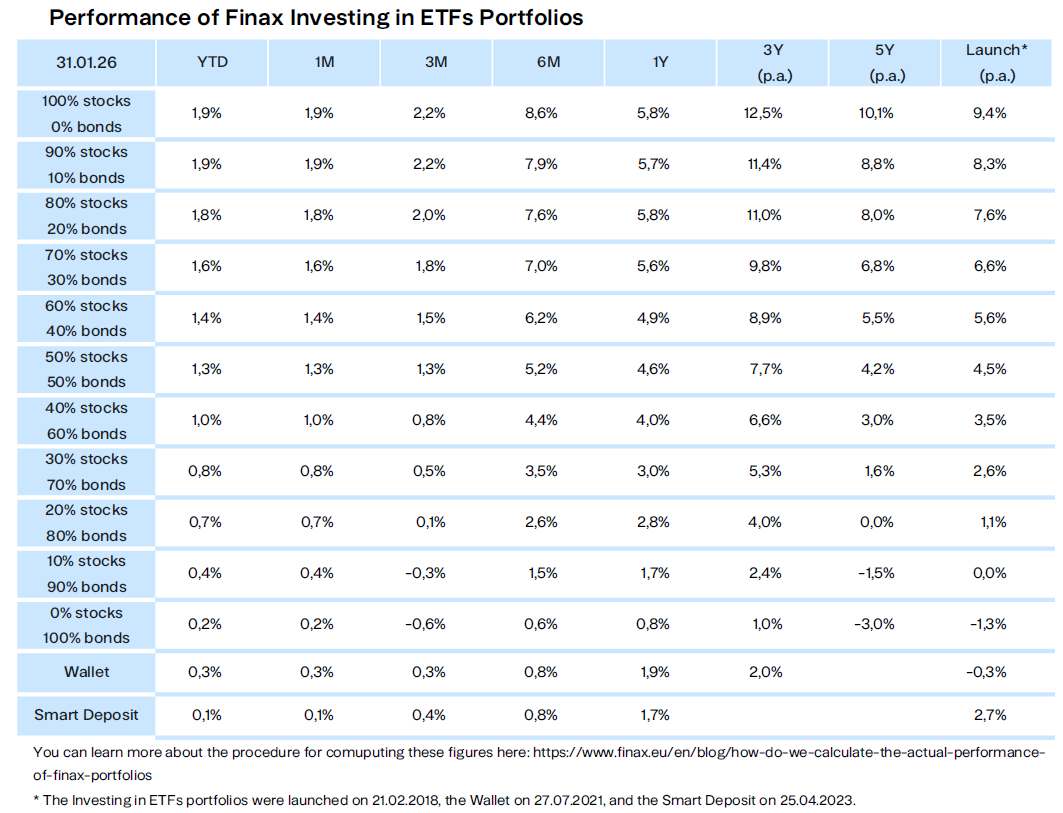
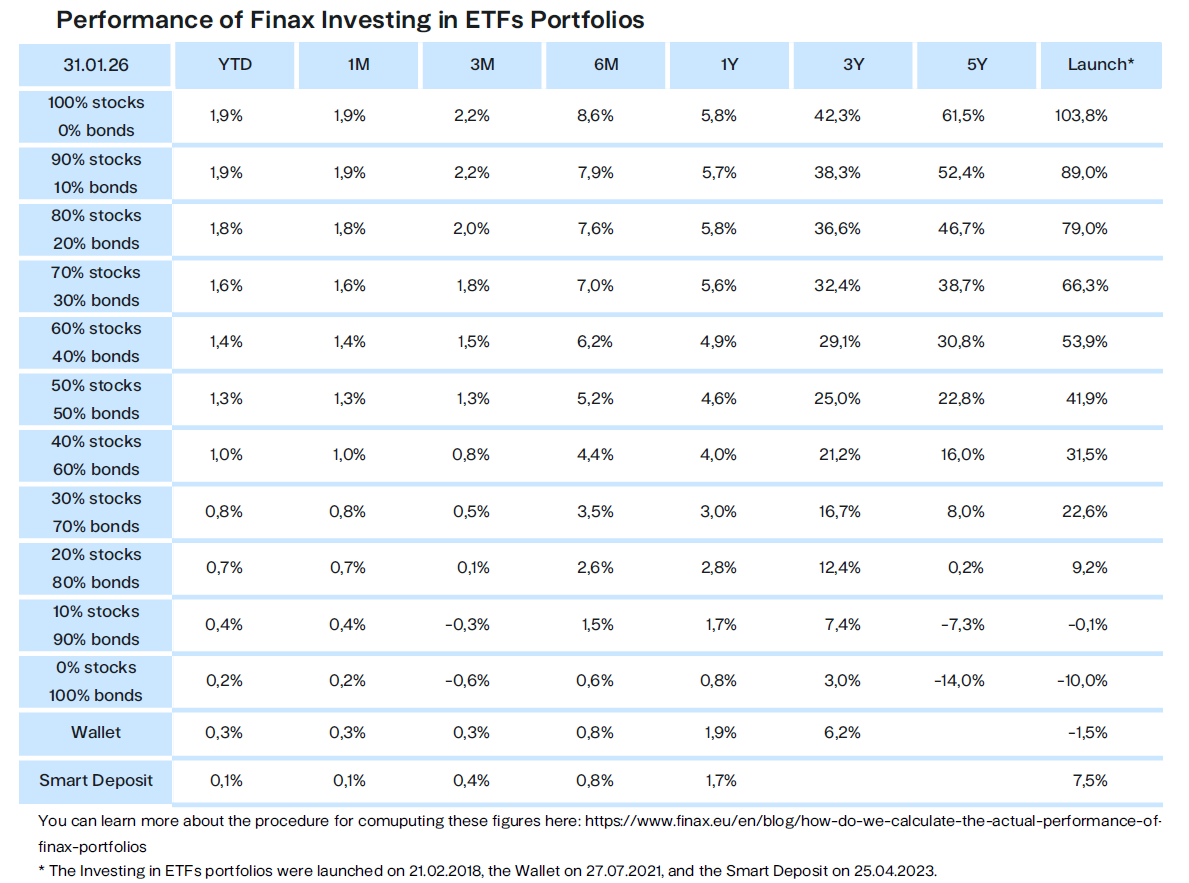
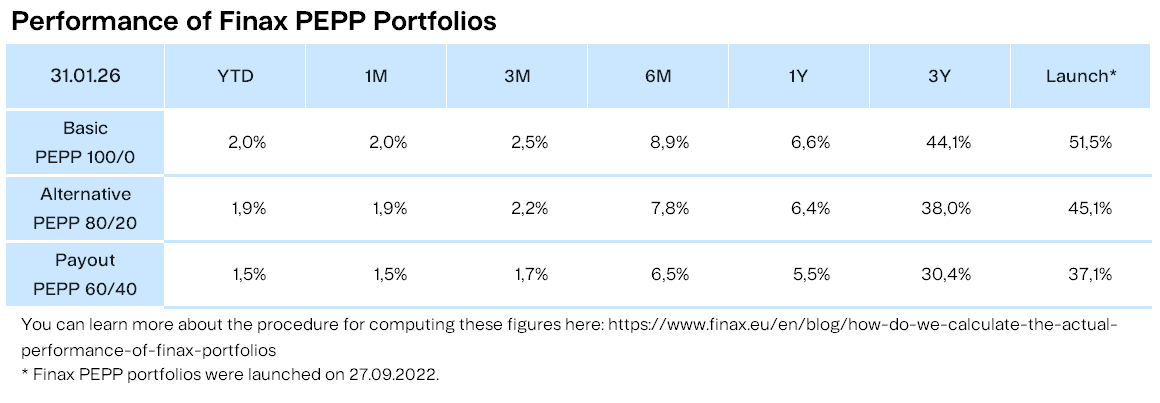
The most significant growth among our ETF Investment strategies was recorded by the dynamic 100/0 portfolio (stock/bond ETFs), which grew by 1.93%. The 0/100 bond strategy grew by 0.18%. The value of the Wallet increased by 0.29%, and the Smart Deposit improved by 0.14%.
At Finax, we diversify your investments to bring you the highest possible appreciation without unnecessarily increasing risk. January’s developments reminded us that:
- investments must be spread globally (emerging markets grew the most),
- one should not panic when looking at negative news (Trump's threats about Greenland did not move the markets),
- in investing, you benefit from the growth of the global economy, which appears to be in good health.