 Difficulty

The main phenomenon of December was commodities. Brent and WTI crude oil prices fell in the middle of the month to their lowest levels since the beginning of 2021. This was largely caused by escalating tensions between the United States and Venezuela, which resulted in the detention of the Venezuelan president at the beginning of the year. The events led to a drop in prices due to Trump's plans to increase oil production in this South American country, which holds the largest oil reserves in the world.
Gold continued in the opposite direction and reached all-time highs during Christmas Day. Precious metals, especially gold and silver, tend to rise during periods of social and economic uncertainty. We see this today in the form of the ongoing war in Ukraine, crises in the Middle East, China's growing presence in the South China Sea, and the unpredictability of the current US administration's actions.
At the same time, there is a gradual diversification of international trade reserves. While in the past, profits generated in US dollars were traditionally invested in US Treasury bonds, growing uncertainty in US political decisions increases the attractiveness of precious metals as an alternative store of value.
US stock markets avoided extreme movements. Investors chose a cautious approach due to continued concerns about overvalued tech stocks, trade restrictions, or a weakening dollar.
Investors therefore continued to look for opportunities overseas. Growth in stocks within the financial and defense sectors continued in December, and the European Stoxx 600 index rose by 2.8%. China also fared well. Rising precious metal prices and government reforms were reflected in a 2.1% increase in the Shanghai Composite index.
In America, even the traditional "Santa Claus rally", a short period of stock market growth around Christmas, failed to materialize this time. The S&P 500 index remained more or less at the same level in December. However, as the dollar weakened during the month, our Euro-based investors recorded a slight loss on American stocks.
Inflation in the United States slowed to 2.7% in November, which was 0.3 percentage points lower than expected. The US Federal Reserve therefore lowered interest rates to the 3.5% – 3.75% range, marking the third rate cut in 2025.
It was led to this step mainly by a weaker-than-expected impact of tariffs on the resilient US economy and a slight increase in unemployment to 4.6%. Other Q3 indicators also beat expectations: the United States recorded GDP growth of 4.3%, China grew by 1.1%, and the Eurozone by 0.3%.
Among the ETFs included in our portfolios, the best performer was the fund tracking large European companies, which achieved 2.9% growth. The highest loss was reported by the S&P 500 large-cap US stock ETF, at 0.4%.
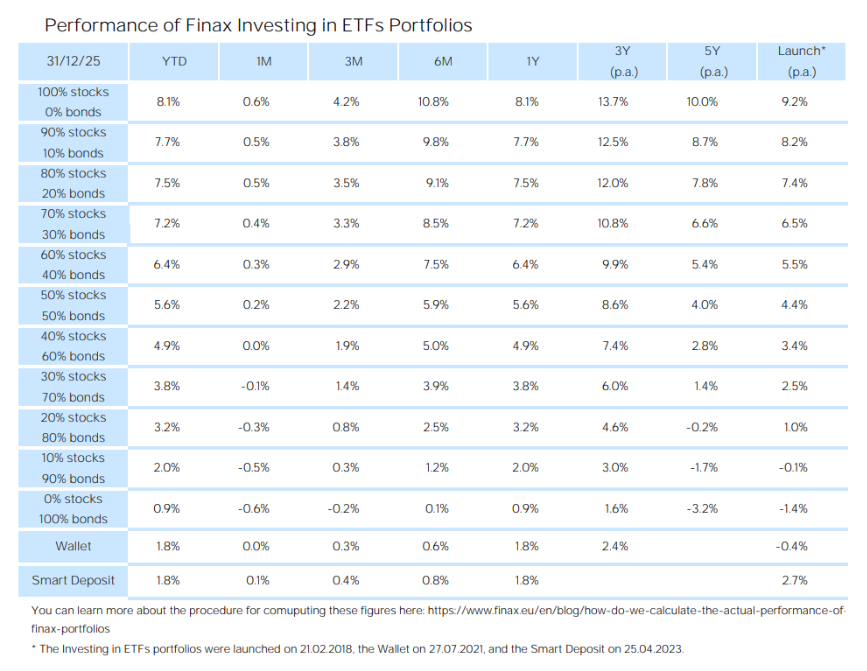
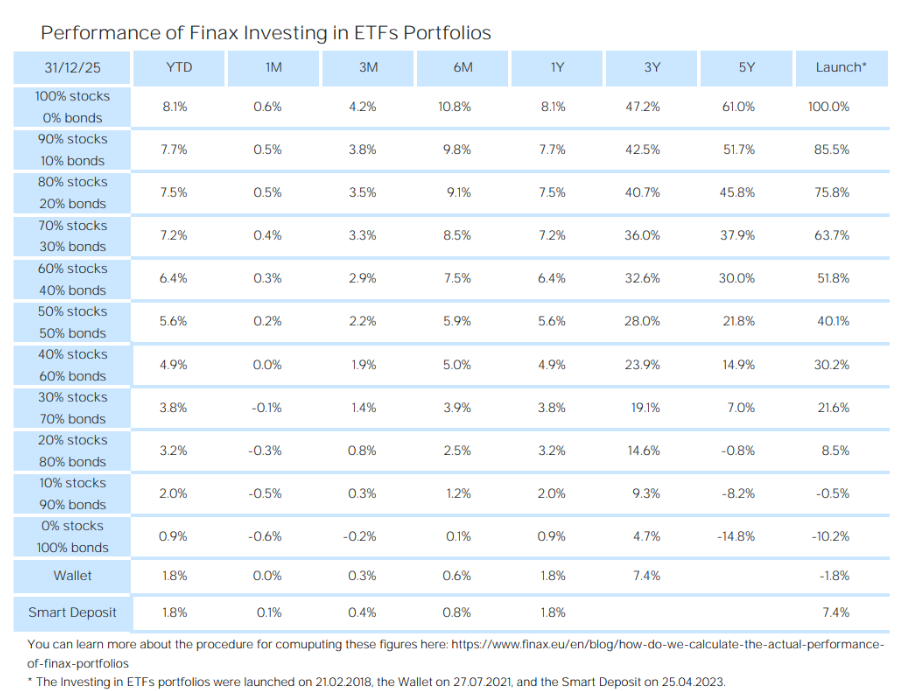
The most significant growth among our Investing in ETFs strategies was recorded by the dynamic portfolio 100/0 (stock/bond ETFs), which grew by 0.6%. The bond strategy 0/100 fell by 0.65%. The value of the Wallet remained flat and Smart Deposit gained 0.13%.