 Difficulty
The war between the US and Iran is nearing its end after more than four months. Presidents Trump and Pezeshkian signed the Islamabad Memorandum on June 17, ending hostilities between Iran, the United States, and Israel. Iran agreed to reopen the Strait of Hormuz, through which a large share of the world's oil passes, and the US lifted its naval blockade of Iranian ports.
For now, though, this is only a framework agreement for the next 60 days, during which the parties will tackle the toughest issues, especially the future of Iran's nuclear program and how much uranium Iran can produce for energy purposes.
News of the deal sent Brent crude prices sharply lower. While oil was still trading just below $100 per barrel in May, it dropped to as low as $77 after the memorandum was signed. A return to pre-war prices won't happen overnight, though. Experts point out that fully restoring production and shipping through the strait could take months, as tensions remain high and restarting well operations is a complex process.
The Middle East conflict, combined with the long-term loss of Russian fossil fuels, caused an energy shock in Europe and a rise in inflation along with it. The European Central Bank responded by raising interest rates from 2% to 2.25%.
US stocks took a breather in June after two strong months. The S&P 500 fell 1.1% in dollar terms, but overall it had one of its best quarters in recent years. The June dip was driven mainly by tech and semiconductor stocks, which were weighed down by doubts about the return on AI investments and weaker smartphone demand.
Our clients' gains in June were also boosted by a stronger US dollar, which gained about 2% against the euro. Finax does not hedge its US stock exposure against currency risk, so a rising dollar increases client returns. On the other hand, when the dollar weakens, our clients earn less.
The Russell 2000 index of small US companies, on the other hand, rose 3.6%. Investors started paying more attention to companies focused on the domestic economy rather than big tech giants.
European stocks performed aswell. The Stoxx 600 index of large European companies has now risen for three months in a row, repeatedly hitting all-time highs and closing out its strongest quarter in more than five years. It was helped by excitement around AI and the easing of tensions in the Middle East.
June also brought the largest IPO in history. SpaceX went public on the Nasdaq on June 12 with a share price of $135. It raised roughly $75 billion from investors, making Elon Musk the world's first trillionaire.
On its very first day of trading, the stock jumped 19% and the company's value topped $2 trillion, even though SpaceX is still unprofitable. The shares then fell nearly a fifth from their peak. The risk this company poses to our portfolios remains zero, since SpaceX does not yet meet the profitability requirement for inclusion in the S&P 500 index that we use.
And one more fun fact to wrap up: the FIFA World Cup kicked off in North America in June. According to a FIFA study, the tournament is expected to contribute nearly $41 billion to the global economy (roughly half of Panama's annual GDP).
On the currency markets relevant to us, the euro weakened by 0.16% against the Czech koruna, gained 0.33% against the Hungarian forint, and strengthened by 1.65% against the Polish zloty.
Among the ETFs in our portfolios, the fund tracking small US companies (Russell 2000) performed best, gaining 5.9%. The worst performer was the fund focused on small European companies (MSCI Europe Small), which fell 2.8%.
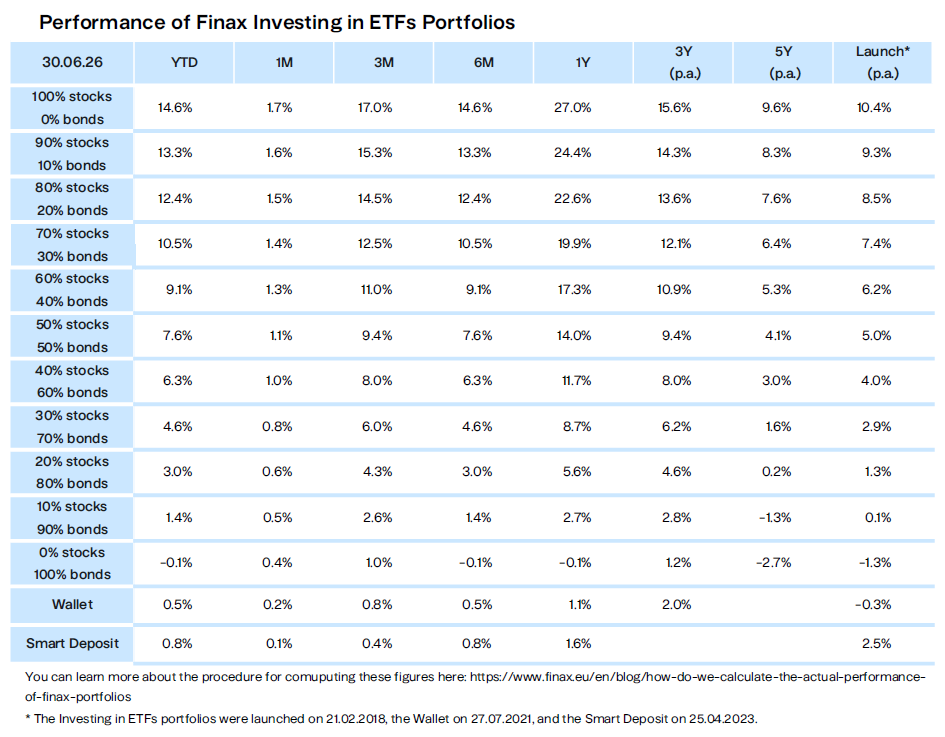
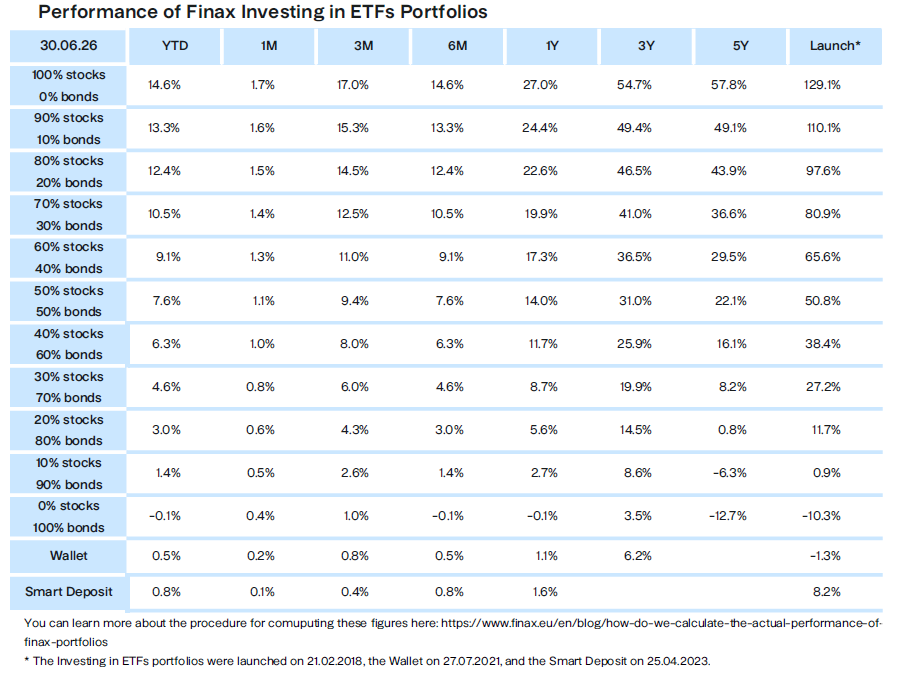
Among our strategies, June had the most positive impact on the 100% equity portfolio, which rose 1.7%. The smallest gain went to the 100% bond portfolio, at 0.4%.
Wallet grew by 0.2% and Smart Deposit gained 0.1%. After the ECB rate increase, their gross yields to maturity stood at 2.2% for the Smart Deposit and 2.5% for the Wallet*.
In July, we will be watching how the restoration of oil production and shipping through the Strait of Hormuz progresses. The second-quarter earnings season will also kick off, revealing how high energy prices and spring geopolitical tensions affected corporate profits. It will also be interesting to see how other major AI companies like OpenAI and Anthropic prepare for their own IPOs following SpaceX's successful debut.
June's developments reminded us of a few important things:
- Patience and adherence to a long-term investment horizon are the best response to unexpected swings and shocks.
- Sometimes the markets that have been lagging start to catch up, as small US stocks did this quarter. That's why diversification matters – it means we don't miss out when they do.
- Investing in individual stocks is an all-or-nothing bet, but investing in broad stock indexes lets us benefit from their growth while taking on less risk.
*This is the gross yield to maturity as of June 18, 2026, as reported by the ETF providers. It is variable, tied to the ECB's base deposit rate and interest rates on euro bond markets, and does not include the Finax fee of 0.5%. This yield may change in line with interest rate developments and is not a reliable indicator of future performance.