 Difficulty
The most important topic of the month was the question of whether the enormous investments in artificial intelligence are starting to pay off. Investors' attention shifted from AI's ambitions to its profitability, i.e. to when the billions poured into data centers will turn into real profits.
Investment therefore flowed out of the large technology companies into the rest of the market.
The rest of the market thus managed to outperform the largest technology companies unusually strongly. While the equally weighted S&P 500 index rose by 0.78%, the technology-focused Nasdaq 100 lagged behind it by 6.6%. In an equally weighted index every company carries the same weight, whereas in classic market-cap-weighted indices the technology giants carry the highest weight. The rise of the equally weighted index therefore shows that the rest of the market did decently compared with the largest companies.
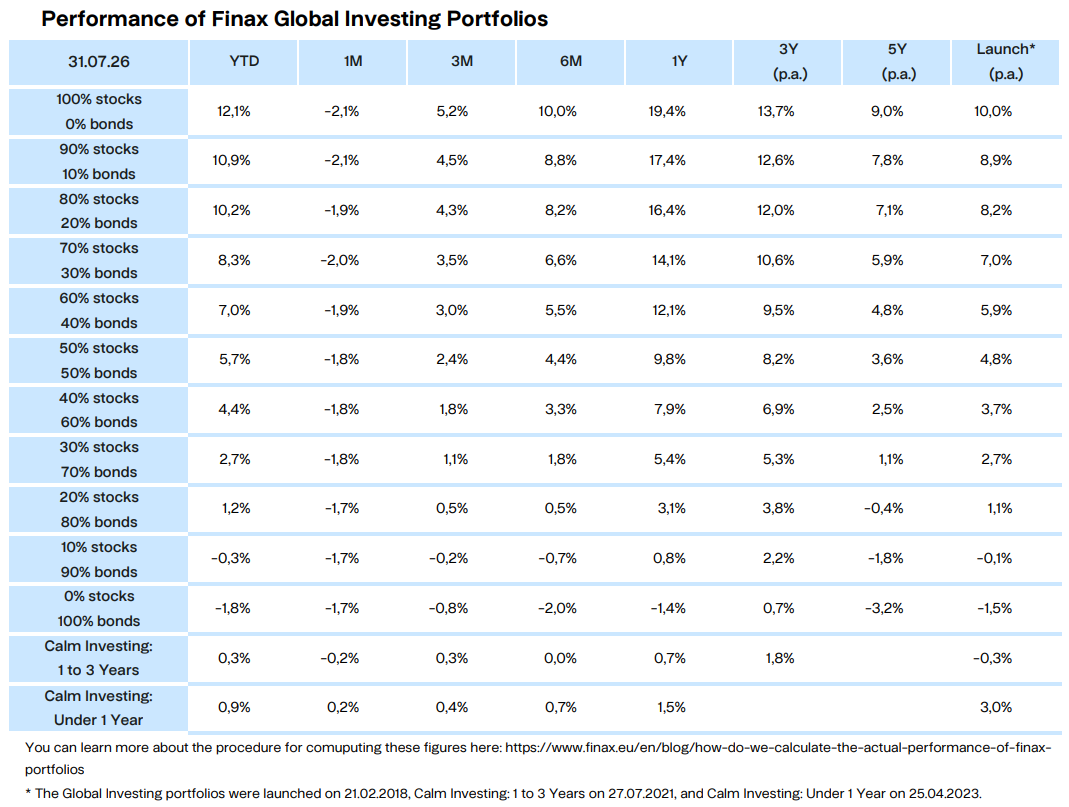
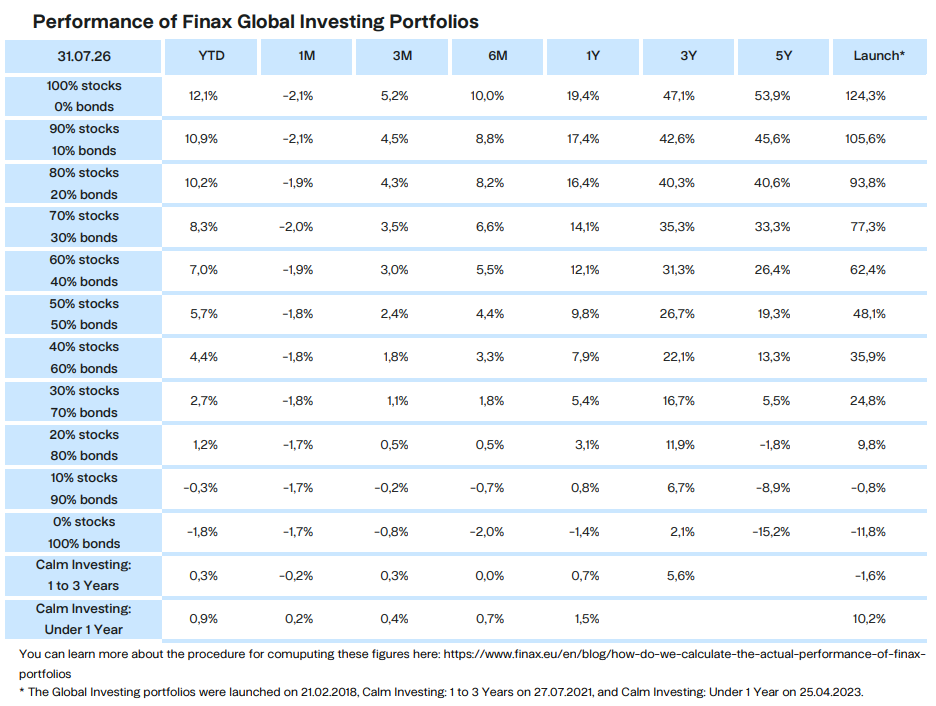
Although technology has had a tough month, our equity portfolio fell only slightly, as the rest of the market supported it. This is exactly where the strength of diversification shows.
July also brought us an instructive real-world story. You may have read in the media about the hedge fund Situational Awareness, which since its inception has delivered extreme returns thanks to a bet on AI companies. However, because it also invested borrowed money, the sharp decline forced it to sell its positions at an unfavorable price to the rival fund Citadel. In doing so it lost 77% of its assets under management (EUR 35 billion). This shows the pitfalls of portfolio concentration and of seeking shortcuts with borrowed money.
The bond market also went through a decline. Prices of existing bonds fell because of a rise in market yields. The yield on the 30-year US government bond climbed to 5.25%, the highest since 2007, and the 10-year yield exceeded 4.7%, the most since January 2025. Higher bond yields also reduced investors' willingness to pick dynamic growth stocks, whose value rests mostly on distant future profits.
As for the seemingly endless war in Iran, the oil market went through a turbulent month. Prices moved back and forth between optimism about diplomacy in the Middle East and fears of the conflict escalating again, which keeps uncertainty around energy prices in Europe.
Asia suffered the most among the markets we track. Japan's Nikkei 225 index lost 8.1% as a correction hit semiconductor and AI stocks, which had driven it higher in the first half of the year.
Finally, one more interesting fact: the first half of 2026 was the best start to a year for small US companies since 1991. The Russell 2000 index has added 22% over seven months. Just a year ago small companies were lagging behind the rest of the market - a nice illustration of why it does not pay to write off any part of a portfolio.
On the currency markets relevant to us, the euro weakened by 0.23% against the Czech koruna, gained 2.49% against the Hungarian forint, and strengthened by 0.23% against the Polish zloty.
Among the ETFs in our portfolios, the fund tracking small European companies gained the most, rising by 3.1%. The biggest loser, by contrast, was the fund focused on emerging market equities, at -7.1%.
Among our Global Investing strategies, the 90/10 strategy recorded the sharpest decline, of 2.1%. The conservative bond portfolio fell by 1.7%.
The Wallet posted a decline of 0.2% and the Smart Deposit rose by 0.2%. Their gross annual yields to maturity at the end of July stood at 2.2% for the Smart Deposit and 2.6% for the Wallet*.
Since the beginning of August we have given these two products a common name, Calm Investing, with the Smart Deposit to be called Calm Investing: Under 1 Year and the Wallet becoming Calm Investing: 1 to 3 Years.
In August we will be watching how the rest of the second-quarter earnings season turns out and whether it confirms that corporate profits are growing outside the technology sector as well. It will also be key whether rising bond yields start to compete with returns on equity markets.
July's developments have once again reminded us of several important things:
- The market is not just a handful of technology giants. When they have a bad month, the rest of the market can still grow.
- Strong economic results do not necessarily mean rising share prices. What investors expected also matters.
- No one can predict in advance when companies in one sector will stop doing well and other stocks will start beating them. That is why you should invest across the whole world.
*This is the gross yield to maturity as at 31 July 2026 as stated by the providers of the ETF products. It is variable, tied to the ECB's base deposit rate and to interest rates on euro bond markets, and it does not include Finax's fee of 0.5%. This yield may change in line with the development of interest rates and is not a reliable indicator of future performance.