 Difficulty
Tech kept the market afloat again. Artificial intelligence helped lift stocks, and the technology and communication services sectors were the only two sectors that rose in September.
Even so, the US S&P 500 index lost 0.5% in dollar terms over the month. For euro investors, however, it ended in positive territory by about 2.9% in our portfolios. That is because the euro weakened against the dollar. Put simply, one dollar now gets you more euros than before.
US stocks are bought in dollars, and when you convert their value into euros, it comes out higher even though it fell slightly in dollars. Bank and financial stocks fell the most, as their costs went up. After the rate hike, they pay higher interest to clients on deposits and to the lenders they borrow money from.
Smaller companies fared worse. They are more sensitive to interest rates, as they borrow more often. As a result, the US S&P 400 index of mid- and small-cap companies posted a 1.4% loss. The index of large European companies fell by 2.5%. A bright spot was Japan, which was among the best-performing markets of the month.
Emerging markets outperformed developed ones. They were helped mainly by a rebound in South Korean stocks, which offset the decline in China.
Once again, though, the most turbulent market was bonds. Most Finax investors use them as a complement to smooth out portfolio swings, or for short-term investments.
When bond yields rise, the price of bonds already issued falls. The reason is simple: nobody wants to buy an older bond with a lower interest rate at full price when they can buy a new one with a higher rate. The yield on the 10-year US Treasury rose by more than 0.5 percentage points in September alone and broke through the 5% mark. The last time it was this high was in 2002.
There are three main reasons behind the rise in yields.
The first is a strong economy. The Atlanta Fed's estimate points to GDP growth of 3.7% for the third quarter. When the economy is doing well, investors expect the central bank to keep interest rates higher for longer.
The second is expensive energy. Refinery outages in the Middle East and Russia sent the price of Brent crude back above $100 a barrel, and diesel in the US hit a record $6.53 a gallon. Investors therefore expect inflation to stay above the 2% target for longer and are demanding higher yields from bond issuers.
The third is concern about debt. US debt exceeded $40 trillion over the summer, and the US president promised every adult American $5,000 if Republicans win the upcoming congressional elections. When the government needs to borrow more and more, investors want a higher reward for it.
In August, the US Treasury Department itself tried to tame yields through bond buybacks. The $6 billion intervention in a US government debt market worth roughly $32 trillion had only a small effect.
In the end, it was the Fed that took the decisive step. Its new chair, Kevin Warsh, pushed through a 0.25 percentage point rate hike. And another hike is likely before the end of the year.
One more interesting fact: according to a September report by the US Census Bureau, for the first time in history there are more people over 65 in the world than children aged 5 and under. In 2025, there were roughly 852 million people aged 65 and over, and by 2060 their number could reach as many as 2 billion. Fewer workers supporting more retirees means greater pressure on pension systems, which is why it pays to start building your own retirement savings as early as possible.
On the currency markets relevant to us, the euro strengthened by 1.14% against the Czech koruna, gained 0.38% against the Hungarian forint, and strengthened by 0.8% against the Polish zloty.
Among the ETFs in our portfolios, the fund tracking large US companies in the S&P 500 gained the most, rising 2.9%. The biggest loser, on the other hand, was the emerging market bond fund, down 3.6%.
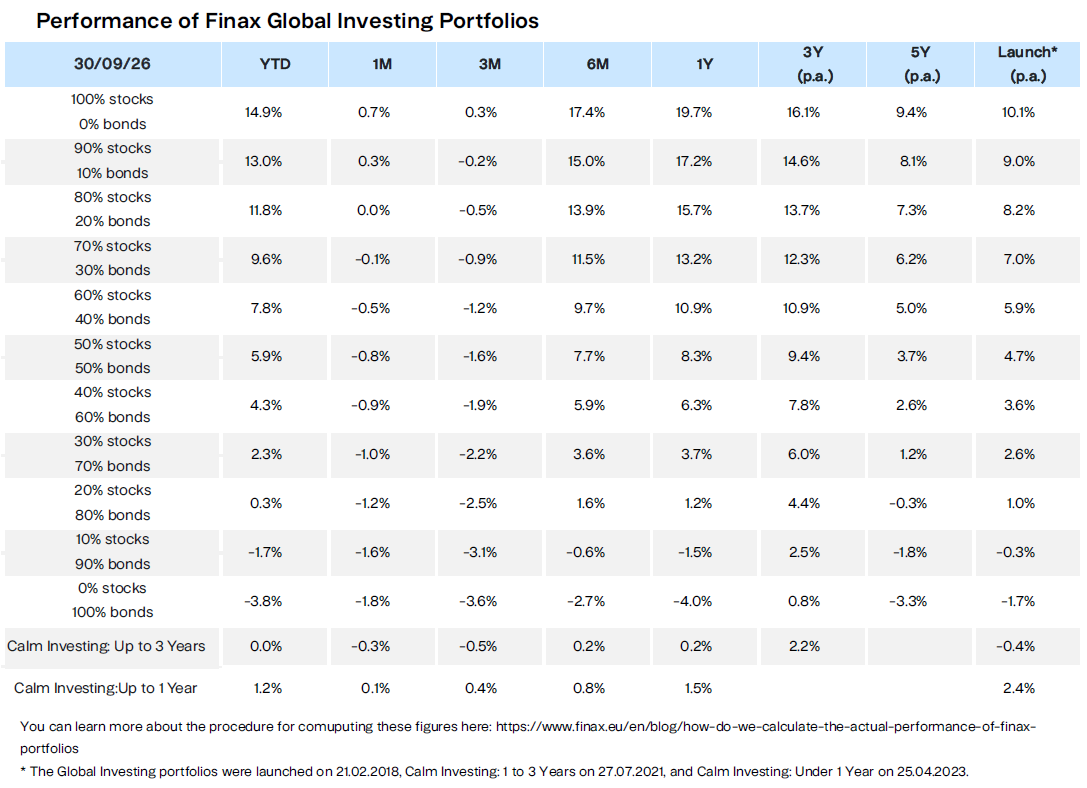
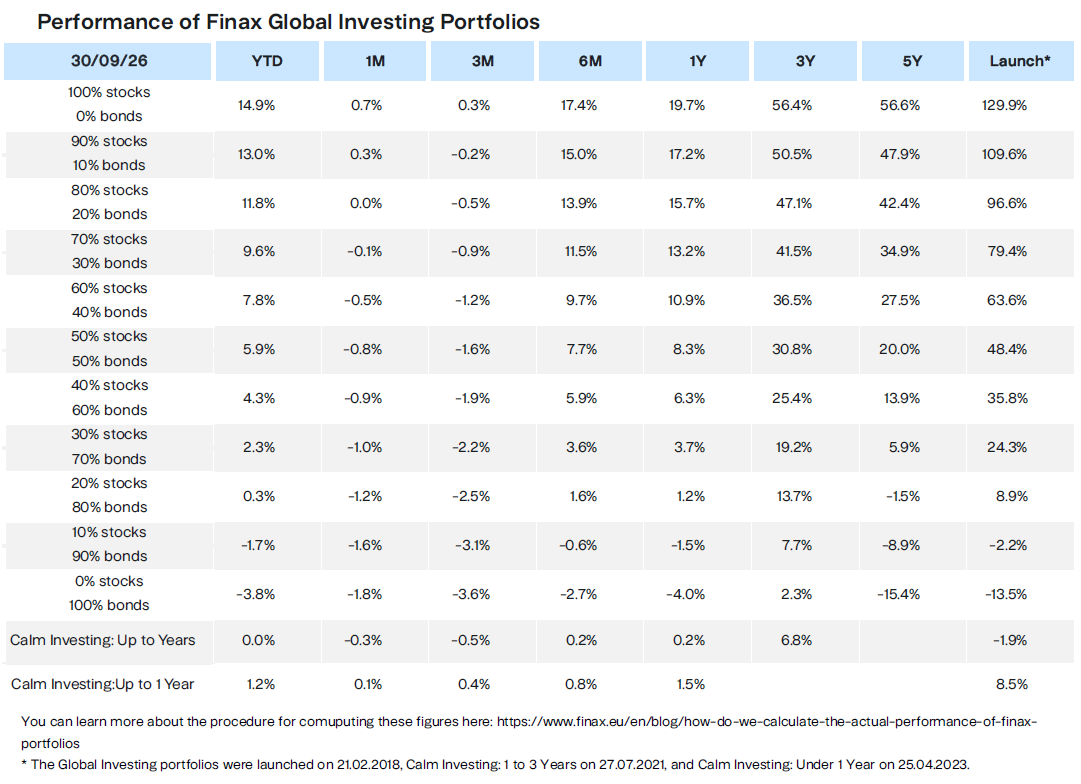
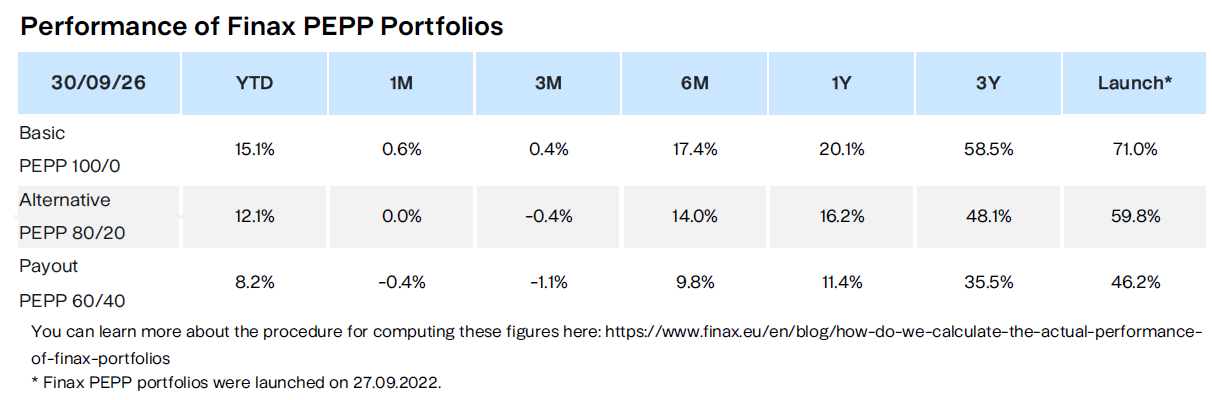
Among our Global Investing strategies, the 100% equity strategy posted the strongest gain, at 0.7%. The conservative bond portfolio fell by 1.8%, mainly due to the rise in yields mentioned above.
In Calm Investing, the 1 to 3 Years strategy declined by 0.35%, while the Under 1 Year strategy rose by 0.14%. Their gross annual yields rose after the European Central Bank's interest rate hike. As of 17 September, they stood at 2.5% for the Under 1 Year strategy and 3.0% for the 1 to 3 Years strategy*.
In October, we will be watching the earnings season closely. We will be interested to see whether investments in artificial intelligence are starting to bring companies real returns. It will also be important whether expensive energy starts to show up more clearly in inflation and how central banks respond.
September's developments reminded us of a few things:
- Stocks and bonds can occasionally fall at the same time. In long-term investing, however, the results of a single month are not what matters.
- Even the government cannot go against the market in the long run. That is why we rely on regularity and diversification instead of guessing the next move.
- Rising yields also have a bright side. Those who invest regularly buy new bonds with higher yields, which they can benefit from in the years to come.
*This is the gross yield to maturity as of 17 September 2026, as stated by the ETF providers. It is variable, linked to the ECB's deposit facility rate and interest rates in euro bond markets, and does not include the Finax fee of 0.5%. This yield may change in line with interest rate developments and is not a reliable indicator of future performance.