 Difficulty
The impulse almost always comes from outside. The bank will most likely offer you a supplementary pension savings plan when you make a deposit, call you with a “special offer,” or a colleague or friend will recommend a product to you. A recommendation can be a good starting point. But the decision itself should be based on the product's terms and your own needs.
The first question you should really ask is different: is this really the best offer? A bank is a great place for transactions and for safely keeping money you'll need in the near future. But what about assets you want to use many years from now, for example for your children's future or for retirement?
Let's first distinguish between saving and investing. A savings account or a term deposit serve a different purpose than a stock portfolio. We'll explain why we don't recommend keeping long-term savings in them, even though many Europeans do exactly that. For long-term investing, we'll mainly compare mutual funds offered by banks with ETF portfolios at Finax.
In this article, I'll cover five aspects:
We can't know an investment's future return. But we can check its costs and rules in advance.
Security: Who Oversees Your Money and How Is It Handled?
Banks have been part of our lives for centuries. The oldest bank still operating today was founded in the Italian city of Siena in 1472. A long history, well-known brands, and a wide network of branches all help create a sense of security and trust. But the safety of banks rests above all on strict rules, capital and liquidity requirements, and supervision to ensure they're followed.
When it comes to investing, though, we still run into fraudulent schemes and promises of quick riches that damage trust in the financial markets. That makes it ever more important to check who you're entrusting your money to, whether they are licensed to conduct their business activities, and the relevant supervisory body.
Other financial institutions are also subject to strict rules and supervision. Finax, for example, is a licensed investment broker. It must follow investor-protection rules and keep client assets separate from the company's own assets, as required by EU and Slovak legislation (as Finax is headquartered in Slovakia). The difference lies in what happens to your money next.
When you put money into a deposit product, you're essentially lending it to the bank. The bank uses it in its own business and lends it on to households, companies, and the state. That's exactly why bank deposits in the EU are protected by national deposit protection schemes up to €100,000. The guarantee exists precisely because someone else is using your money.
With investing, it's the other way around. The securities in your portfolio remain exclusively in your possession. Client assets sit in separate accounts, and securities are held in custody by a custodian (in Finax's case, at the Belgian bank KBC), separately from the company's own assets.
As a Slovak investment broker, Finax and its clients fall under the protection of Slovak Investment Guarantee Fund (Garančný fond investícií, GFI), which covers client claims up to €50,000 if client assets become unavailable. The GFI does not cover losses caused by market fluctuations, meaning declines in the value of investments you've purchased.
Assets held in mutual funds are protected in a similar way, kept separately with a depositary.
Both paths have their own protection, and both are regulated. You're not choosing between something safe and something risky, but between two regulated options.
Returns: Where Does the Yield on Your Money Come From?
The interest in a savings account or a term deposit isn't a reward for how well the economy is doing. It's the price the bank pays to borrow your money. It raises funds on the market at one rate, pays you a lower one, and the difference is its margin. When the ECB rates rise, that margin usually grows faster than your interest rate does. With a fixed-rate term deposit, the agreed interest rate stays the same for the whole term.
Before we move on to more popular Global Investing portfolios, I'll also highlight our conservative solution, Calm Investing. It uses conservative ETFs, and its return moves with interest rates and bond market developments. Unlike bank term deposits, it achieves returns comparable to current interest rates, since we don't profit from the gap between European Central Bank rates and your interest. We don't borrow your money; we simply invest it. And the biggest difference? With a term deposit, your money is locked in. With Calm Investing, it isn't.
Calm Investing is an investment, though, not a deposit. Its value can fluctuate, and the result can even be a loss. It isn't covered by the Deposit Protection Fund guarantee; instead, it falls under the Investment Guarantee Fund.
Now let's look at investing in stocks and bonds. Their return works differently. Through equity ETFs, you participate in business results of many companies across different countries and industries. Bond ETFs invest in the debt of governments and companies. At Finax, we tailor the combination of the two to your investment goal and investment horizon.
Let's look at this in numbers. Say you have €10,000 that you likely won't need for 15 years. The calculation doesn't include fees:
- At 2% a year, a typical level for a conservative interest-bearing product, you'll have approximately €13,500.
- At 8% a year, which corresponds to the long-term average of the global stock market, you'll have approximately €31,700.
The difference is more than €18,000 on the exact same amount invested. Of course, these figures are purely illustrative, and the risk involved needs to be pointed out too.
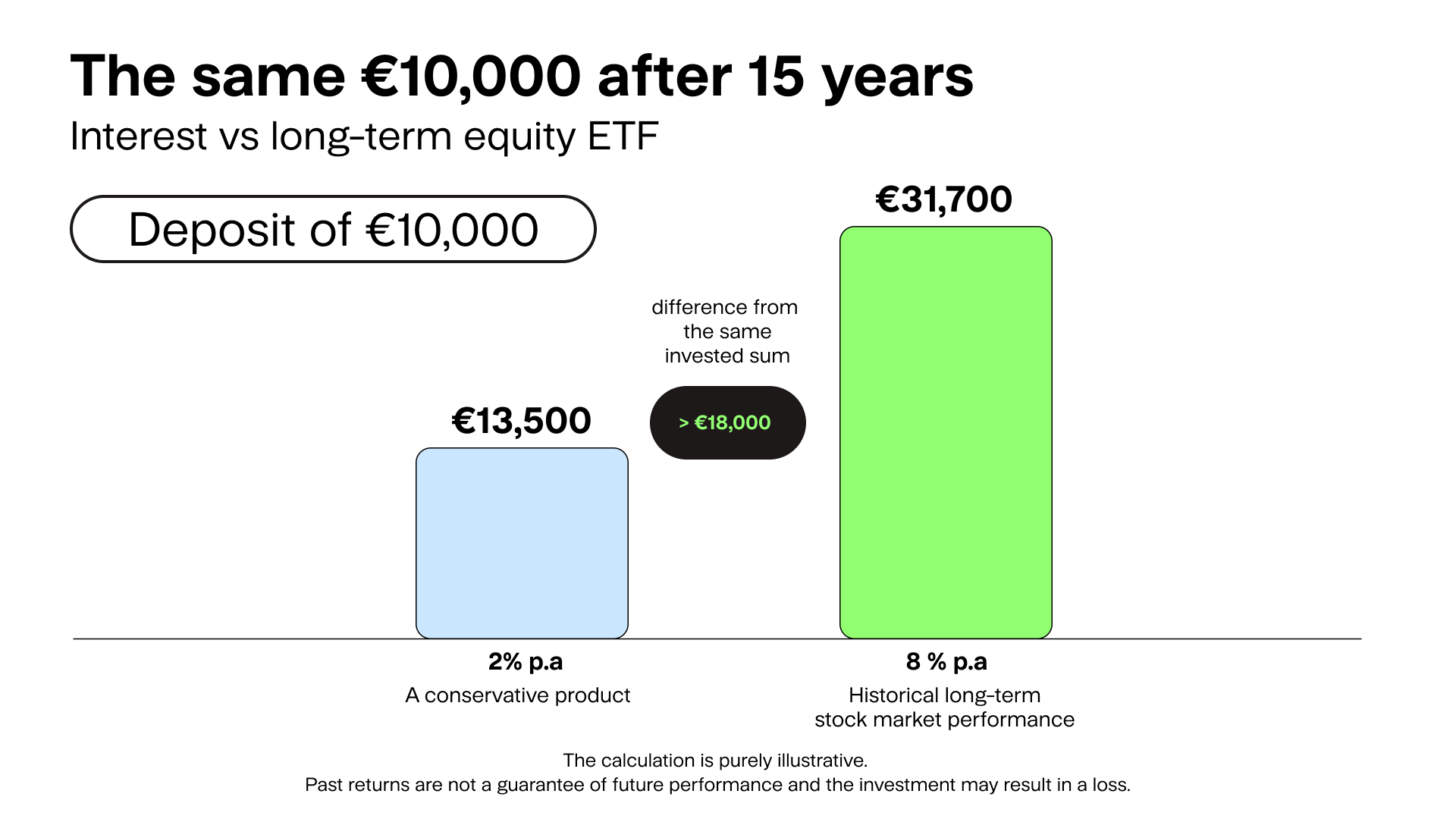
With interest-bearing products, the value of your money remains stable, while with equity ETF investing it is going to fluctuate; sometimes it rises and sometimes falls. Past performance is no guarantee of future results, and equity investments can end in a loss. Historically, though, stock markets have recovered from downturns. That's exactly why equity ETFs should be a long-term investment, so they have enough time to recover from any downturns.
Fees: One Number Versus Four Lines in the Prospectus
When comparing options, add up all the costs. Check on what base amount they're charged and how often you pay them. A one-time fee on a deposit has a very different impact than an annual fee on your entire, growing pool of assets.
With mutual funds, check the entry and exit fees, ongoing costs, transaction costs, and any performance fees. Their size and combination depend on the specific fund and the management company, and you'll find them in the Key Information Document (KID) published on the fund's website. That lets you compare it with other options.
At Finax, you pay a single fee of 1% a year plus VAT, of the total value of your managed assets. The total cost of the investment also includes the cost of the ETFs themselves, which is already reflected in their ongoing value. At Finax, you pay no fee for buying, selling, crediting a deposit, rebalancing or closing your account. What's more, if you transfer an investment from another provider and meet the conditions, we'll manage 50% of the transferred amount free of the management fee for two years, or until you withdraw from that account.
Access: What If You Need the Money Sooner?
From conversations with people who haven’t invested yet, I know that two things hold them back. They don't want their money locked away, and they're afraid of a penalty for early withdrawal. Both concerns are understandable, because that's exactly how the term deposits they're offered are structured.
At Finax, you can start from just €10, whether as a one-time or a regular deposit. Thanks to fractional ETF shares, even that small deposit is spread across the whole portfolio. Why mention this? Because it's a simple way to test whether investing suits you. Even a small amount can help you build the habit of investing regularly and gradually grow your wealth.
And your money isn't tied down anywhere. There's no minimum holding period and no penalty for withdrawing early. Once you request a withdrawal, the money is usually in your account within a few business days. Most mutual funds work the same way, though they may sometimes charge exit fees if you withdraw before the agreed period is up.
A term deposit on the other hand only rewards you if you stick it out until the end. If you need the money sooner, you lose the interest or pay a penalty. Your money is yours, then, but only on a date someone else decided.
Create an account and start investing today
Simplicity: How Much Time Will Investing Take You?
When you invest with Finax, you don't have to pick individual ETFs yourself or place purchase and sale orders. Based on a questionnaire, we'll recommend a strategy suited to your goal, horizon, and risk tolerance. You simply set up your deposits, and we take care of the ongoing management of your portfolio. Part of that management is regular rebalancing. It helps keep your portfolio's composition in line with your chosen strategy, and you pay no separate fee for it.
There's one more thing that belongs here, one you won't find in a price list: whether an institution educates you or just sells you a product. At Finax, we send regular newsletters and publish articles and podcasts that help you understand money and market developments. This kind of extensive mentoring still isn't a market standard. Our customer support team is trained in how to properly handle investment advisory.
The result of an investment is often determined by behavior: whether you deposit regularly, stick to your planned investment horizon, and don't panic during market swings. That's why quality mentoring can play a key role in building your wealth.
What to Check Before You Decide: Four Questions
Before you entrust your money to anyone, go through this list. It applies to a bank, an intermediary, and to us as well:
1. Who supervises it? Look for a license and supervision by your local regulatory body (mostly your local central bank), and for information on how your assets are protected.
2. What are the terms and costs associated with managing my assets? Not just one number from a leaflet, but every line: entry, management, depositary, exit.
3. How quickly can I get to my money if I need to? Will I be charged any fee for withdrawing early?
4. Does the institution help me understand what I'm doing? A good manager explains things when markets are falling too, not just when they're rising.
If you have a clear answer to all four questions, the decision is easier than it seemed at the start.
At Finax, you get management of a global ETF portfolio, automatic investing and rebalancing, clear terms, and client support. When you invest, you pay no entry, exit or performance fees. Finax combines long-term ETF investing with professional management, so you can build wealth without following the financial markets every day.
You can get started online for as little as €10. You choose your goal, fill in an investment questionnaire, and get a recommended strategy. You set the amount of your regular deposits according to your means, and you can increase or decrease them at any time.
Frequently Asked Questions about investing in Finax and bank
1. Is it better to invest through a bank or through Finax?
A bank is ideal for day-to-day transactions. For long-term investing, however, the deciding factors are fees, taxes, and asset management methods. With Finax, you invest in a global ETF portfolio with a single fee of 1% p.a. + VAT with the actual average management fee Finax clients pay being 0.69% p.a. free of entry and exit fees, complete with automated management and rebalancing.
2. How are my assets protected?
Both banks and investment brokers are heavily regulated. Bank deposits in the EU fall under the protection of national deposit guarantee schemes which protect the money up to €100,000. Clients of a licensed investment broker fall under protection of a national protection scheme of a country where the broker is headquartered in. Therefore, Finax clients fall under protection of Slovak Investment Guarantee Fund and their assets are protected up to €50,000. Furthermore, client assets are held in a separate account from that of the broker.
3. What are the investment fees at Finax compared to mutual funds at a bank?
At Finax, you pay a single fee of 1% p.a. plus VAT on the value of managed assets, with no charges for purchases, sales, deposits, rebalancing, or account closures. Mutual funds offered by banks may include entry and exit fees, ongoing charges, and performance fees, which can be found in the KID (Key Information Document). If you prefer a more conservative approach, consider exploring Calm Investing.