 Difficulty
Technology returned to the lead. Results led by Nvidia, whose shares rose by roughly 10% since the start of the month, once again pulled the entire technology sector up. The S&P 500 index gained 2.6% during August (in USD). The rally was again driven mainly by the largest companies, precisely those that had struggled in July. Thanks to diversification, such shifts in trend are not a problem for Finax investors, since our portfolios contain a range of countries and sectors.
The gains were not limited to the tech giants, though. Smaller companies did well too. The US small-cap index Russell 2000 improved by 0.9% (in USD). Software stocks, which had lagged in previous months, also joined in.
In emerging markets, performance was driven by Taiwan, helped by demand for chips. Chinese equities, measured by the MSCI China Index, slipped slightly by 0.3% on weak domestic consumption, although more and more new artificial-intelligence companies are listing on the exchange there.
The most turbulent market, however, was bonds. Most Finax investors use them as a complement to smooth out portfolio swings, or for short-term investments. They can also reveal interesting information about the state of the economy.
Companies or governments that issue bonds naturally want to pay the lowest possible yield (which you can think of simply as the interest rate on a mortgage). The rise in yields was therefore not welcome news for the United States. On its 10-year government bond, for example, the yield climbed from 4.2% to 4.8% between the start of the year and the end of August.
Experts generally see three reasons behind the rise in yields.
The first is the long-term decline in demand for the dollar from the BRICS countries. These states are gradually holding a smaller share of their reserves in dollars, and so they are also buying fewer US government bonds. When demand for bonds falls, the US has to promise a higher yield to find a buyer. Borrowing therefore costs it more.
The second is stubborn inflation, which remains above the 2% target. When prices rise faster than the central bank would like, investors assume that interest rates will stay high or rise further. That is why they already demand a higher yield from bonds today, as otherwise inflation would eat up most of their return.
The third is the popularity of technology companies' bonds. Large tech firms are borrowing right now to invest in artificial intelligence, for example by building data centres, and they offer a higher yield on their bonds than the government does. Part of the money that would otherwise end up in government bonds is therefore flowing to them.
Bond yields are usually managed by the Fed, the central bank. This time, the US Treasury stepped in directly instead. It unexpectedly announced that from September it would double the pace of buybacks of its own long-dated bonds.
Yields on 30-year bonds, which in July jumped to their highest levels since 2007, were tamed as a result. The Treasury used unconventional financial engineering to smooth out swings in the market for its own debt and to prevent an uncontrolled rise in interest rates. It thus took over part of the role that the Fed would otherwise have played.
The approach of the new Fed chair, Kevin Warsh, is also interesting. In the past there were concerns that he would be more accommodating to the government's interests. So far that is not happening. The government has to push through its own steps, and during the month Warsh even hinted at a possible rate hike.
Among commodities, gold drew the most attention with a 10% gain. It was helped by the weakening of the US dollar and by fears of currency debasement, that is, that money will gradually lose value because of high government debt.
What does this look like in practice? Anyone holding global equities saw their money grow in August thanks to ETFs. Bonds added another few tens of euros. In July it was the other way round. That is exactly why we hold several asset classes in our portfolios: we do not have to guess which one will lead in any given month.
On the currency markets relevant to us, the euro weakened by 0.14% against the Czech koruna, gained 0.38% against the Hungarian forint, and strengthened by 0.48% against the Polish zloty.
Among the ETFs in our portfolios, the best performer was the fund tracking emerging-market equities, with a gain of 4.4%. The biggest loser was the fund focused on US mid-cap companies, at -0.8%.
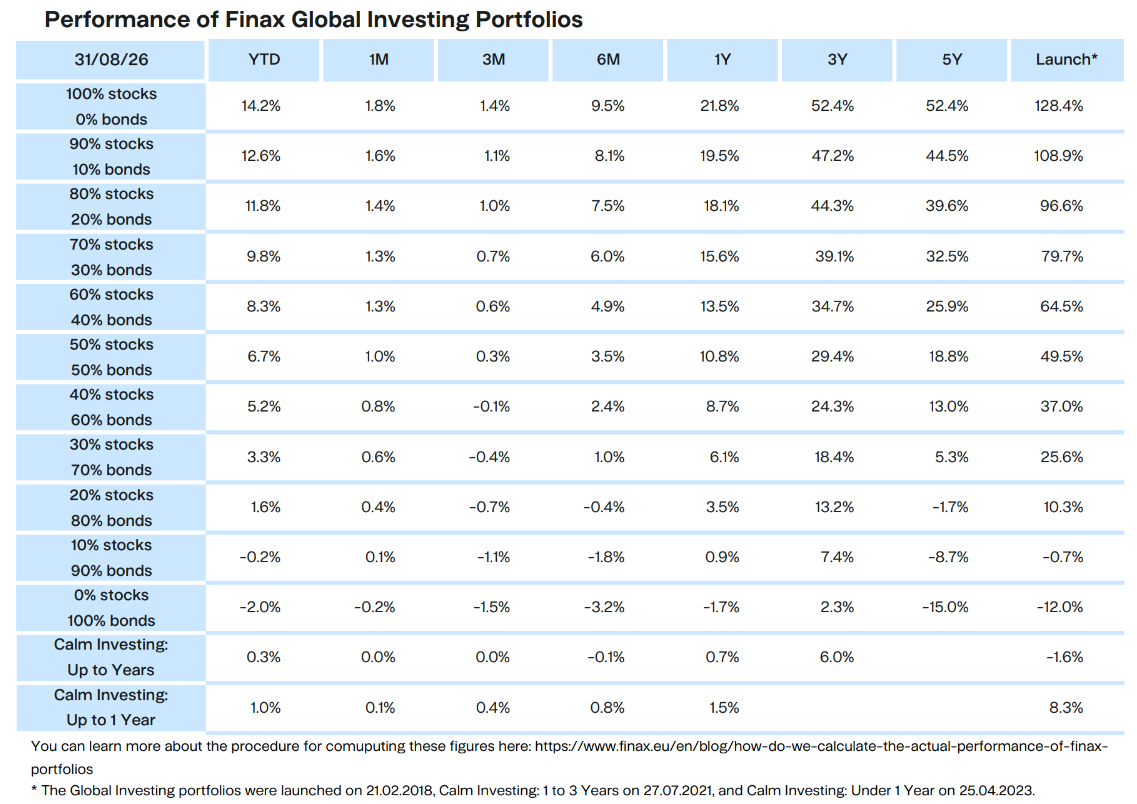
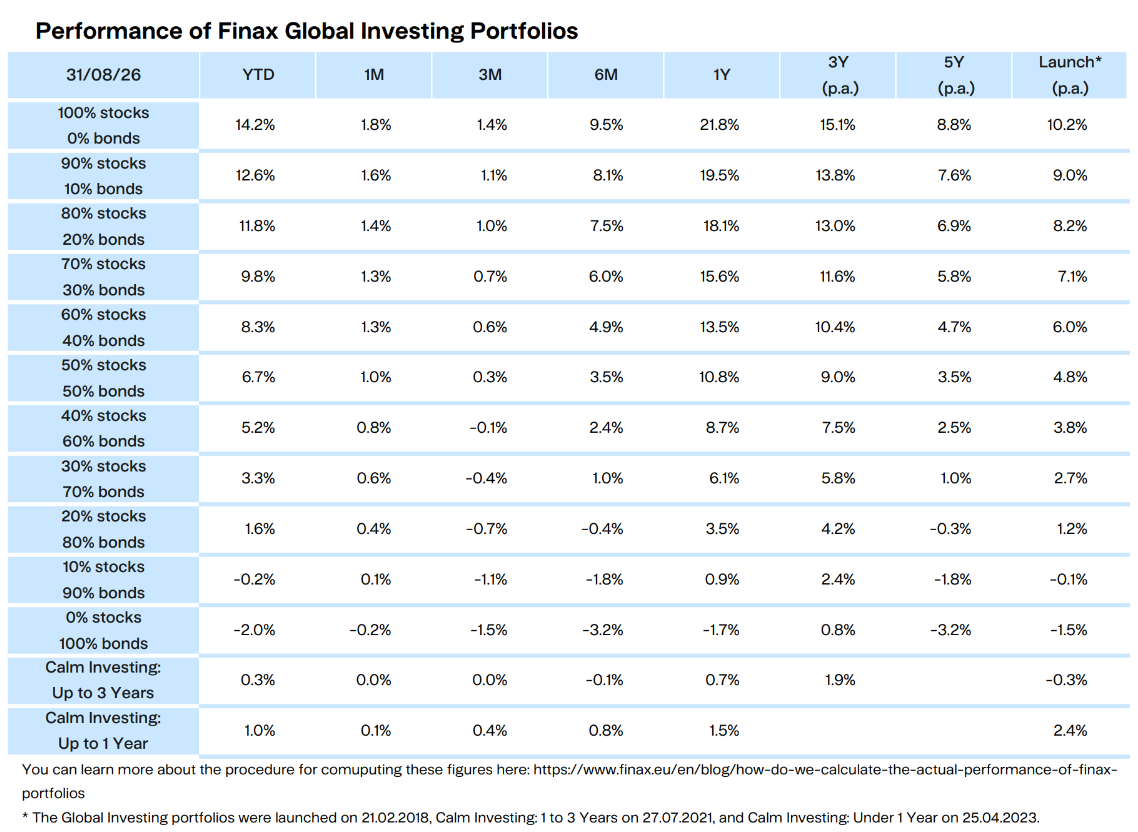
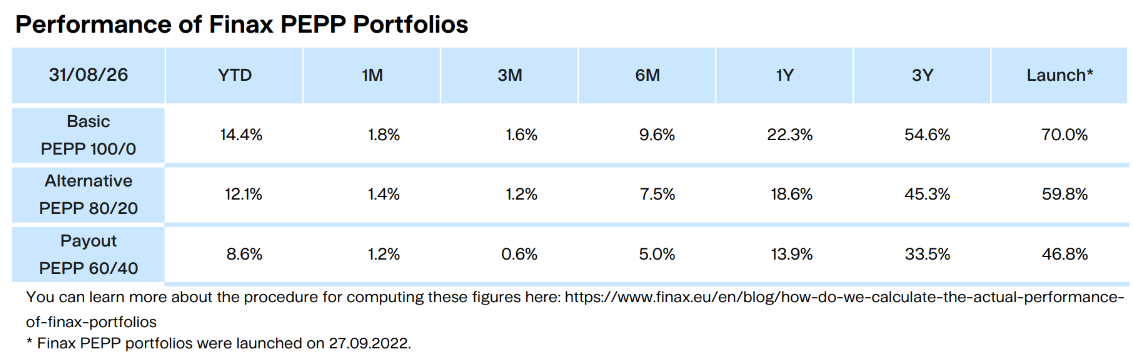
Among our Global Investing strategies, the strongest gain was recorded by the 100% equity strategy, up 1.8%. The conservative bond portfolio fell by 0.2%.
In Calm Investing, 1 to 3 Years strategy gained 0.03% and Under 1 Year strategy 0.14%. Their gross annual yields to maturity at the end of August stood at 2.3% for the Under 1 Year strategy and 2.6% for the 1 to 3 Years strategy *.
Since the beginning of August, these two products have shared the name Calm Investing. Smart Deposit became Calm Investing: Under 1 year and Wallet became Calm Investing: 1 to 3 years.
In September we will be watching above all the Fed's and the ECB's rate decisions. It will also matter whether technology companies keep growing their profits, and whether the money invested in artificial intelligence starts to show up outside chipmakers as well, for example in industry or healthcare.
August's developments reminded us of a few things:
- Short declines during the year are entirely normal. The July one was definitely not worth reacting to.
- Market leadership can change from month to month. In July the market was driven by the rest of the world outside technology; in August it was the tech giants again.
- Government interventions can help markets in the short term, but nobody can predict them in advance. That is why we rely on regularity and diversification instead of guessing the next move.
*This is the gross yield to maturity as at 31 August 2026 as stated by the creators of the ETF products. It is variable, tied to the ECB's base deposit rate and to interest rates on euro bond markets, and it does not include the Finax fee of 0.5%. This yield may change in line with the development of interest rates and is not a reliable indicator of future performance.