 Difficulty
How much money do Europeans keep in banks?
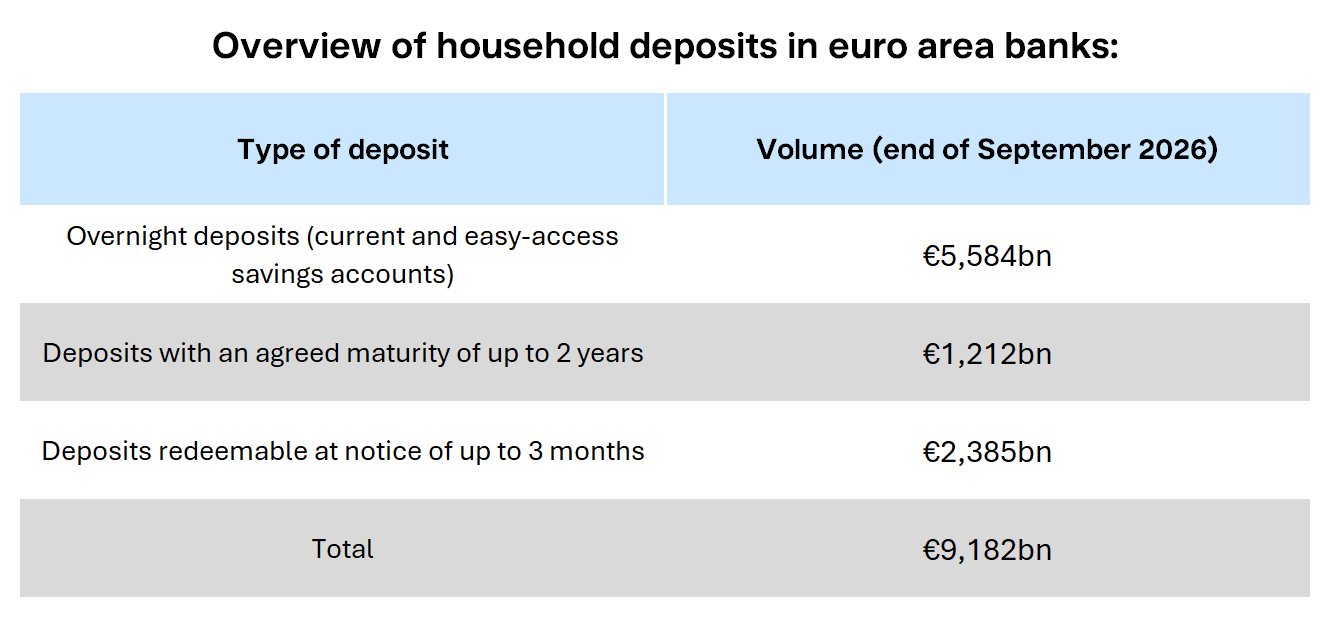
Across the euro area, households hold truly staggering sums of money in banks. According to data from the European Central Bank (ECB), at the end of September 2026 euro area households held almost €9.2 trillion in bank deposits. A tidy sum.
Of this, €5.6 trillion was in overnight deposits, i.e. money you can withdraw from the bank immediately. Think, for example, of the balance on your current or easy-access savings account. A further €1.2 trillion was held in deposits with an agreed maturity of up to two years. The remaining €2.4 trillion was held in deposits redeemable at notice of up to three months, a category that in many countries covers regulated or notice savings accounts.
Source: ECB, Monetary developments in the euro area: September 2026 (seasonally adjusted)
What interest do you receive on savings and what do you pay on loans?
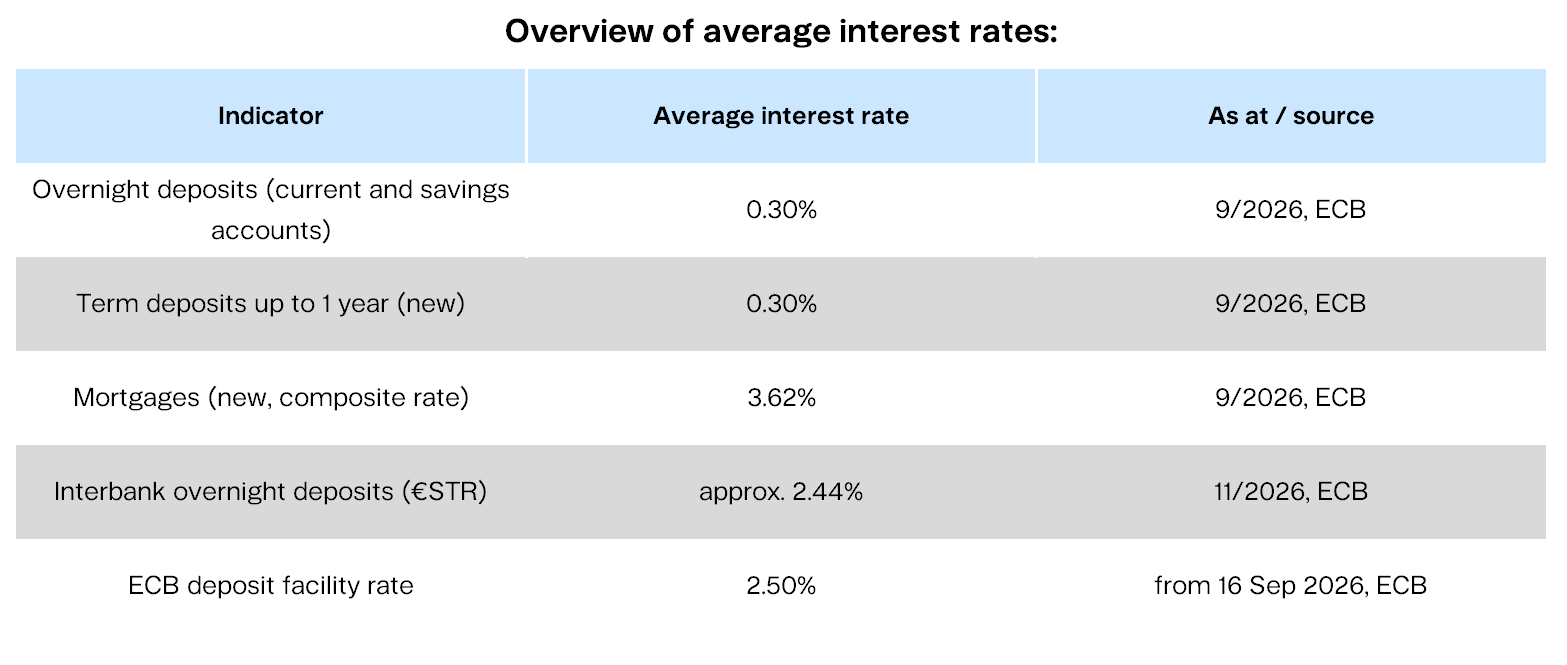
On overnight deposits (current and easy-access savings accounts), euro area households receive an average of 0.30% a year, and on new term deposits of up to one year 2.33%, while they pay an average of 3.62% on new mortgages and 7.82% on new consumer loans (ECB). In the past, it was standard practice for banks to pay for this money. After all, they don't keep it in a vault with your name on it. On the contrary, they try to make more money from it, for example by lending it out at a higher rate or investing it sensibly. In other words, the bank borrows your money for its own use. In return, it promises you some interest.
The problem is that we've somehow got used to deposits not paying much interest. Try asking yourself right now what interest you receive on the money in your savings account.
The data suggest it probably won't be much. The average interest rate on households' overnight deposits in the euro area was 0.30% in September 2026. If you lend the bank €100 for a year, it will give it back with 30 cents extra – and in most countries the state will still take tax out of that.
In many cases, the bank will also charge you an account fee that swallows the entire 30-cent gain and leaves you out of pocket. At that price, banks have €5.6 trillion at their disposal.
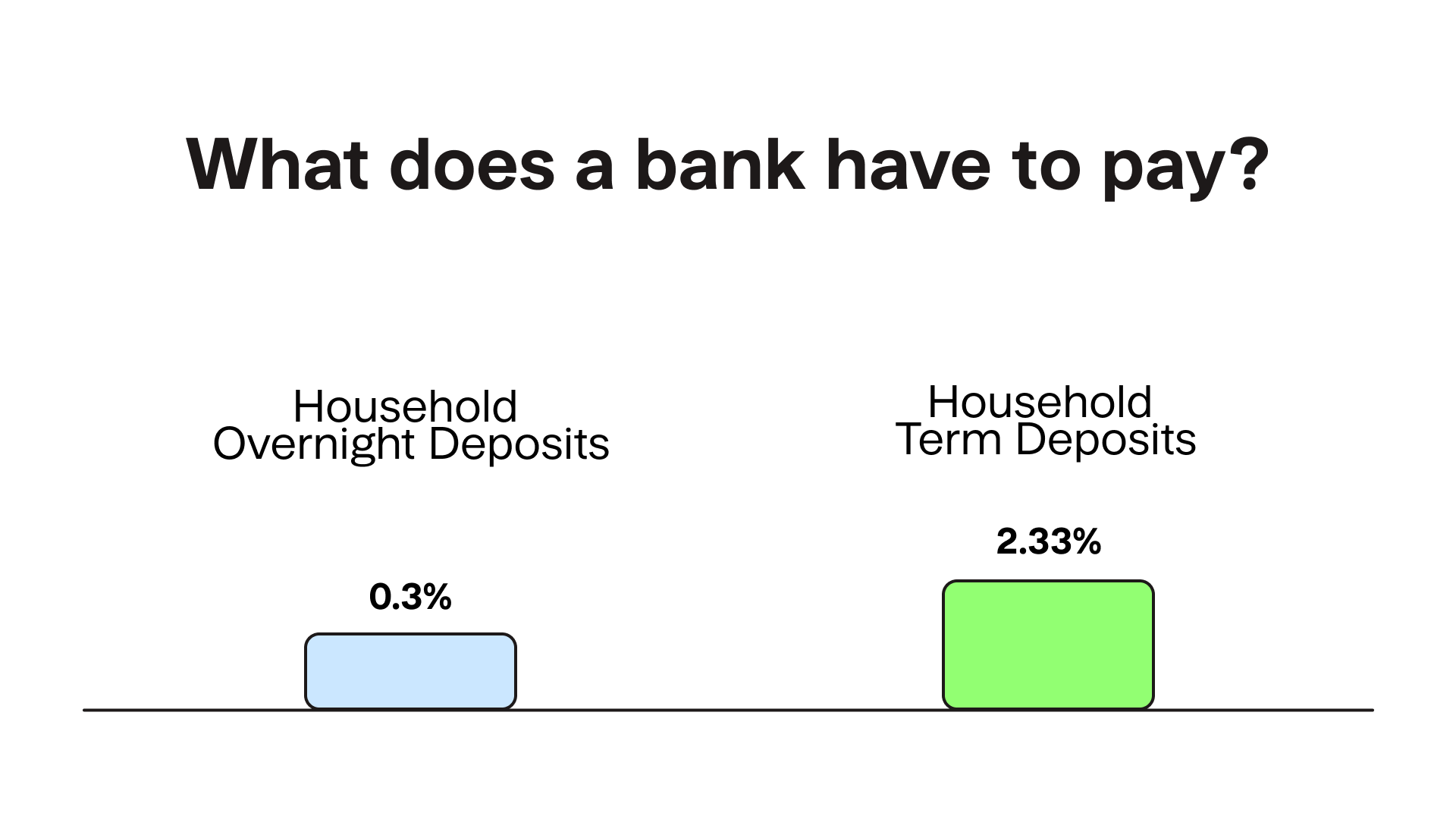
The situation is better for term deposits. Central bank interest rate rises (which you probably read about in the media more than once during the period of high inflation) and competition have pushed the average rate on new household term deposits of up to one year to 2.33% (according to ECB data for September 2026). So for the €1.2 trillion in term deposits, banks already have to pay somewhat more. The question, however, is how much they can make on this money.
In their advertising, banks often promote special savings account rates of several per cent a year. However, these usually apply only to new clients, for a limited time or up to a certain amount. According to the ECB, the actual average that euro area households receive on overnight deposits is 0.30%. We discuss why savings rates are so slow to rise in the article When will the interest on my savings account increase?
How do banks make money?
Banks make money mainly from the net interest margin: rather than keeping your money hidden in vaults, they lend it on and deposit it at a higher interest rate than they pay you. They try to lend most of the money at their disposal through mortgages, consumer loans, overdrafts, business loans and similar products. For these loans, they charge their borrowers a certain rate of interest.
Those of you with loans probably have an idea of how sharply the interest on them rose in 2022 and 2023. The average interest rate on new mortgages in the euro area was 3.62% in September 2026, and on new consumer loans as much as 7.82%. So banks earn considerably more on them than they have to pay on savings accounts or term deposits.
Of course, banks can't lend out all the money at their disposal. They keep part of it in reserve to cover withdrawals and other costs they have to pay on an ongoing basis. Even reserves, however, can earn decent interest in 2026 at minimal risk.
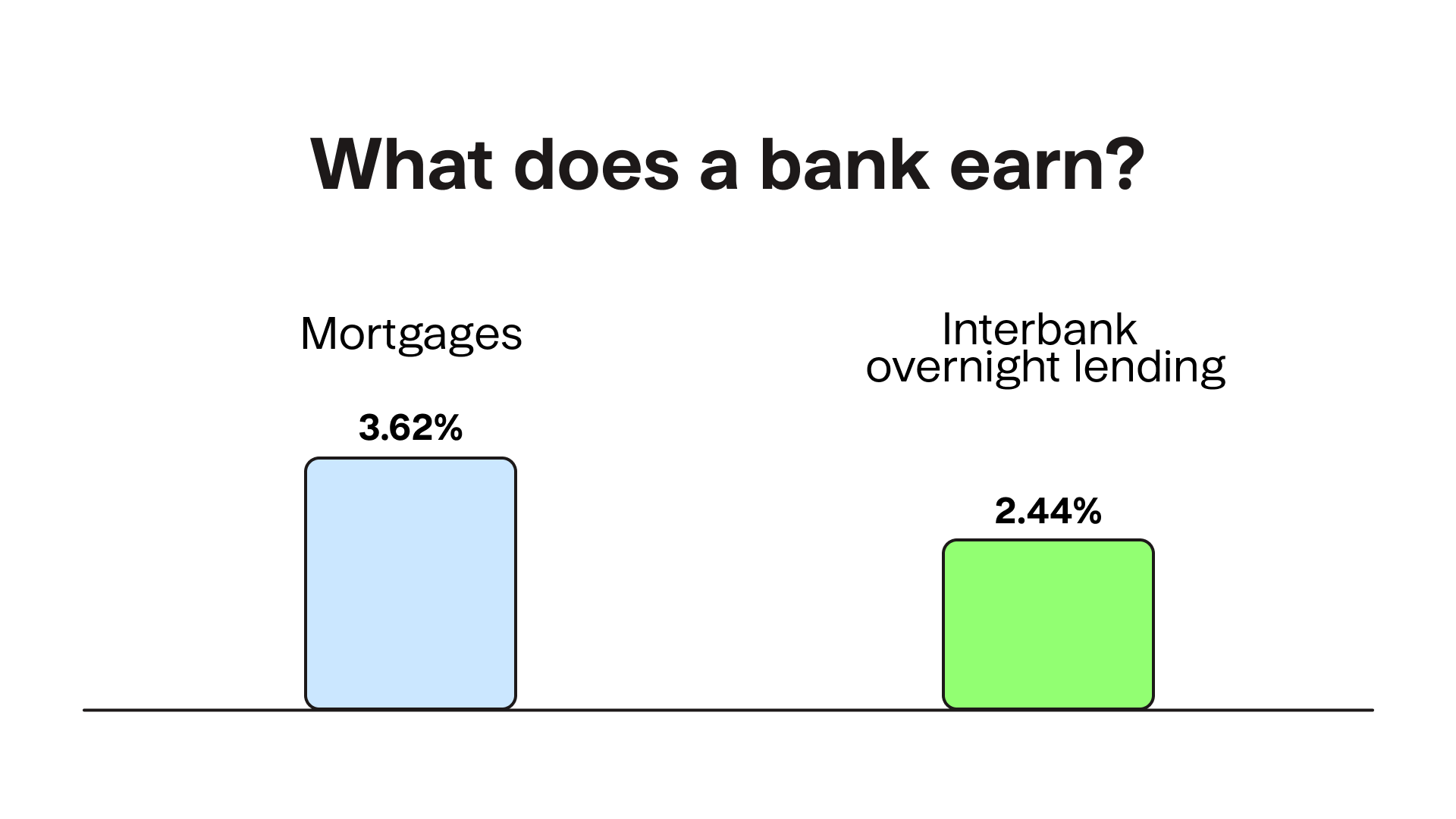
For example, banks lend reserves to one another for one day through overnight deposits. In November 2026, banks in the eurozone lent to each other at an average interest rate of around 2.44% (the €STR). Again, a decent return compared with the 0.30% paid on overnight deposits.
In addition to interest, banks also earn from fees for account maintenance, payment cards and other services, from foreign exchange trading and from commissions for arranging insurance or investment products. The main source of profit, however, remains the net interest margin, i.e. the difference between the interest the bank receives from loans and reserves and the interest it pays on deposits. According to the ECB, euro area banks' return on equity hovered close to 10% in 2025, even though net interest income declined somewhat, as growth in non-interest income made up the difference (ECB, Financial Stability Review, May 2026).
Why do banks pay such low interest on deposits?
Banks pay low interest on deposits because they don't have to compete for them. They have ample liquidity, and most clients leave their money in their accounts even when interest is close to zero. Banks therefore pass ECB rate rises on to loan rates quickly, but to deposit rates only partially and with a delay (ECB, Financial Stability Review, November 2026). According to the ECB, competition for deposits in the eurozone is largely limited to term deposits, while rates on current and savings accounts remain well below the ECB rate and have barely moved since its recent increase. We look at this in more detail in the article When will the interest on my savings account increase?
How much do banks earn on your deposits?
So banks take your money, earn relatively high interest on it (2.5 - 4% or more) and pass on only a small part of the earnings to you (0.3 - 2.3%). The rest goes straight into their pockets. No wonder, then, that euro area banks' profitability remains higher than in the years of low interest rates before mid-2022. Return on equity at the banks directly supervised by the ECB has stayed at around 9.5% for three years in a row.
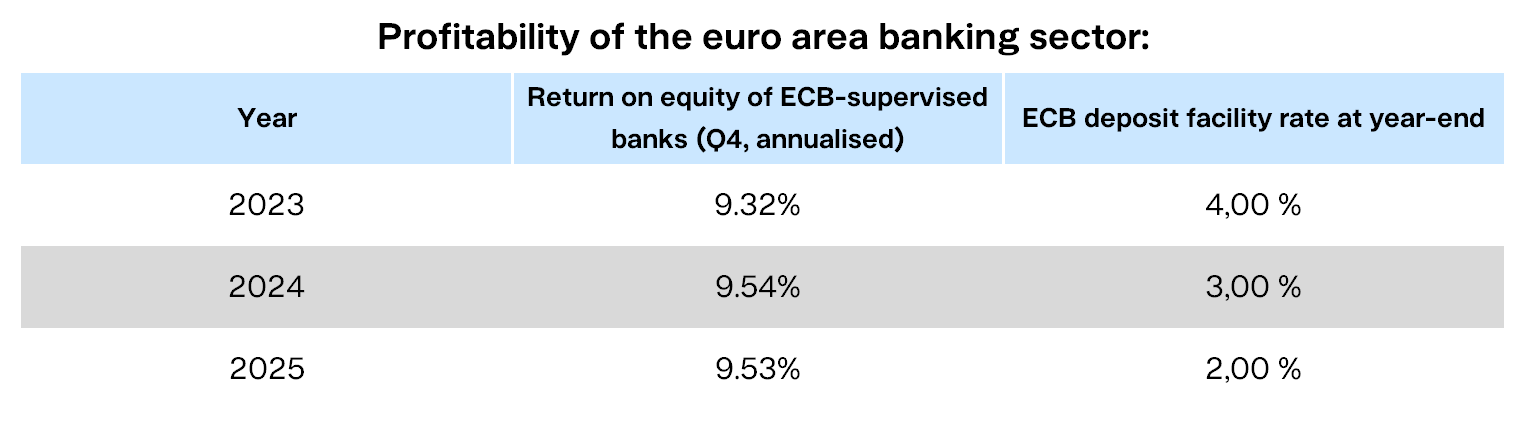
Source: ECB Banking Supervision, supervisory banking statistics on significant institutions; ECB.
What it costs you: the real value of savings after inflation
If inflation is higher than the interest on your account, your savings lose value in real terms, even though the balance in your account grows. You can calculate the real value of a deposit after one year as follows:
Real value = deposit × (1 + interest rate) / (1 + inflation)
Example: you have €1,000 in a savings account paying 0.5% interest and inflation is 4%. After a year, you will have €1,005 in your account, but its real value will be 1,005 / 1.04 = €966.35. Over the year, you will therefore lose €33.65 in real terms, i.e. 3.4% of your purchasing power.
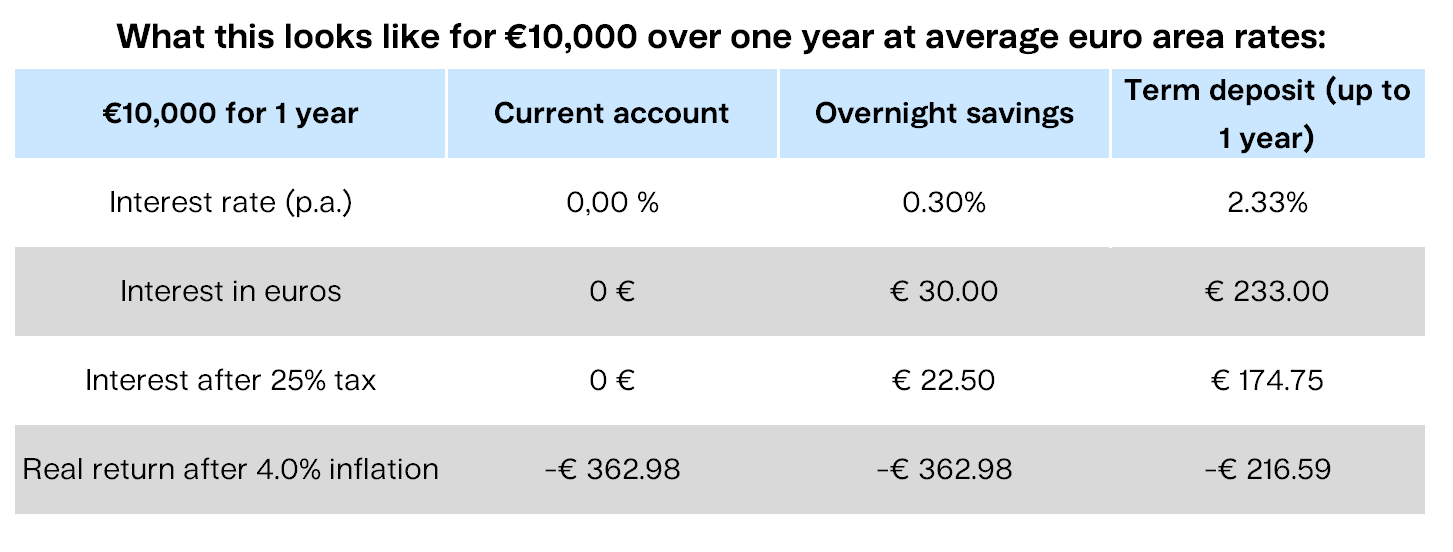
Assumptions: average euro area interest rates on new household deposits in September 2026 (ECB; current account calculated without interest), euro area annual inflation of 4.0% in October 2026 (Eurostat, harmonised index of consumer prices) and an illustrative 25% tax on interest - the actual rate depends on your country. This is a model calculation, not a forecast. We discuss how to protect your savings from inflation in the article How to protect your savings from inflation.
What can you do with your savings?
What to do with your savings depends on when you will need them: an emergency fund can safely stay in the bank, money for 1 to 3 years is well suited to money market funds, and long-term savings to an ETF portfolio. The good news is that you don't have to sit idly by and watch the shareholders of the banks line their pockets with your money. You can do with your savings much the same as a bank does: instead of keeping them in a vault (in a savings account or term deposit), invest them sensibly. That way, most of the earnings stay with you and your family instead of being snapped up by the bank.
You may have heard that you shouldn't keep your savings in a bank account, as inflation (i.e. rising prices) gradually erodes their value there. We often find, however, that although people have heard about the importance of investing, nobody has explained to them how investing actually works. If that's your case, you can read this article. In it, we try to explain in plain language what investing means and why it should be part of everyone's life.
The next logical question is what it makes sense to invest in. Just as with banks, the choice of investment will depend on whether you're putting in short-term reserves or money you won't need for many years.
You can invest through a bank as well as through an investment company or a securities dealer such as Finax. The difference lies mainly in the product range and costs; we discuss it in more detail in the articles Finax or a bank? and Finax portfolios vs. funds. We summarise when not to leave your savings sitting in a bank in the article 10 cases when you should not leave your savings sitting in the bank.
For short-term reserves, we recommend investing in money market products. These are investments built on similar safe instruments to those banks use to park their short-term reserves. At Finax, precisely so that you too can enjoy the advantages traditionally available only to banks, we have created the Calm Investing product, which consists of two strategies: one for savings you will need within 1 year and one for savings you will need within three years.
With longer-term savings, you don't have to limit yourself to interest-bearing products; you can invest in shares and bonds. These offer the potential for higher returns.
Equity investments, for example, have historically returned approximately 8 - 9% a year when held over the long term (and by that I mean genuinely lifelong investing, ideally 15, 20 or 30 years) (for example, the MSCI World index in euros with reinvested dividends returned an average of 8.4% a year between 1970 and 2025; source: MSCI, Curvo calculation). In exchange for these returns, however, you will have to accept your portfolio's value fluctuating up and down.
Nor do you have to struggle with choosing an equity or bond portfolio on your own these days. Our robo-adviser, for example, can help. It's a simple questionnaire in which you answer questions about your financial goals, situation, planned investment horizon and general attitude to risk. Finax's algorithm then selects a portfolio for you with a level of risk suitable for your situation.
Investing involves risk. Past returns are no guarantee of future returns, and an investment may also result in a loss. Find out about the risks you take when investing.

Create an account and start investing today
Frequently asked questions about investing in banks
1. How do banks make money from my deposits?
Banks make money mainly from the net interest margin: they pay low interest on deposits and earn more by lending the money out or depositing it elsewhere. In September 2026, euro area households received an average of 0.30% on overnight deposits, while banks charged 3.62% on new mortgages and could earn 2.50% at the ECB deposit facility. Compare your options in the article Finax or a bank?
2. What is a better alternative to a savings account?
It depends on when you will need the money. Keep your emergency fund in an easy-access bank account. For money you will need within 1 to 3 years, money market investments such as Calm Investing aim for returns linked to money market rates, and for long-term savings, a diversified ETF portfolio offers higher potential returns. Unlike bank deposits, investments are not covered by deposit guarantee schemes and their value can fall.
3. Is it better to save or invest money?
Do both, in the right order. Build an emergency fund in the bank first, then invest money you won’t need for years. Over long periods, equities have historically outpaced inflation, although their value fluctuates and past returns are no guarantee of future results. Read more in the article Which is more important: saving or investing?
4. Is it worth keeping savings in a savings account?
For an emergency fund, yes; for longer periods, not really. With average interest of 0.30%, inflation of 4.0% and a 25% tax on interest, €10,000 in an overnight savings account will lose approximately €363 in real terms over a year (model calculation above, not a forecast).
5. Is my money safe in a bank?
Yes, across the EU, bank deposits are protected by national deposit guarantee schemes up to €100,000 per depositor per bank. Find out more in the article Is my money safe in the bank?
I completely understand if all of this sounds complicated and you feel you're getting lost. You may even be annoyed that the bank is raking in fat profits on your savings, but investing is simply too unfamiliar and complicated for you to take the plunge.
If that's your case, try learning more about investing and trying it out with a smaller amount of money. At Finax, we publish educational content every week in which we try to explain topics such as financial markets, investment risk, shares, bonds and personal finance in plain language. I'd recommend, for example:
- An article on diversification
- An article on whether investing can cause you to lose everything
- An article on what causes stocks to grow
- An article on what to do when the markets drop
- Finax webinars, in which we look at financial topics in greater detail
Don't feed the banks with your money; fill your own pockets instead. We'd be honoured if you decided to try investing with us.
Find out what return your savings could make depending on when you'll need them.